
 Worksheets
Science Investigation Quiz
Total questions: 10
Worksheet time: 10mins
A student placed 2 grams of baking soda in a balloon and 100 mL of vinegar in an Erlenmeyer flask. The mass of all materials was 180.34 grams prior to the investigation. After stretching the opening of the balloon across the neck of the flask, the student raised it to dump the baking soda into the flask. He immediately observed foaming bubbles in the flask and the balloon began to expand. The student found the mass of all materials was still 180.34 grams after the investigation. The student concluded that —
only a physical change was occurring
the baking soda and vinegar were products of a chemical reaction
the gas was oxygen
mass was conserved in a closed system because the gas could not escape the balloon
What types of changes occur during the erosion and deposition of sediments in a river? Mark only one oval.
The erosion and deposition of sediment are physical changes.
The erosion and deposition of sediment are chemical changes.
The erosion of sediment is a chemical change, and the deposition of sediment is a physical change.
The erosion of sediment is a physical change, and the deposition of sediment is a chemical change.
The chemical formula for methane is CH4. Which statement describes the atoms present in FOUR molecules of methane?
Four molecules of methane would contain 1 atom of carbon and 4 atoms of hydrogen.
Four molecules of methane would contain 4 atoms of carbon and 1 atom of hydrogen.
Four molecules of methane would contain 4 atoms of carbon and 16 atoms of hydrogen.
Four molecules of methane would contain 16 atoms of carbon and 16 atoms of hydrogen.
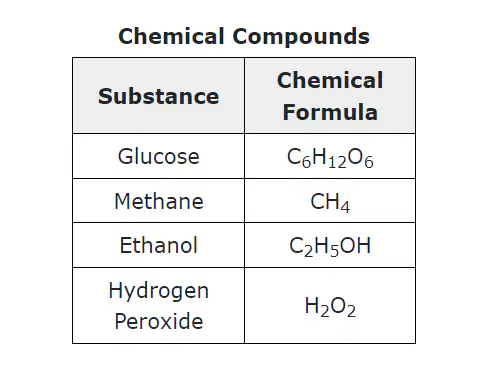
Refer to the Chemical Compounds table above. How many total elements are in Ethanol? Record your answer. Be sure to use the correct place value.
6
4
8
3
Which statement supports the claim that combining sodium and chlorine to make salt is a chemical change? Mark only one oval.
Salt has the same chemical and physical properties as chlorine.
Salt has the same chemical and physical properties as sodium.
Sodium and chlorine have different chemical and physical properties.
Salt has different chemical properties than sodium and chlorine.
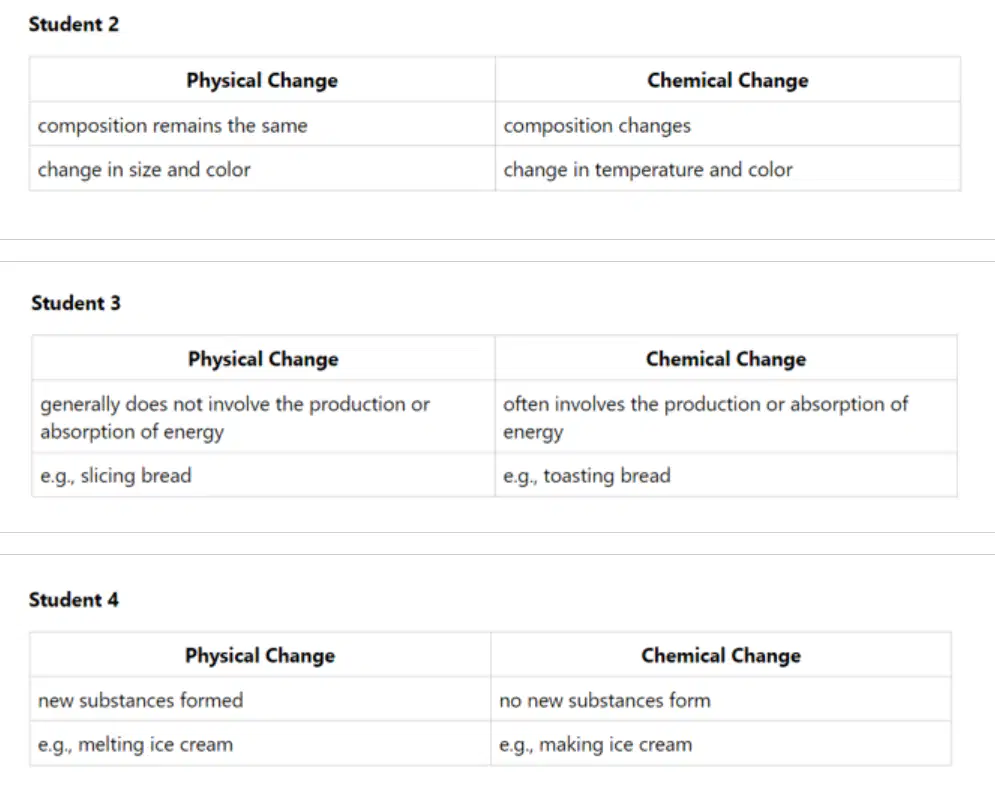
Four students create tables to summarize some differences between physical changes and chemical changes. Which table is incorrect?
Student 2
Student 3
Student 4
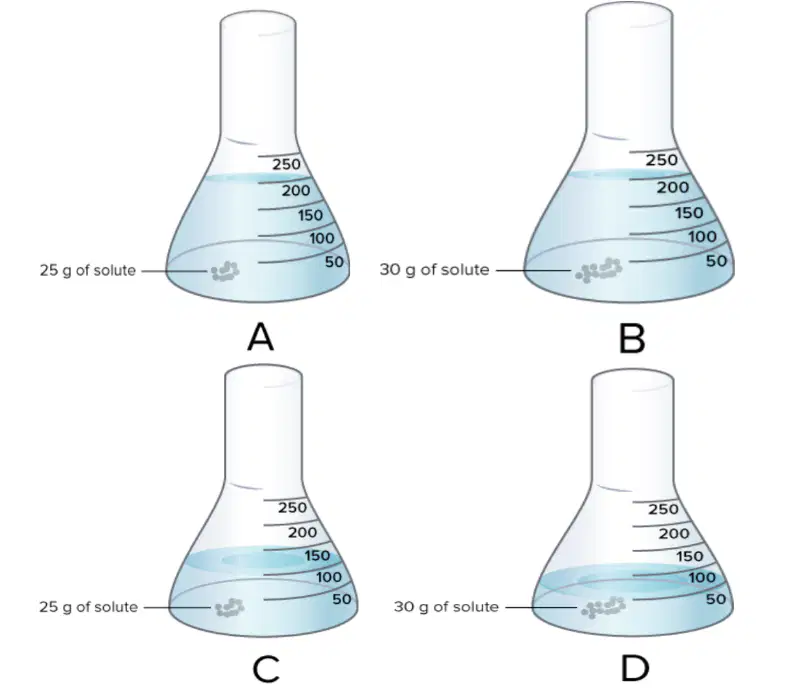
Examine the following four figures showing solutions containing different amounts of a solute dissolved in different amounts of water. Which of the following statements is true?
Solution A is more concentrated than Solution B.
Solution B is more concentrated than Solution C.
Solution A is more concentrated than Solution C.
Solution D is the most concentrated of your four solutions.
Will an aqueous solution stay an aqueous solution if we swap one solute for another solute?
No, because the solvent and solute create the solution.
Yes, because the solvent is water with both solutes.
Yes, because every solute is dissolved in any solvent.
No, because this changes the solution that is created.
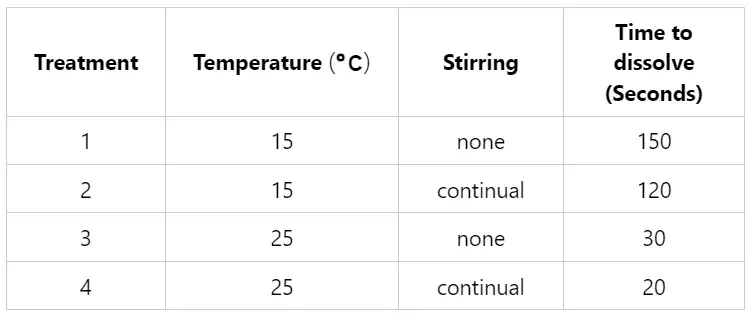
A chemist is investigating the effect of temperature and stirring on the rate of dissolution of a solid. She places 10 g of the solid in each test tube and places the test tubes in the conditions summarized in the following table. She then records how long it takes for the solid to dissolve. What can you conclude from these results?
Higher temperature and stirring both effect the rate of dissolution, but temperature has a stronger effect.
Higher temperature and stirring both effect the rate of dissolution, but stirring has a stronger effect.
Higher temperature and stirring both effect the rate of dissolution about the same amount.
Higher temperatures increase the rate of dissolution and stirring has no effect.
Which step in the digestive process represents a chemical change in food? Mark only one oval.
Storing of swallowed food in the stomach
Churning of food, liquids, and digestive juices in the stomach
Movement of food down the esophagus to the stomach
Substances in the mouth and stomach breaking down fats and proteins

