
 Worksheets
bonds
Total questions: 175
Worksheet time: 4hrs 58mins

Element Astros (symbol Ao) is found in group 6 and element Braves (symbol Bv) is found in group 16. What is the name of the compound Ao2Bv3?
Astros bravide
Astros (I) bravide
Astros (II) bravide
Astros (III) bravide
Can not be determined from the information provided.


What is the correct name for this formula: BeI2?
beryllium (II) iodide
beryllium diiodide
beryllium iodine
beryllium iodide

Element Astros (symbol Ao) is found in group 1 and element Braves (symbol Bv) is found in group 16. What is the name of the compound Ao2Bv3?
Astros bravide
Astros (I) bravide
Astros (II) bravide
Astros (III) bravide
Can not be determined from the information provided.

Using IUPAC rules, state the name of the following compound:
FeCl3
Iron (III) Chloride
Chloride (III) Iron
Iron (I) Chloride

What is the chemical name for the compound FeCl₂?
iron chloride
iron (II) chloride
iron (I) chloride
iron dichloride

Name the following compound: FeO
iron oxide
iron (II) oxide
iron (III) oxide
ugly
What is the correct name for this formula: BeI2?
beryllium (II) iodide
beryllium diiodide
beryllium iodine
beryllium iodide
Name the following ionic compound: BeCl2
beryllium chlorine
beryllium II chloride
beryllium chloride
beryllium dichloride
Name the ionic compound SnSe2
Tin diselenide
Tin (IV) Selenide
Tin selenide
Tin (II) triselenide
Na2S
When naming a compound, which of these is written first?
Metal
Nonmetal
Anion
Cation
What is the name of the compound Sc(OH)3?
Scandium (III) hydroxide
Scandium (I) hydroxide
Scandium (II) hydroxide
Scandium hydroxide
Name the following ionic compound: Cs2S
cesium sulfide
cesium sulfate
cesium II sulfate
cesium II sulfide
The name of FeCl₂ is
iron chloride
iron (II) chloride
iron (I) chloride
iron dichloride
What is the name for MgF2 ?
magnesium fluoride
manganese Phosphide
magnesium(III) fluoride
magnesium fluoride(II)
A tightly-bound group of atoms that is covalently bonded, yet carries a net charge:
monatomic ion
polyatomic ion
A tightly-bound group of atoms that is covalently bonded, yet carries a net charge:
monatomic ion
polyatomic ion
A single atom with a positive or negative charge.
monatomic ion
polyatomic ion
diatomic ion
Produces a hydrogen ion when dissolved in water:
acid
base
Produces a hydroxide ion when dissolved in water:
acid
base
When naming a transition metal ion that can have more than one common ionic charge, the numerical value of the charge is indicated by a __________.
prefix
suffix
superscript after the name
Roman numeral following the name
The nonmetals in Groups 6A and 7A ______.
lose electrons when they form ions
have a numerical charge that is found by subtracting 8 form the group number
all have ions with a -1 charge
end in -ate
Which of the following is NOT a cation?
iron (III) ion
sulfate
Ca2+
sodium ion
Which of the following is true about the composition of ionic compounds?
They are composed of anions and cations.
They are composed of anions only.
They are composed of cations only.
They are formed from two or more nonmetallic elements.
An -ate or -ite at the end of a compound name usually indicates that the compound contains _____________.
fewer electrons than protons
neutral molecules
only two elements
a polyatomic anion
Which element, when combined with fluorine, would most likely form an ionic compound?
lithium
carbon
phosphorus
chlorine
What is the correct formula for potassium sulfite?
KHSO3
KHSO4
K2SO3
K2SO4
Which of the following compounds contains the lead(II) ion?
PbO
PbCl4
Pb2O
Pb2S
Molecular compounds are usually _________.
composed of two or more transition elements
composed of positive and negative ions
composed of two or more nonmetallic elements
exceptions to the law of definite proportions
When naming acids, the prefix hydro- is used when the name of the acid anion ends in _______.
-ide
-ate
-ite
-ic
What is the name of H2SO3?
hyposulfuric acid
hydrosulfuric acid
sulfuric acid
sulfurous acid
What is the correct name for the compound CoCl2?
cobalt(I) chlorate
cobalt(I) chloride
cobalt(II) chlorate
cobalt(II) chloride
What is the correct formula for barium chlorate?
Ba(ClO)2
Ba(ClO2)2
Ba(ClO3)2
BaCl2
Consider a mystery compound having the formula MxTy. If the compound is not an acid, if it contains only two elements, and if M is not a metal, which of the following is true about the compound?
It contains a polyatomic ion.
Its name ends in -ite or -ate.
Its name ends in -ic.
It is a binary molecular compound.
Cr3+ O2-
K1+ S2-
Hydrogen nitrite (nitrous acid)
Ca(CO3)
Pb4+ O2-
Sr+2 + (CO3)-2


Name the compound.
nonene
2,2-dimethylhept-3-ene
1,1,5-trimethylhex-2-ene
2,6-dimethylhept-3-ene

Name this organic molecule.

Name this organic molecule.
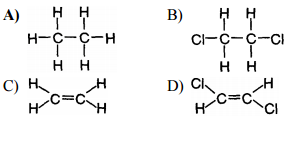
Which compound belongs to the alkene family?
C2H2
C2H4
C6H6
C6H14

Name this organic molecule.
Name this organic molecule.

Name this organic molecule.
A molecule of 2,3 dimethyl hexane would have how many TOTAL carbons?
6
7
8
9


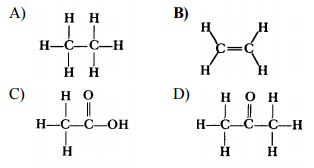
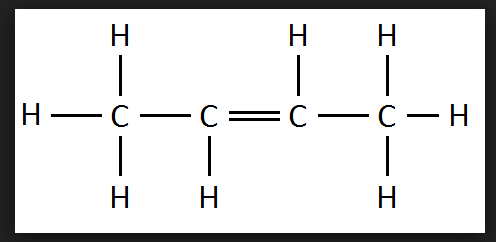
Which substance would have the weakest intermolecular forces of attraction?
CH4
H2O
________________________ have the strongest intermolecular forces of attraction.
Dipole- Dipole
Dispersion
Hydrogen Bonds

Intermolecular forces for: CO2
Dispersion Force
Dipole dipole
Hydrogen bonding

Intermolecular forces for: NH3
Dispersion Force
Dipole dipole
Hydrogen bonding
Rank these in order of strength:
London dispersion forces
hydrogen bond
dipole-dipole attraction
dipole-dipole>hydrogen bond>London
London>dipole-diple>hydrogen bond
hydrogen bond>dipole-dipole>London


Forces that holds atoms together within the molecule
intermolecular forces
intramolecular forces
Which substance has the weakest intermolecular forces?
Substance A, boiling point of 75 °C
Substance B, boiling point of 105 °C
Substance C, boiling point of 25 °C
Substance d, boiling point of 45 °C
The weaker the intermolecular forces of a substance the _____________ the boiling point
higher
lower
Which substance will have the highest vapor pressure
CH3CH2CH2CH2CH2CH3
H2O
CH4
CH3F
What is vapor pressure
the amount of energy required to evaporate
the amount of energy required to boil
the force per unit area exerted by the gaseous layer above a liquid
the force per unit area exerted by a liquid on the gaseous layer above it

What is the main intermolecular force in methanol?
hydrogen bonding
dipole-dipole forces
london dispersion forces
none
What are hydrogen bonds?
Any time hydrogen is bonded to another atom
Any time hydrogen is bonded to N, O, or F
An interaction between molecules with H-N, H-O, or H-F bonds in them
Any attraction to hydrogen atoms
What is the relationship between vapor pressure and intermolecular forces?
Vapor pressure does not depend upon intermolecular forces, only the strength of chemical bonds.
Stronger intermolecular forces cause particles to repel each other, raising the vapor pressure.
Stronger IMFs cause particles to stick together, lowering the vapor pressure.
Intermolecular forces cause all liquids to have the same vapor pressure.
Select the correct order of molecules from lowest to highest boiling point, based on intermolecular forces.
CH4 < C2H6 < H2O < SO2
H2O < SO2 < C2H6 < CH4
C2H6 < CH4 < H2O < SO2
CH4 < C2H6 < SO2 < H2O

Which model represents a LOWER Vapor Pressure?
A
B
Which statement explains why Br2 is a liquid at STP and I2 is a solid at STP?
Molecules of Br2 are polar, and molecules of I2 are nonpolar.
Molecules of I2 are polar, and molecules of Br2 are nonpolar.
Molecules of Br2 have stronger intermolecular forces than molecules of I2.
Molecules of I2 have stronger intermolecular forces than molecules of Br2.
Which type of intermolecular force is the weakest?
hydrogen bonding
Van der Waal's / London Dispersion
dipole-dipole
covalent bonding
If a substance has a high vapor pressure, this indicates that the substance has ____________ IMFs.
Weak
Moderate
Strong
If a substance has a high boiling point, this indicates that the substance has ____________ IMFs.
Weak
Moderate
Strong
A substance has a low melting and boiling point, a high vapor pressure, and is a nonpolar molecule that contains polar covalent bonds. What is the identity of the substance?
H2
H2O
CCl4
HCl
Which of the following does NOT experience hydrogen bonding?
HF
HI
NH3
H2O

Is this molecule polar or non-polar?
Polar
Non-polar

Is this molecule polar or non-polar?
Polar
Non-polar

Is this molecule polar or non-polar?
Non-polar
Polar

Is this molecule polar or non-polar?
Non-polar
Polar



What is the molecular geometry for this molecule?
Bent
Trigonal pyramidal
Trigonal planar
Linear


What is the molecular geometry of this molecule?
trigonal bipyramidal
square planar
trigonal pyramidal
square pyramidal
If a molecule has an electronegativity difference of 0.6, and has no lone pairs around the central atom, is the molecule polar, nonpolar, or ionic?
Polar
Nonpolar
Ionic
None of the above
Which of the following is an example of square pyramidal molecular geometry?


What are the bond angles between each H in CH4?
109.5
120
180
360
What are the bond angles between each H in BeH2?
90
120
109.5
180
Why isn't H2O's molecular geometry linear?
It has two atoms around the central atom, which distorts the shape.
It has three atoms around the central atom, which distorts the shape
It has two lone pairs around the central atom, which distort the shape.
It is linear.
Why do lone pairs affect molecular geometry?
They don't affect molecular geometry.
Lone pairs pull the atoms bonded to the central atom towards them
Lone pairs repel other electron domains, such as bonds, away from themselves
Lone pairs are made of protons, which repel the protons in the atoms around the central atom
What is electronegativity?
An electron's charge
The same as atomic bonding
Whether they can easily repel electrons
How easily elements can attract electrons to themselves
What does VSEPR mean?
Valence electron pairs attract one another
Protons repulse one another
Valence electron pairs repulse each other
Atoms are repulsed from the central atom
What is the correct Lewis Dot Structure for ammonia NH3


Which is the correct molecular structure for carbon dioxide?


NH3 has how many lone pairs?
0
1
2
3
CCl4 has how many double bonds?
0
1
2
3
3. Which is a correct Lewis structure for hydrogen cyanide, HCN?


Why is this Lewis Structure incorrect? Choose all that apply.
There are too many bonds around Si.
There should only be single bonds in this Lewis Structure.
The Structure is missing a triple bond.
Chlorine only has 6 electrons surrounding it.
CO2 has how many lone pairs?
0
1
2
3
4
Carbonate (CO32-) has how many double bonds?
0
1
2
3
