
 Worksheets
Classical East and West Review
Total questions: 33
Worksheet time: 17mins
Which statement would most likely represent the view of a citizen of ancient Athens visiting Sparta?
The government and society of Sparta are too strict. The people have little voice in government.
I feel as though I have never left home. Everything here is the same as it is in Athens.
This society allows more freedom of expression than I have ever experienced in Athens.
I have never seen a society that so valued its citizens as here in Sparta.
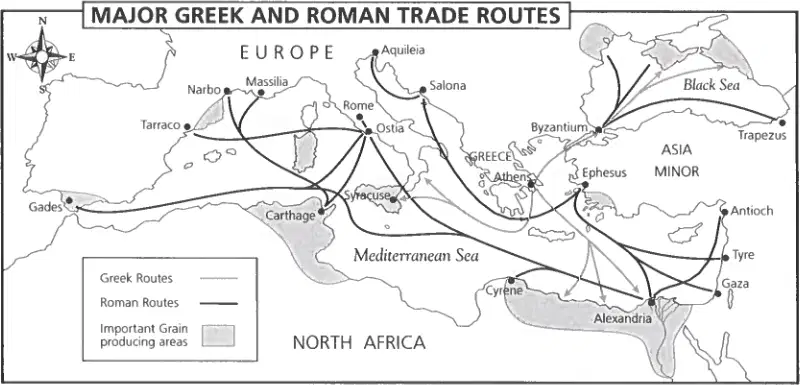
Which statement is most accurate based on the information in the map?
Spain was ancient Europe’s largest grain producer.
Rome’s main trading partner was Carthage.
Rome traded extensively throughout the Mediterranean region.
Greece limited its trade to Alexandria in North Africa.
Which society was the first to practice direct democracy?
city-state of Athens
city-state of Sparta
empire of Alexander the Great
Persian Empire
One effect of rugged, mountainous geography on the civilization of ancient Greece was the development of —
absolute monarchies
extensive trade
separate, independent city-states
belief in one God
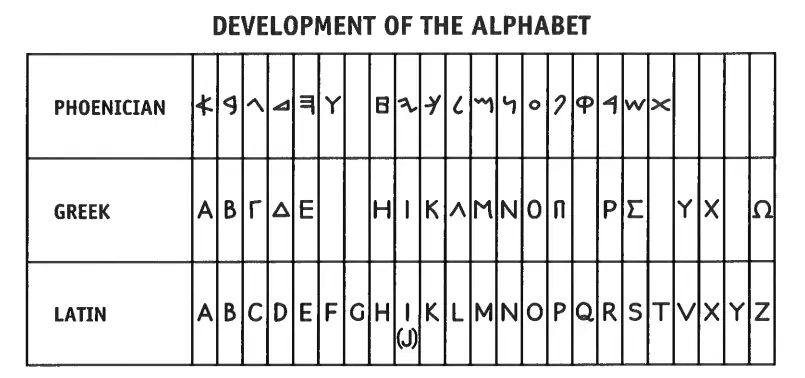
Use the diagram and your knowledge of social studies to answer the following question. What conclusion can best be drawn from the development shown above?
The Phoenician, Greek, and Latin alphabets were unrelated.
The spread of ideas often has little impact on culture.
The alphabet spread from Phoenicia to Greece and later to Rome.
A people’s culture often has a strong influence on its institutions.
Roman women could own property and make wills leaving their property to whomever they chose. What conclusion could be drawn from this statement?
Roman women had the right to vote.
Roman women enjoyed some legal rights.
Roman women were equal to men.
Roman women could hold political offices.
In what way were the Code of Hammurabi and the Twelve Tables of Rome similar?
They allowed for belief in one god.
They established written legal standards.
They provided records of economic activity.
They legalized democratic government.
How did Italy’s geography influence the development of the Roman Empire?
A harsh climate prevented sufficient agricultural production.
Unnavigable rivers in the northern part of the peninsula protected the Romans from their neighbors.
The lengthy, rugged seacoast encouraged frequent invasions by hostile foreigners.
The central location of the peninsula contributed to Roman control of the Mediterranean region.
Which ancient civilization is most closely associated with the Twelve Tables, an extensive road system, the invention of concrete, and the spread of Christianity?
Babylonian
Greek
Phoenician
Roman

Use the paragraph below and your knowledge of social studies to answer the following question: Which statement best summarizes this historian’s view of Athens?
It marked a dark period in its history.
Although a small city-state, it had a deep impact on the culture of the Western world.
It was one of several ancient civilizations that disappeared.
Little appreciation of art and thought existed in Athens.
Which statement describes a characteristic of democracy?
Religious leaders control government policy.
Citizens are the source of power in government.
The government limits the thoughts and actions of the people.
The decisions of government are made by influential military officers.
In what way were ancient Egyptian, Hellenistic, and Roman civilizations similar?
They failed to develop a system of writing.
They extended their control over other peoples.
They established advanced industrial economies.
They all had democratically elected governments.
The Roman system of justice is considered a milestone because it —
greatly limited the emperor’s powers
served as a model for many later European legal systems
provided the first democratic constitution
united Greco-Roman and Chinese ideas of justice
Who were Socrates, Plato, and Aristotle?
Consuls of the Roman Republic
pharaohs of ancient Egypt
religious leaders of the ancient Hebrews
philosophers of ancient Greece
Which culture became known for building marble temples with ideal proportions, statues of athletes with ideal features, and the first works of drama and history?
ancient Egypt
the Persian Empire
ancient Greece
the Roman Empire
One way in which the actions of Cyrus the Great and Alexander the Great were similar was that each —
conquered neighboring peoples to build vast empires
issued written constitutions that defined the rights of citizens
refused to grant religious freedom to their subjects
introduced important legal changes to protect basic human rights
Which conclusion about Europe and the Mediterranean world in 526 A.D. can be drawn from the information on this map?
Gaul dominated trade on the Mediterranean Sea.
Rome was the capital of the entire western region.
The eastern region was unified under the Byzantine Empire.
The division between eastern and western Rome followed natural boundaries.
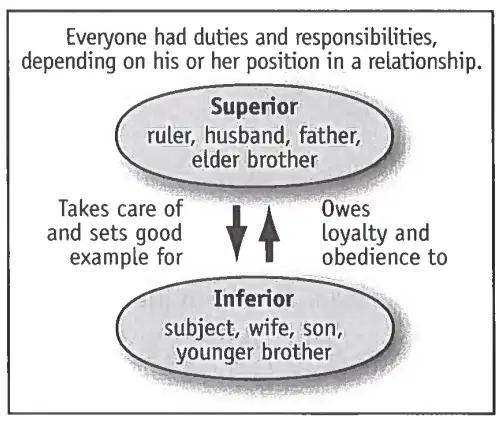
Use the diagram and your knowledge of social studies to answer the following question: The diagram to the right shows the relationship between individuals in a society based on the ideas of —
Confucius
Moses
Emperor Asoka
Siddhartha Gautama
Which type of geographic feature served as a barrier that protected ancient China but through which the Aryans found a route to ancient India?
deserts
mountains
rivers
plateaus
Which statement can best be supported by the information on the map?
By 260 B.C., the Mauryan Empire extended northward into Central China.
The Mauryan Empire controlled more of the Indian subcontinent than the Gupta Empire.
Most of the Gupta Empire was located on the Deccan Plateau.
The economies of India’s early empires were mainly based on overland trade.
Which belief is most closely associated with the teachings of Siddhartha Gautama (Buddha)?
People are born into a specific caste.
Believers must follow the Ten Commandments.
Followers must fast during Ramadan.
People can overcome their selfish desires by following the Eightfold Path.
Which belief is shared by both Hindus and Buddhists?
Everyone should have the same social status.
People should pray five times a day.
The soul is reborn after death.
Material wealth is a sign of blessing from the gods.
One way in which Confucian teachings, the Ten Commandments, and the Eightfold Path in Buddhism were all similar was that they —
promoted polytheism
established equality between men and women
provided codes for moral behavior
affirmed belief in one God

These achievements refer to contributions of the —
Gupta Empire
Persian Empire
Greek city-states
Han dynasty
In China, the development of civil service examinations and a belief in filial piety reflect the influence of —
Shinto
Jainism
Confucianism
Buddhism
The caste system in India was characterized by —
toleration for various religious beliefs
equality between men and women
a lack of social mobility
the right of people to choose their occupations
Which religion is most closely associated with self-denial, meditation, the “Four Noble Truths,” and nirvana?
Buddhism
Christianity
Judaism
Shinto
Which accomplishments are most closely associated with the Gupta Empire?
adoption of democracy and construction of the Pantheon
defeat of the Roman Empire and adoption of Christianity
establishment of Pax Mongolia and founding of a Chinese dynasty
use of the Sanskrit language and development of the concept of zero
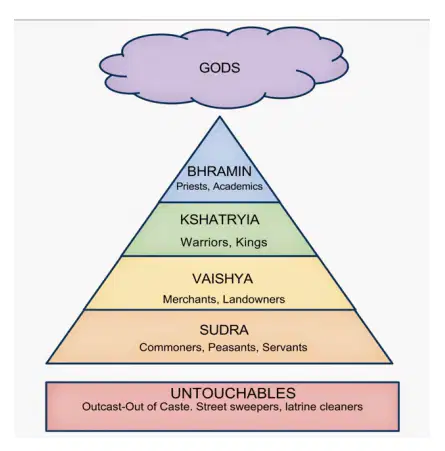
Use the illustration to the right and your knowledge of social studies to answer the question. Which concept is illustrated in the diagram?
the Mandate of Heaven
the caste system
reincarnation
Confucian teachings on superior-inferior relationships
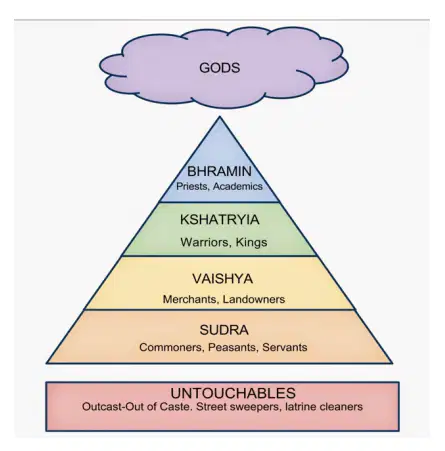
Use the illustration to the right and your knowledge of social studies to answer the question. Which religion is most closely associated with the diagram?
Hinduism
Christianity
Daoism
Confucianism
How were the collapses of the Roman Empire and the Han Dynasty similar?
Both emperors handed power to a warlord
Both societies faced pressure from outside invaders
Christian teachings made both societies less warlike
In both societies, city-dwellers relied extensively on slavery
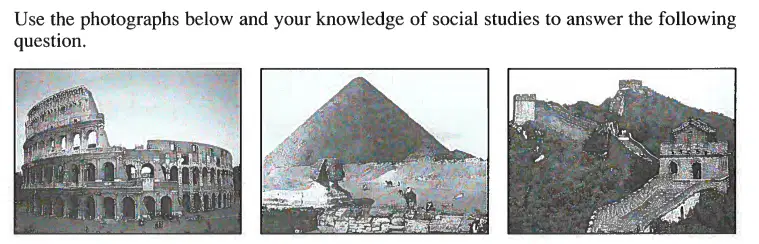
Use the photographs below and your knowledge of social studies to answer the following question. These architectural achievements indicate that —
advanced building techniques existed in ancient civilizations
religion was of little importance
entertainment was important to the cultures of most ancient societies
trade routes existed between China and Western Europe
The Han Dynasty and the Roman Empire were similar in that both —
developed extensive trade networks
created classless societies
encouraged democratic ideals
established free-market economies

