
NEW
Font size
 Worksheets
Quiz on American Revolutionary History
Total questions: 15
Worksheet time: 8mins
The Declaratory Act, passed in 1766, stated that Parliament had the same power in the colonies as it had in Great Britain. It further stated that Parliament had the authority to pass any laws it chose. This act added to colonial unrest because many colonists believed that
Parliament was undermining the power of the king.
Parliament intended to implement more unfair taxes.
Parliament should be relocated to the colonies.
Parliament intended to abolish colonial governments.
The First Continental Congress met in Philadelphia in 1774 to discuss a response to the Intolerable Acts. What was the main accomplishment of the Congress?
It passed the Articles of Confederation to create a new independent government.
It created the Association to start a boycott in the colonies of many British goods.
It passed land ordinances for the Northwest Territory to encourage settlement.
It authorized the Declaration of Independence to break away from the British.
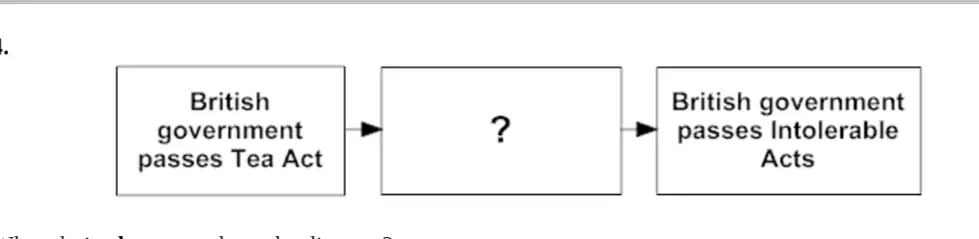
What choice best completes the diagram?
Declaration of Independence
Boston Tea Party
Boston Massacre
Albany Crisis
Which battle marked the first military clash in the American Revolution?
Battle of Lexington
Battle of Bunker Hill
Battle of Saratoga
Battle of Yorktown
How did the Royal Proclamation of 1763 impact colonial opinion towards the king of England?
Colonists agreed with the king that Native American land should be respected.
Colonists were upset that the king would restrict their expansion
What was Benjamin Franklin's main purpose in republishing the "Join or Die" cartoon during the American Revolution?
to encourage the separate colonies to unite against British trade policies
to encourage the separate colonies to unite with Spain against the British
to convince the separate colonies to unite in the fight against Great Britain
to convince the separate colonies to unite with France against Great Britain

Which of the following best describes the role that the four South Carolinians in the box above played in the American Revolution?
They were all Loyalists who supported the British.
They all signed the Declaration of Independence.
They were generals in the Continental Army.
They organized boycotts of British goods.
At Valley Forge, the Continental Army
defeated British troops and managed to steal their supplies.
suffered because of harsh weather conditions and a lack of supplies.
worked on new military formations and received ammunition.
found out British military plans and launched a surprise attack.
Why is the Boston Massacre considered to be a significant event?
It gave the thirteen colonies a focus for their sentiments against British authority.
It showed that the colonists were willing to use deadly force against British troops.
It gave the thirteen colonies a reason to immediately begin an armed revolt.
It showed that the colonists were willing to ignore proclamations by the king.
With which statement would a Loyalist during the Revolutionary War most likely agree?
We should respect the will of the people and the Continental Congress.
We owe our allegiance to the reigning king and to
What was one of the most important differences between the First Continental Congress and the Second Continental Congress?
The first congress made alliances with foreign countries, while the second congress had no diplomatic powers.
The second congress took over as the acting national government, while the first congress assumed no political power.
The second congress made it legal to trade with foreign countries, while the first congress encouraged local commerce.
The first congress was able to impose taxes on the individual states, while the second congress lacked this power.
The beliefs stated in Common Sense and fought for during the American Revolution made sure that the United States would have a ______ form of government.
dictatorial
monarchic
theocratic
oligarchic
republican
In 1781, British General Charles Cornwallis led the British army to Yorktown, Virginia to resupply after a military campaign in the American south. Cornwallis had been planning to be transported by the British navy to a different location, but a fleet from ______ defeated the British ships and blockaded Chesapeake Bay.
Germany
France
Spain
Portugal
Netherlands
During the American Revolution, many colonists remained loyal to the British crown. A Loyalist during the American Revolution would most likely agree with the statement "We owe our allegiance to the reigning king and to ______."
Parliament
the Spanish crown
the Dutch government
the American colonies
the French monarchy
During the early days of the Revolutionary War, many people in the Lowcountry believed that the colony should be freed from English rule. They put diplomatic and military pressure on the ______, where Loyalist beliefs tended to be the strongest.
Lowlands
Upcountry
Midlands
Highlands
Coastal regions

