
 Worksheets
Atoms and Chemical Reactions Quiz
Total questions: 20
Worksheet time: 12mins
What do atoms connected by covalent bonds share?
hydrogen ions
ionic compounds
pairs of electrons
carbon and oxygen
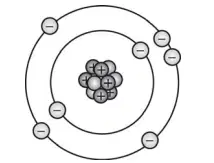
The diagram shows the particles that make up an atom. What is the name of the negatively charged particles shown in this model of an atom?
prions
protons
neutrons
electrons
From the information that two atoms have two different proton counts, you can conclude that the atoms __________.
belong to two entirely different elements
represent different isotopes of one element
are likely to react violently with each other
might be different ions of the same element
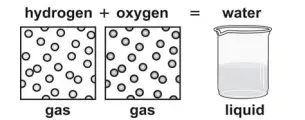
The diagram shows both a chemical change and a physical change. Which statement is supported by the diagram?
Atoms of most elements become less stable when they bind to form compounds.
Compounds can most easily form between elements that have full outer energy levels.
Compounds can have different properties than the elements that make up the compound.
Two elements will always combine in the same ratios when they react to form a compound.
ATP (adenosine triphosphate) stores energy in the bonds between its __________.
nucleotides
carbon atoms
hydrogen atoms
phosphate groups
What do light-independent reactions of photosynthesis need?
water
oxygen
cellulose
carbon dioxide
Which of these is the site of the photosystems in the light-dependent reactions of photosynthesis?
stroma
ATP synthase
thylakoid membrane
mitochondrial matrix
Which chemical equation best represents the process of photosynthesis?
6CO2 + 6H2O → C6H12O6 + 6O2
C6H12O6 + 6O2→ 6CO2 + 6H2O
C6H12O6 + 6H2O → C6H12O6 + 6O2
6CO2 + O2 → C6H12O6 + 6O2 + H2O
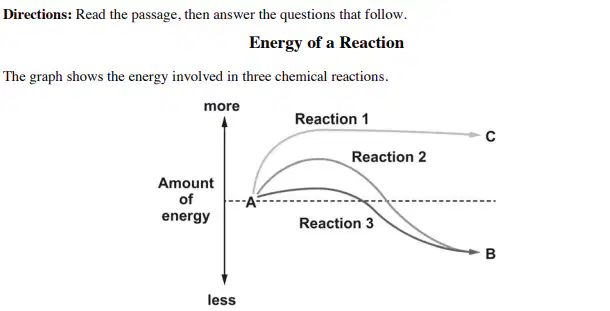
Which statement accurately describes the graph?
Reaction 2 occurs faster than Reaction 3 because Reaction 2 requires more energy than Reaction 3.
Product B contains more energy at the end of the reaction than reactant A has at the beginning of the reaction.
Reactant A contains more energy at the beginning of the reaction than product C has at the end of the reaction.
The data plotted for Reaction 2 and Reaction 3 indicate a difference in the activation energy of these reactions.
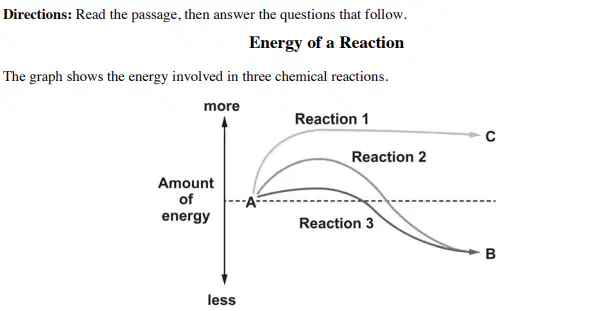
Reaction 3 in the graph __________.
is slower than Reaction 2
is the same as Reaction 1 but faster
probably occurred in the presence of an enzyme
requires more activation energy than Reaction 2
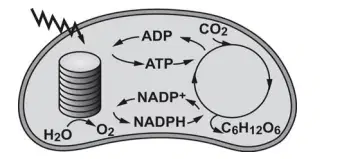
The diagram shows a process in living organisms. Identify the process shown in the diagram and explain why it is important to living organisms.
The process of photosynthesis. It is important to all iiving organisms because it provides chemical energy that can be used by cells.
The process of cellular respiration. It is important to all iiving organisms because it provides chemical energy that can be used by cells.
The process of photosynthesis. It is important to all iiving organisms because it provides light energy that can be used by cells.
The process of cellular respiration. It is important to all iiving organisms because it provides light energy that can be used by cells.
Think about photosynthesis and cellular respiration. Identify what form carbon takes after the light-dependent reactions of photosynthesis and after cellular respiration.
After the light DEPENDENT reatcions of photosynthesis, carbon is still in the CARBON DIOXIDE from. After cellular respiration, carbon is in CARBON DIOXIDE molecules.
After the light INDEPENDENT reatcions of photosynthesis, carbon is still in the CARBON DIOXIDE form. After cellular respiration, carbon is in CARBON DIOXIDE molecules.
After the light DEPENDENT reatcions of photosynthesis, carbon is still in the GLUCOSE from. After cellular respiration, carbon is in GLUCOSE molecules.
After the light DEPENDENT reatcions of photosynthesis, carbon is still in the GLUCOSE from. After cellular respiration, carbon is in GLUCOSE molecules.
All living things are made of carbon-based molecules. These molecules have different structures and functions. Explain how the atomic structure and covalent bonding properties of carbon atoms allow carbon to form many different types of molecules with many different functions. In your answer: Define covalent bond.
two atoms share at least one pair of electrons
3 atoms share one pair of electrons
two atoms share 5 pairs of electrons
All living things are made of carbon-based molecules. These molecules have different structures and functions. Explain how the atomic structure and covalent bonding properties of carbon atoms allow carbon to form many different types of molecules with many different functions. In your answer: Explain how carbon-based rings and chains can form very large molecules.
Carbon can form covalent bonds with up to 4 other atoms, including other carbon atoms, to form rings an dchains of molecules. These rings and chains are bond with each other to form very large molecules.
Carbon can form covalent bonds with up to 8 other atoms, including other carbon atoms, to form rings an dchains of molecules. These rings and chains are bond with each other to form very large molecules.
Carbon can form covalent bonds with up to 2 other atoms, including other carbon atoms, to form rings an dchains of molecules. These rings and chains are bond with each other to form very large molecules.
Carbon can form covalent bonds with up to 1 other atom including another carbon atom, to form rings an dchains of molecules. These rings and chains are bond with each other to form very large molecules.
All living things are made of carbon-based molecules. These molecules have different structures and functions. Explain how the atomic structure and covalent bonding properties of carbon atoms allow carbon to form many different types of molecules with many different functions. In your answer: Choose the four main types of carbon-based molecules in organisms and the description of one of their functions.
Carbohydrates that can be broken down to make usuable energy.
Lipids can be used to form strucures
Proteins can be used as enzymes (speed up reactions)
nucleic acids store genetic information
What are the two reactants and two products for the process of photosynthesis?
water
carbon dioxide
glucose (sugars)
oxygen
Explain the importance of producers and photosynthesis for all life on Earth.
produce the source of chemical energy
produce carbon dioxide for animals
produce sunlight
produce water
The chemical formula for photosynthesis: (a) + (b) + (c) → (d) + (e)
Which of the following best describes the role of enzymes in biological reactions?
Enzymes increase the activation energy required for reactions.
Enzymes decrease the activation energy required for reactions.
Enzymes are consumed in the reactions they catalyze.
Enzymes are only active at high temperatures.
What is the primary function of chlorophyll in photosynthesis?
To absorb carbon dioxide
To absorb sunlight
To release oxygen
To produce glucose

