
 Worksheets
Topic 5 Test
Total questions: 46
Worksheet time: 2hrs 32mins
What benefit did a standardized currency bring to China?
It made it easier to trade anywhere in the empire.
It reduced the economic power of warlords.
It increased wealth for all citizens.
It allowed the government to collect taxes.
Among the major achievements of the Shang were the development of a written language and the
building of the Great Wall.
introduction of metal coins.
invention of the seismometer.
development of bronze metalworking.
Why did the ancient Chinese make loud noises at festivals and during holiday celebrations?
to show loyalty to the emperor
to celebrate their blessings
to awaken the spirits of their ancestors
to chase away evil spirits
In order to keep the economy stable, Han emperors
introduced the first Chinese coins.
prevented merchants from selling goods outside of China.
bought and stored goods to avoid shortages.
banned monopolies in major industries.
Emperor Wudi and later Han emperors sent envoys to
establish relations with western kingdoms.
oversee civil service examinations.
destroy rebellious warlords.
spread Buddhism throughout China.
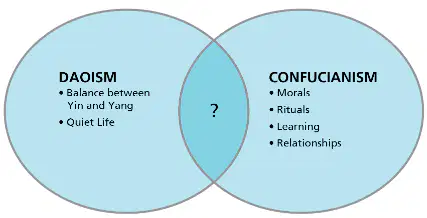
Look at the Venn diagram comparing Daoism and Confucianism. Which phrase replaces the question mark in the diagram?
Competition for wealth
Order and stability
People are basically evil
Development of bureaucracy
What impact did the Silk Road have on China under the Han dynasty? Choose the TWO correct answers.
It enabled the Han to expand Chinese territory.
It brought new ideas such as Buddhism into China.
It increased the prosperity of Han merchants.
It made travel easier between northern and southern China.
It allowed the Chinese to learn the process of making silk.
Followers of Daoism believe that the Dao is
proper relationships between people.
a form of ancestor worship.
a pathway to a just and stable government.
the natural way of the universe.

Look at the table. Which statements replace the question marks in the table? Choose the TWO correct answers.
father and son
teacher and student
ancestors and the living
older and younger brothers
Filial piety is a major feature of which system of thought influential in China?
Confucianism
Daoism
Legalism
Buddhism
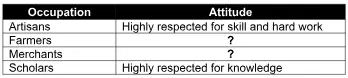
Look at the table of the social order of Han society. Which Confucian attitudes replace the question marks in the table, from top to bottom?
Highly respected for production of basic goods; Highly respected for wealth
Little respected for low social status; Little respected because they do not produce goods
Little respected because they work at a lowly job; Highly respected for wealth
Highly respected for production of basic goods; Little respected because they do not produce goods
Under the Han, iron and salt were so important that
it was forbidden to trade them outside of China.
production of these goods was made a state monopoly.
only wealthy merchants were allowed to produce them.
only the emperor and his family were allowed to own them.

Look at the photo. The form of art shown here was developed during what dynasty?
Han
Shang
Zhou
Qin
Where did China’s first civilization develop?
along the Chang River
along the Huang River
on the Plateau of Tibet
in the Gobi Desert
What is loess?
silt that settles on a hilltop
a grass-covered plain
a dry wind from the Gobi
a fine, dustlike material
According to Laozi, what is the Dao?
the home of the heavenly spirits
respect for authority
the natural way of the universe
reverence for ancestors
Which spirits were most important to the ancient Chinese?
spirits of one’s ancestors
evil spirits who controlled the crops
spirits found in the natural world
spirits representing the Mandate of Heaven
What philosopher who helped shape Chinese thought is known as the “First Teacher”?
Laozi
the Zhou emperor
Confucius
Mencius
What is the main topic discussed in the Analects of Confucius?
proper behavior and ideals
successful battle strategies
living in harmony with nature
the nature of the afterlife
According to Daoism, the symbols of yin and yang represent the ideal of
authority.
good government.
balance.
material success.
What was the purpose of the Great Wall?
to separate warring states
to keep out nomads to the north
to standardize Chinese roads
to make trade and transportation easier
What was the Silk Road?
a mountain pass through the Hindu Kush
a path for ideas from Japan
a road through the silk-weaving province of China
a network of trade routes that crossed Asia
In Han China, the majority of people made their living as
farmers.
merchants.
scholar officials.
artisans.
Which invention of the Han was called the “wooden ox”?
paper
seismometer
compass
wheelbarrow
What benefit did standardized currency (money) bring to China?
It made it easier to trade anywhere in the empire.
It reduced the economic power of the warlords.
It increased wealth for all citizens.
It allowed the government to collect taxes.
The kind of money used by a group or a nation
Li
Ren
Civil Service
Currency
The Chinese believed in many gods which is...
polytheism
monotheism
In order to keep the economy stable, Han emperors
bought and stored goods to avoid shortages.
introduced the first Chinese coins.
banned monopolies in major industries.
prevented merchants from selling goods outside of China.
What was the initial basis of China's economy in ancient times?
Trade with other civilizations
Agriculture
Pottery making
Silk weaving
Scarcity can best be defined as
Abundance of resources in comparison to limited wants and needs
Equal distribution of resources to meet all wants and needs
Unlimited availability of resources to meet all wants and needs
Limited availability of resources
Trade route that stretched from western China to southern Asia
filial piety
Silk Road
Great Wall
Anyang
Which Dynasty established the Silk Road?
Shang Dynasty
Zhou Dynasty
Qin Dynasty
Han Dynasty
What was the primary purpose of the Silk Road?
Military conquests
Religious pilgrimages
Trade and cultural exchange
Scientific expeditions
Identify one way in which China benefited from the Silk Road
Cultural diffusion brought new goods and ideas to China
Conflicts started over who had the right to trade
China began trading with the Americas
China grew poor because other countries took advantage of them
What was one of the major impacts of the Silk Road on China?
It led to the isolation of China from the rest of the world.
It facilitated the spread of Buddhism into China.
It caused the Great Wall of China to be built.
It decreased the wealth of China.
Filial piety is a major feature of which system of thought influential in China?
Confucianism
Daoism
Legalism
Buddhism
Which of the main Ancient Chinese philosophies is best connected to opposing dissension?
Taoism
Legalism
Confucianism
Hinduism
Which of the main Ancient Chinese philosophies is best connected to respect?
Taoism
Legalism
Confucianism
Hinduism
Having the favor of the gods means you have the _____.
Buddha
Gift of Knowledge
Mandate of Knowledge
Mandate of Heaven
Filial piety is a major feature of which system of thought influential in China?
Confucianism
Daoism
Legalism
Buddhism
Which of the main Ancient Chinese philosophies is best connected to promoting strict government?
Taoism
Legalism
Confucianism
Hinduism
The belief that rulers should use harsh punishment to control their people.
Legalism
Confucianism
Darwnism
Skonbergism
Which of the following was a major export on the Silk Road from China?
Spices
Silk
Gold
Coffee
What is a dynasty?
A series of rulers from the same family
A series of rulers from the same continent
A series of rulers from the same country
A series of rulers
What is a line of rulers that belongs to the same family?
Dynasty
Heiroglyphics
Empire
Democracy
The word _______means the "way of nature and is used to describe a belief system in China
Animism
Dao
Islam
Shinto

