
 Worksheets
5th Grade Science 3rd 9 Weeks Spiraled Review
Total questions: 92
Worksheet time: 1hrs 15mins
What is the definition of an insulator?
Allows the flow of electricity
Stops or slows the flow of electricity
An example would be metals
None of them.
Which of the following is the definition of a conductor?
Stops or slows the flow of energy
An example would be plastic.
An example would be rubber.
Allows the flow of energy.
Select all the magnetic choices.
Nickel
Copper
Cobalt
Iron
Steel
Which of the following are physical properties?
Matter
Mass
Solubility
Conductivity
Why do we have so many trials in experiments?
To allow multiple opportunities for us to answer.
To make the data more reliable
Because labs are fun
None of the above
What is the type of force that pulls things down to earth?
Gravitational Force
Frictional Force
Equal Force
None of the above
What is an unbalanced (unequal) force?
A force that does not cause motion
A force that causes motion
A push
A pull
An (a) force does not cause motion.


What is a material that resists, or does NOT allow, energy to flow through?
circuit
insulator
series
conductor
What are the 2 main types of forces?
Push
Pull
Gravitational Force
Frictional Force
What is frictional force?
A force that causes things to fall back down to earth.
A force that causes a push.
A force that causes a pull.
A force that works in the opposite direction of motion.
Which of the following causes the most friction?

ice skating rink
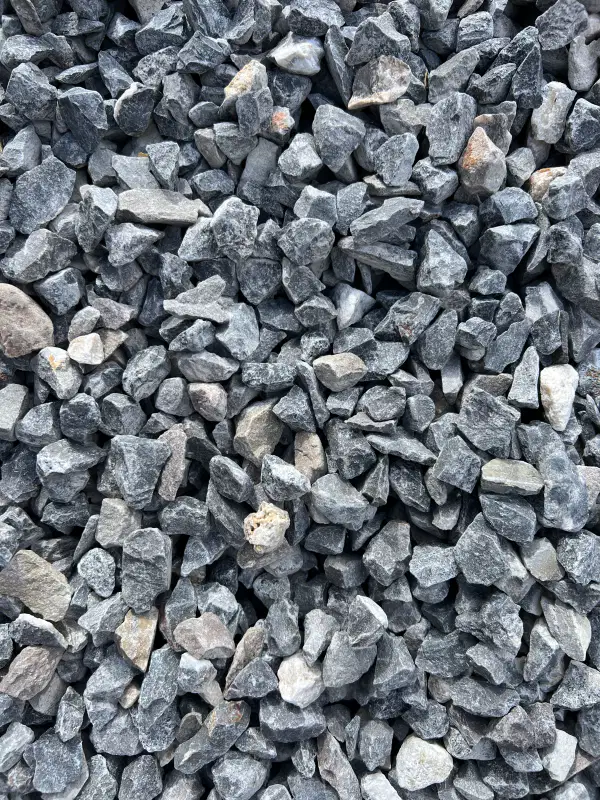
gravel road
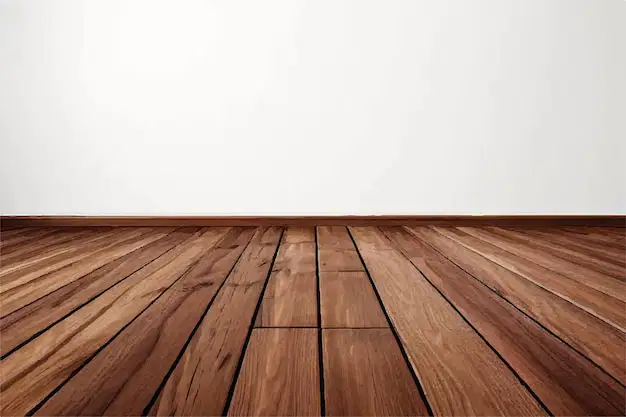
wood floor
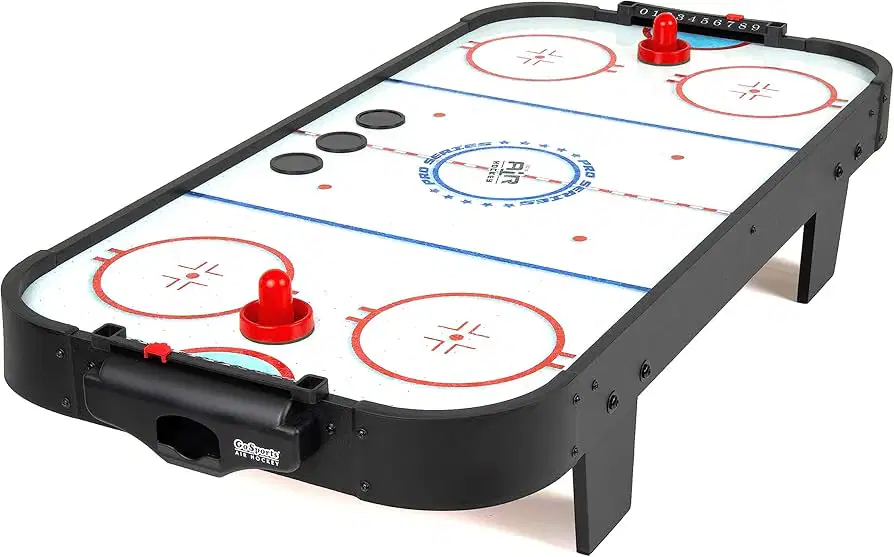
air hockey table top
Which of the following is the best way to represent that air takes up space?
Leaves blowing in the wind
A balloon
Riding in an airplane
Wind in a sail
Which of the following is an example(s) of an unbalanced (unequal) force?
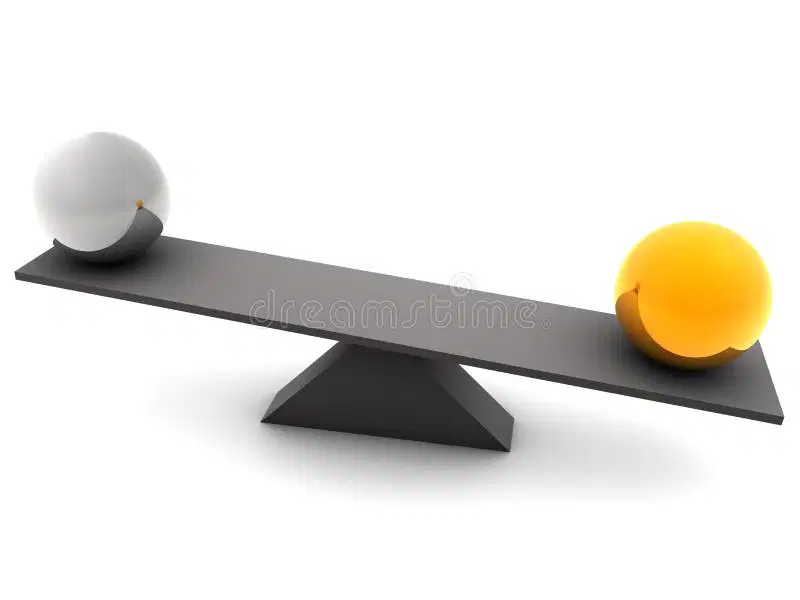
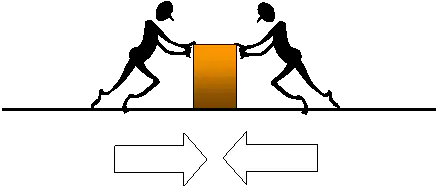
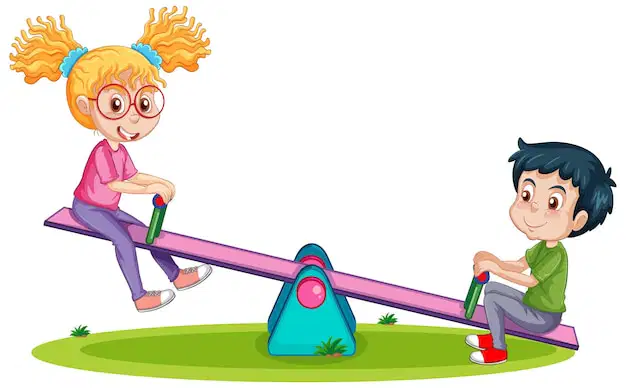
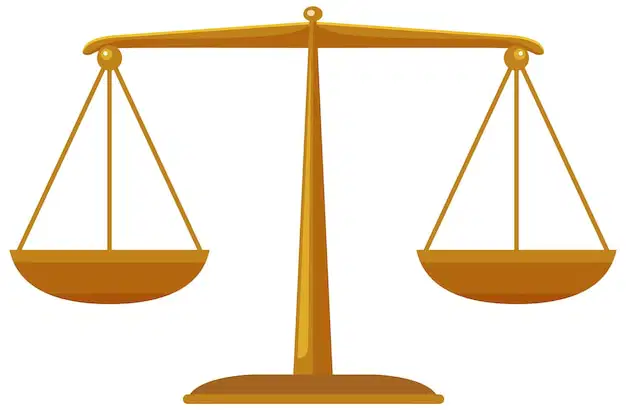
Which of the following are soluble in water?
Salt
Sugar
Lemon Juice
Gravel
Sand
What is the definition of soluble?
Something that dissolves in water
Something the floats on water.
Something that sinks in water and does not dissolve
An example would be sand.
Which of the following is less dense?
Copper Penny
Cork
Tennis Ball
Metal paper clip
Which of the following are more dense?
Copper Penny
Cork
Metal Paper Clip
Ping Pong Ball
What force(s) acted on the toy car in our lab?
Gravitational Force
Frictional Force
Push
Pull
Which of the following is an example of an energy transformation?
Plugging in and turning on the microwave
Hearing a train
Looking at a light bulb
Smelling donuts
Which of the following is not a form of potential energy?
Chemical energy
Nuclear energy
Kinetic energy
Gravitational energy

Which position on the roller coaster has the greatest potential energy ?
A
B
C
D

A bicycle rider is traveling up a hill. When the rider reaches the top of the hill, she stops to rest. Then she travels down the hill. The diagram shows the rider in the three different positions.
Which of these correctly describes the potential energy and the kinetic energy of the bicycle rider?
When the rider is at the top of the hill, her potential energy is the greatest, and her kinetic energy is the least.
As the rider moves up the hill, her kinetic energy increases, and her potential energy decreases.
When the rider goes down the hill, her potential energy increases, and her kinetic energy decreases.
As the rider reaches the bottom of the hill, her kinetic energy and her potential energy decrease.
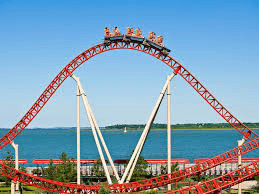
When a roller coaster is at the top of a hill it has
high potential energy
high kinetic energy
low potential energy
equal amounts of kinetic and potential energy
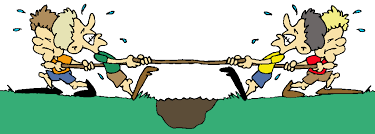

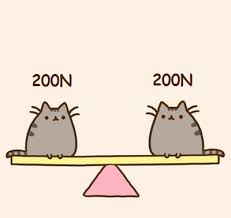

These forces are...
Balanced
Unbalanced

These forces are...
Balanced
Unbalanced
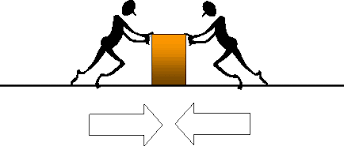


The net force is...
-20 N
0 N
80 N
20 N
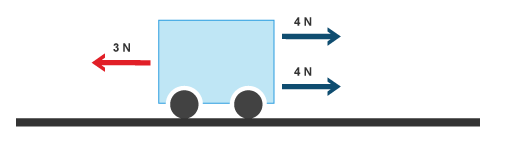
What is the net force on the object pictured?
3 N
5 N
4 N
8 N


Students investigate the physical properties of some substances. They draw a table to show how the substances can be grouped. The students need to complete the table with column headings. Which column headings should they use for their table?
Conductors
Insoluble in water
Soluble in water
Magnetic
Tornadoes, Hurricanes, Earthquakes, and Volcanic Eruptions are all examples of which of the following?
Slow changes to Earth's surface
Rapid changes to Earth's surface
Movement
High winds
Select the correct definition for erosion.
Breaking down into smaller pieces
Wind and moving water carry bits of rock
Materials being dropped in a new place
An example are mountains
Select the correct definition for weathering.
Wind and water carry bits of rock
An example is a flood
Materials being dropped in a new place
Breaking down rock into smaller pieces
Select the correct definition for deposition.
Wind and water carry bits of rock
An example is a mountain
Materials being dropped in a new place
Breaking down rock into smaller pieces
Deltas are formed by which of the following two processes:
Erosion
Deposition
Wind
Weathering
Glaciers form which of the following structures?
V-shaped valley
U-shaped valley
Mountain
Fjord
Sand dunes are formed by which of the following?
Erosion
Deposition
Wind
Earthquakes
Landforms are examples of which of the following?
Rapid changes to Earth's surface
Slow changes to Earth's surface
Tornadoes, Hurricanes, and Earthquakes
None of the above
Rivers form which kind of landform?
V-shaped valleys
Canyons
U-shaped valleys
Mountains
Volcanic eruptions cause which of the following to form?
Islands
Earthquakes
Hurricanes
Tornadoes
Which of the following is an example of a rapid change to Earth's surface?
Tornado
Hurricane
Earthquake
Volcanic Eruption
A flood is an example of which of the following?
Erosion
A rapid change to Earth's surface
A slow change to Earth's surface
A landform
A hypothesis uses the following format to answer a question.
I think that...
The data shows that...
If ____, then ____.
Therefore, ____.

The chart below shows objects that conduct heat and objects that insulate heat. Which answer choice best completes the chart?
Glass block
Gold ring
Plastic spoon
None of the above

WHAT STRATEGY DO YOU USE?
CONDUCTORS - PLASTICS
INSULATORS - METALS
CONDUCTORS - NICS
INSULATORS - PLASTIC, WOOD, GLASS, COTTON, RUBBER.
CONDUCTORS - WATER
INSULATORS - ONLY WOOD
CONDUCTORS - LEMON JUICE
INSULATORS - PAPER

The electrical wires in many homes are made of copper and covered with plastic. Why are copper and plastic good choices for electrical wires?
Copper is a conductor of electricity, and plastic is an insulator of electricity.
Copper is an insulator of electricity, and plastic is a conductor of electricity.
Copper is a conductor of electricity, and plastic is an insulator of heat.
Copper is an insulator of electricity, and plastic is a conductor of heat.
Which of the following describes precipitation?
Water goes up to the clouds where it cools down
Water is turned into water vapor
Water falls from the clouds as rain, snow, sleet, or hail
Water runs off of a surface
Which of the following describes evaporation?
Water goes up to the clouds where it cools down
Water is turned into water vapor
Water falls from the clouds as rain, snow, sleet, or hail
Water runs off of a surface
Which of the following describes condensation?
Water goes up to the clouds where it cools down
Water is turned into water vapor
Water falls from the clouds as rain, snow, sleet, or hail
Water runs off of a surface
Which of the following describes runoff?
Water goes up to the clouds where it cools down
Water is turned into water vapor
Water falls from the clouds as rain, snow, sleet, or hail
Water runs off of a surface
Which of the following best describes the difference between weather and climate?
Weather is a daily occurrence and climate is data gathered over a 30 year period.
Weather is data gathered over 30 years and climate is day to day.
Weather happens yearly and climate happens daily.
None of the above.
What causes the apparent movement of the sun across the Earth's sky?
Earth's Revolution
Sun's Rotation
Sun's Revolution
Earth's Rotation
Which of the following are renewable resources?
Sunlight
Oxygen (air)
Plants
Fossil Fuels
Which of the following is an example of conservation?
Littering
Putting trash in the bin
Recycling
Cutting down trees to build homes
Which of the following causes seasons?
The sun's rotation
Earth's tilt on its axis and its orbit around the sun
The sun's revolution
The moon
Which of the following is the correct definition of orbit (revolve)?
To go around an object
To spin
To turn
None of the above
What causes the day and night cycle?
Earth revolving around the sun
Earth's rotation on its axis
The moon revolving around earth
The sun revolving around the earth
What time of day are shadows the shortest?
Noon
Afternoon
Evening
Sunrise
What time(s) of day are shadows longest?
Sunrise
Sunset
Noon
Afternoon
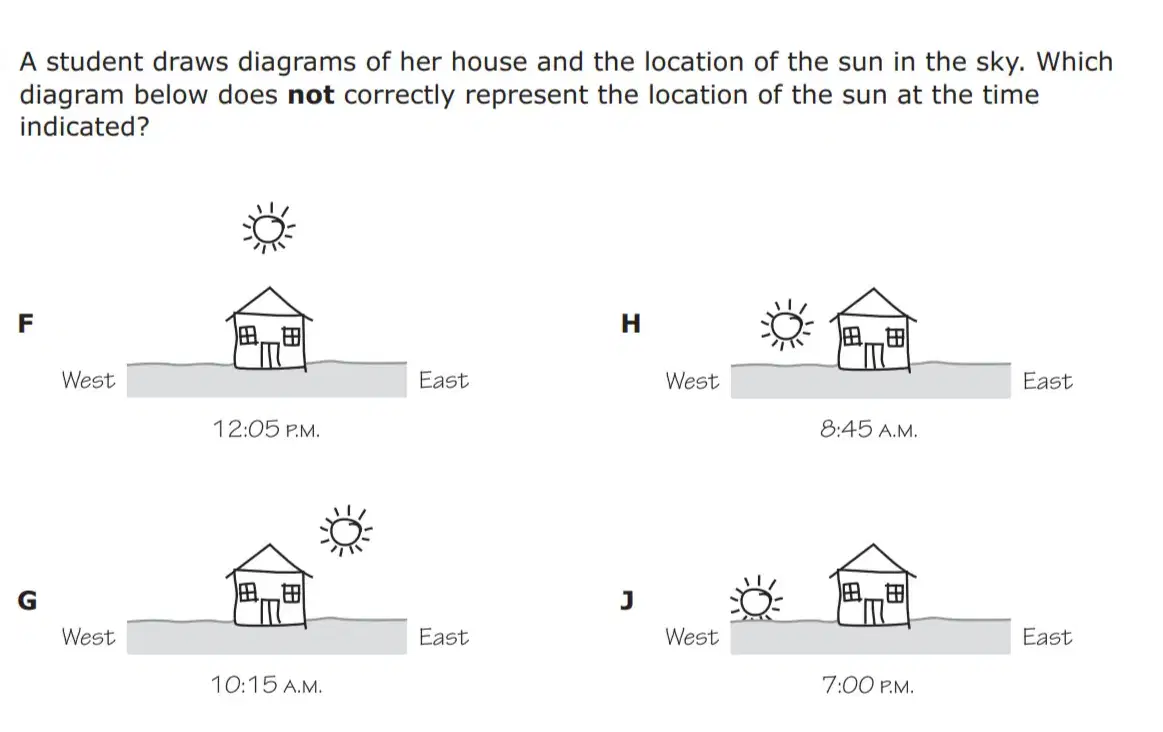
A student draws diagrams of her house and the location of the sun in the sky. Which diagram below does not correctly represent the location of the sun at the time indicated?
F
G
H
J
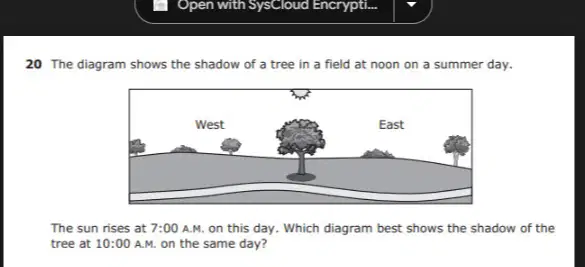
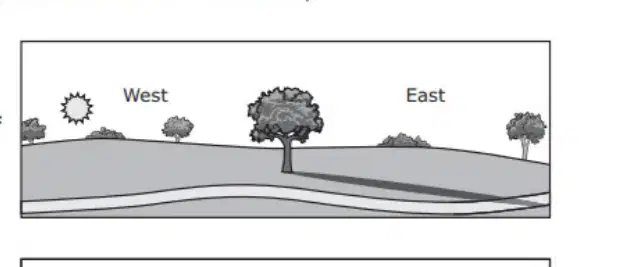
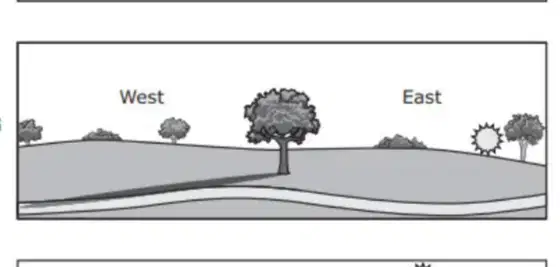
The diagram shows the shadows of a tree in a field at noon on a summer day. The sun rises at 7:00am on this day. Which diagram best shows the shadow of the tree at 10:00am on the same day?
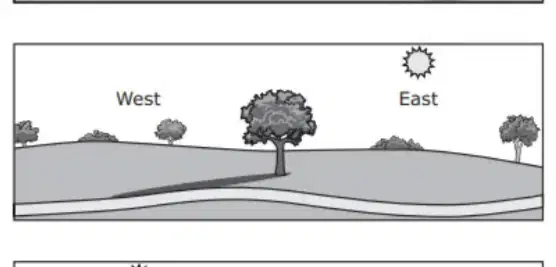
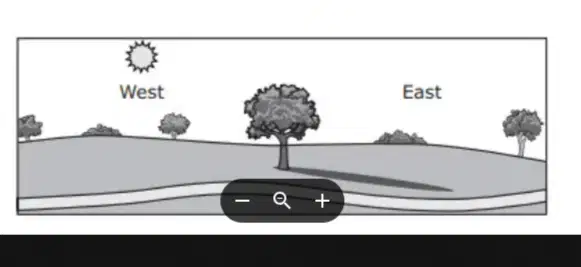
Which of the following is our saying for remembering where the sun is for shadows?
Early in the East, rest in the West
Sun set sun rise
North South
We don't have a saying!
Which of the following is/are inherited behaviors?
Seeking food from a human
Migrating south for the winter
A child has blue eyes
A tiger has stripes
Which of the following is/are an example of a learned behavior?
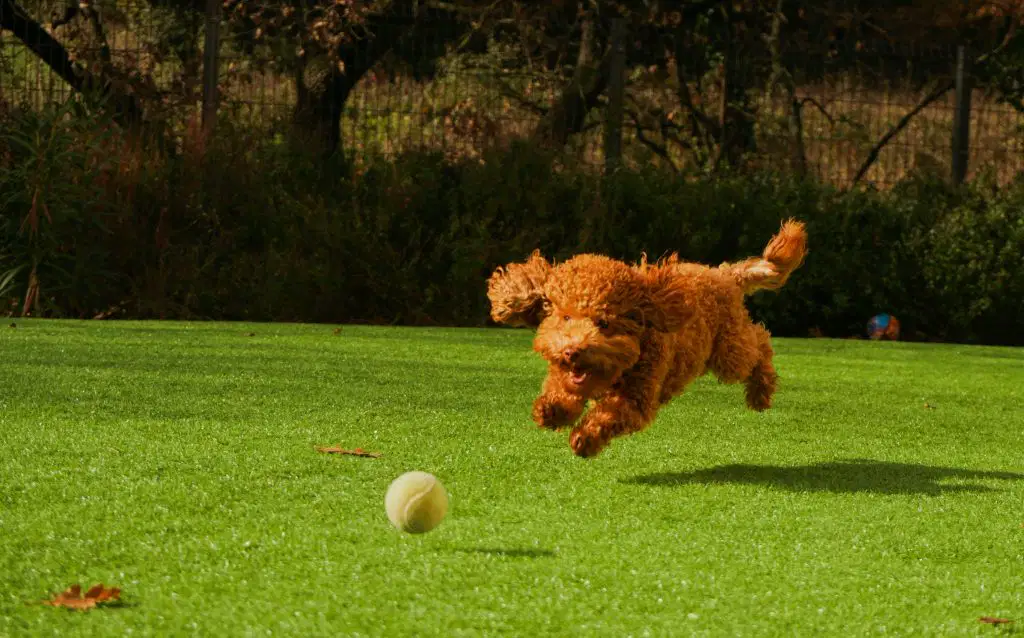
A dog chasing a ball

A person having blue eyes

An elephant having tusks

A person driving a car
Which of the following describes what happens when a pen is placed into water?
Refraction because the pen looks bent or broken
Reflection because the pen looks bent or broken
Refraction because the light bounces off of the water
Absorption because the light is absorbed by the water
Which of the following is an example of mimicry?
A moth has owl eyes on its wings to scare off predators
A butterfly flies in circles
Birds fly south for the winter
Bears sleep all winter
Which of the following describes camouflage?
Rabbits shed their fur multiple times a year having white fur in January, brown fur in May, and white and brown fur in the summer.
A white tailed deer raises its tail to warn other deer that danger is near.
An owl hoots at predators.
Bats use sonar to detect predators and obstacles in the night.
Why would a deer have a white tail in grassland prairies?
To warn other deer that danger is near.
To camouflage into the prairie
To jump higher on hills
To run faster
Which of the following is/are an example of an abiotic factor?
A bird
An elephant
Air
Water
Which of the following is/are biotic factors?
Plants
Wood
Water
Air
True or False: An animal has died so it is an abiotic factor.
True
False
Which of the following is an example of a biotic factor and an abiotic factor interacting in an ecosystem?
A bird takes a drink out of a pond.
A hawk eats a cardinal.
A dog chases a cat
A frog eats a fly
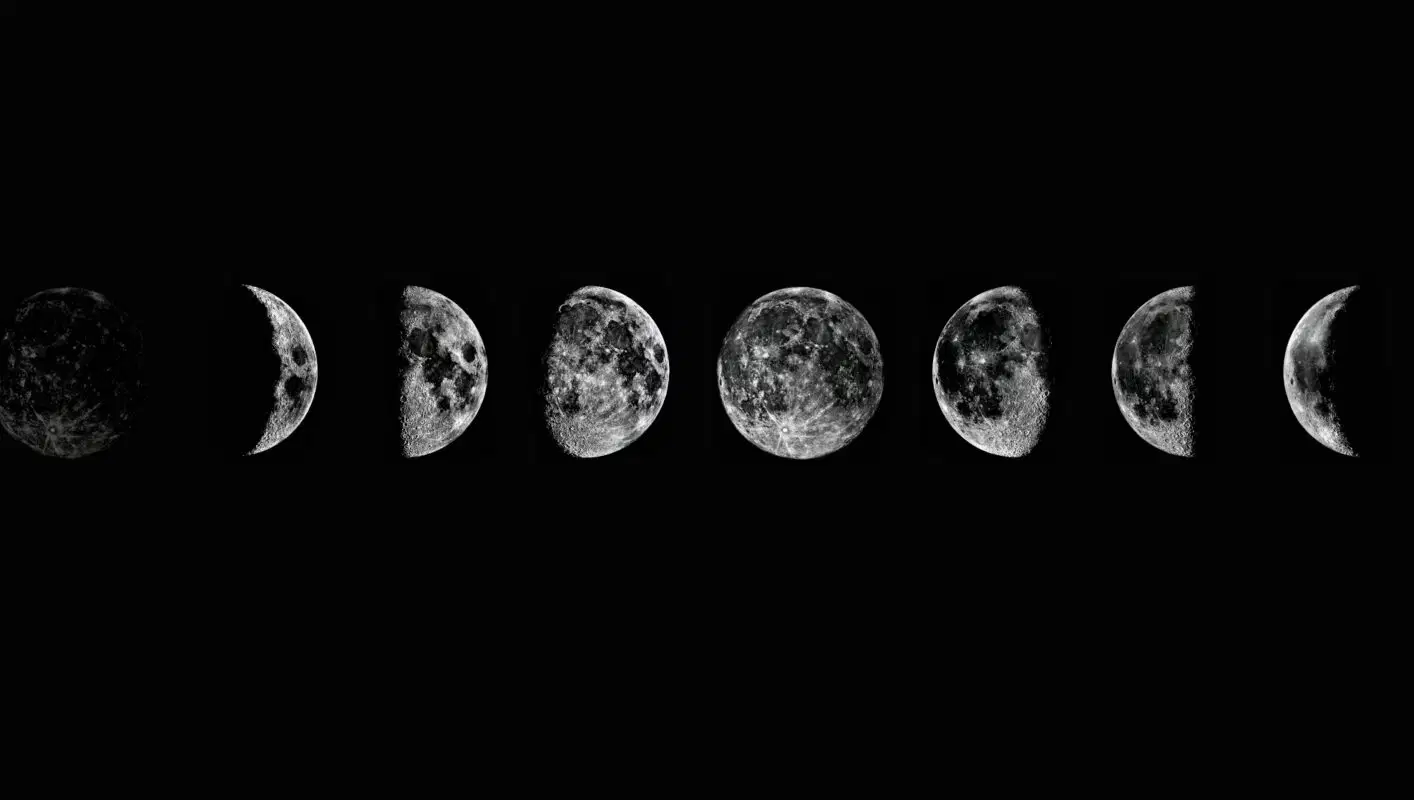
Which of the following would be the next phase in the moon cycle?
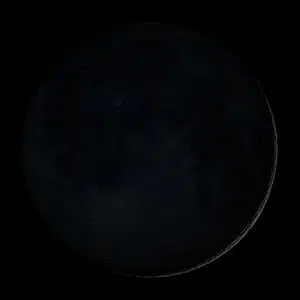
new moon

full moon

crescent moon
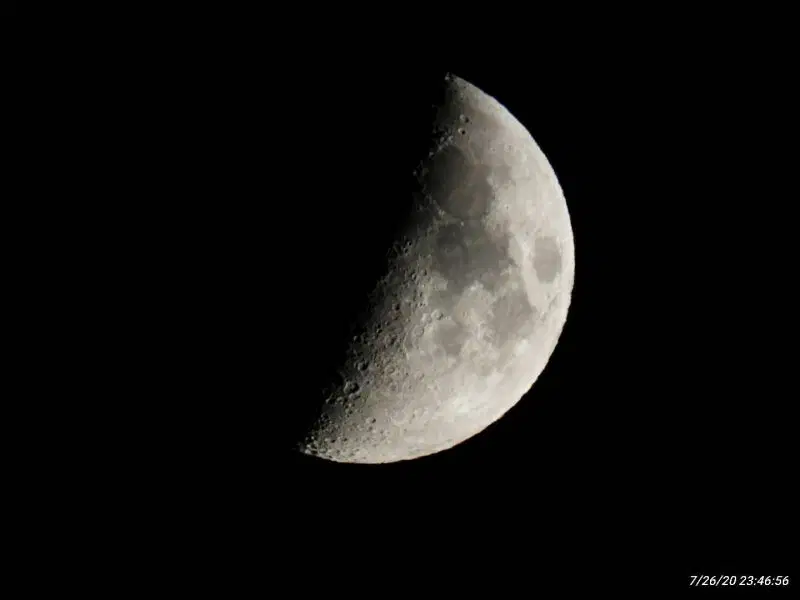
half moon
If a full moon happened today, when would the next full moon be?
Next week
Tomorrow
2 months
In about a month (30 days)

