Worksheets
Q1102024 MPB
Total questions: 29
Worksheet time: 18mins
Water is a compound of hydrogen and oxygen. If you were able to take water and separate it into hydrogen and oxygen, what would the smallest unit of each component be?
a molecule of oxygen and 2 molecules of hydrogen
an atom of oxygen and a molecule of hydrogen
an atom of oxygen and 2 atoms of hydrogen
an atom of hydrogen and a molecule of oxygen
When solid X is heated, it breaks up into gas Y and another solid Z. The solids X and Z and the gas Y are all pure substances. Based on this information alone, which substance or substances must be compounds?
X Only
Z Only
X and Z
X and Y Only
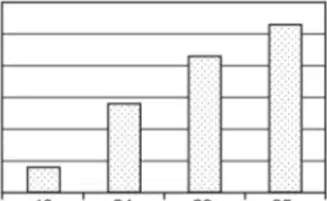
A class performed an experiment to investigate mass changes in a closed system. The teacher divided the class into pairs and gave each pair either a physical or chemical change to perform. Multiple groups investigated a change of state, dissolving salt into water, heating copper & sulfur, and dissolving alka-seltzer & water. The mass of reactants was measured before the change and the mass of the products was measured after the change was complete. The mass of the reactants was subtracted from the mass of the products. The teacher collected the data from each pair and calculated the averages to make the following graph. Why did the teacher use data from all the groups to make a single graph?
To ensure the validity of the data.
To ensure she could read everyone’s results.
To ensure everyone’s graph looked the same.
To ensure the experiment was conducted correctly.
When silver nitrate is added to saltwater, white powder-like solid appears in the beaker. Which of the following best describes the result?
A physical change occurred as indicated by the bubbling.
A chemical change occurred as indicated by the precipitate.
A chemical change occurred as indicated by a change in state.
A physical change occurred as indicated by the formation of a gas.
JJ Thompson’s theory thought that atoms were composed purely of negatively charged electrons. This model became known as the plum pudding model. What does current atomic theory propose?
Electrons are in shells surrounding the nucleus.
Electrons are found in the nucleus of an atom.
An atom’s nucleus contains both protons and neutrons.
Both A and C are true statements about what we know about atoms.
Reynalda was asked by a classmate why she would place hydrogen in the first column of the periodic table. Which of the following reasons could she give as a response?
I. Hydrogen combines with chlorine in the same atomic ratio as sodium.
II. Hydrogen is a gas at room temperature.
III. Hydrogen forms diatomic molecules.
I and II
II and III
I only
III only
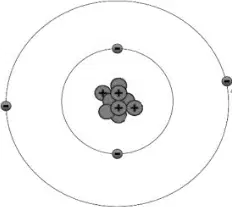
In the diagram below “D” represents one valence electron of the atom Beryllium. The valence electrons help to determine the number of bonds an atom can make with another to form a compound. What would the chemical formula be for Beryllium combining with the element Chlorine?
Be₂Cl
BeCl
BeCl₂
Be₂Cl₂
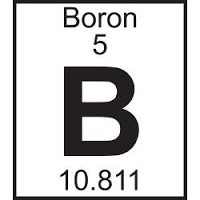
Which piece of information in a square on the periodic table represents the number of protons in an atom.
Symbol
Atomic Number
Atomic Mass
Element Name
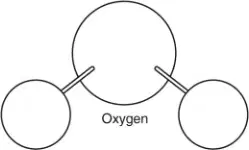
Molecular model kits are used to model elements, compounds, and molecules. A model of water is shown below. What is the benefit provided to scientists using this model?
The model provides information about the structure of an atom, helping scientists determine the locations of protons and electrons.
The model provides information about the ways the atoms are arranged, helping scientists identify chemical bonding opportunities.
The model provides information about the actual size of chemical substances, helping scientists determine the volume of the molecules.
The model provides information about the abundance of atoms in the universe, helping scientists discover additional elements in space.
Which piece of information in a square on the periodic table represents the number of protons and neutrons in an atom?
Symbol
Atomic Number
Atomic Mass
Element Name
Lilly was testing a sample of plastic and wrote down the following observations in her lab notebook: “The plastic I had reflected a lot of light and would not bend.” What was Lilly observing?
The physical properties of luster and flexibility (malleability).
The chemical properties of luster and flexibility (malleability).
The chemical property of luster and the physical property of flexibility (malleability).
The physical property of luster and the chemical property of flexibility (malleability).

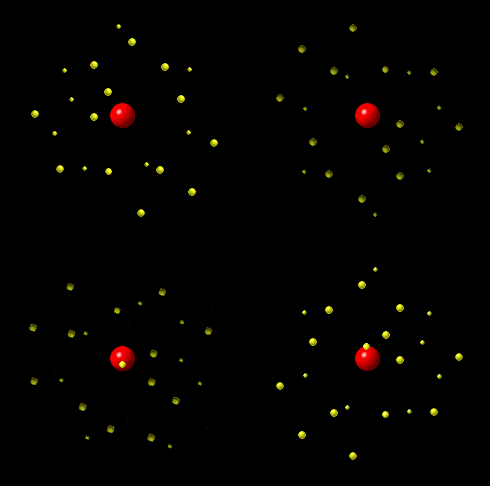
How many valence electrons are in the element Fluorine modeled below?
2
7
8
9
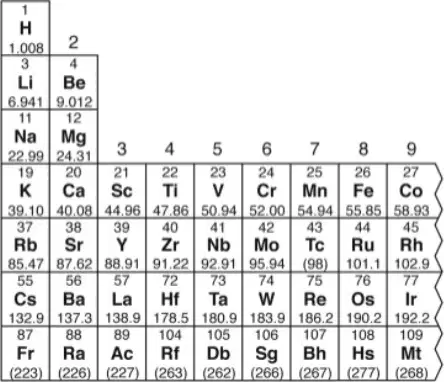
There are more than 100 elements in the periodic table. The first nine groups of the periodic table are shown below. Which two elements are most likely to have similar properties?
sodium (Na) and calcium (Ca)
cesium (Cs) and osmium (Os)
lithium (Li) and potassium (K)
Sodium is a metallic solid and chlorine is a poisonous yellow-green gas. Sodium and chlorine react to form sodium chloride, which is common table salt. Is table salt an element or a compound?
Element
Compound
Mixture
Solution
Sodium is a metallic solid and chlorine is a poisonous yellow-green gas. Sodium and chlorine react to form sodium chloride, which is common table salt. What are the physical properties of table salt?
White crystalline solid
Yellow-green gas
Metallic solid
Liquid at room temperature
Sodium is a metallic solid and chlorine is a poisonous yellow-green gas. Sodium and chlorine react to form sodium chloride, which is common table salt. How do the properties of table salt compare with those of sodium and chlorine?
Table salt has similar properties to sodium and chlorine.
Table salt is a metallic solid like sodium.
Table salt is a poisonous gas like chlorine.
Table salt has different properties from both sodium and chlorine.
Which statements are true concerning elements in the same group of the periodic table?
They have similar periodic properties and the same outer shell electron configuration.
They are all metals or nonmetals, but not both.
They are either all solids or all liquids or all gases.
They have the same number of shells of electrons.
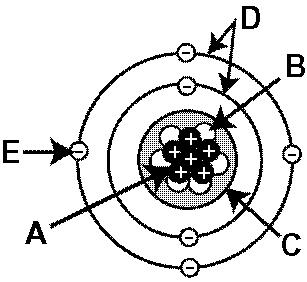
In the atom diagram shown, A is pointing to the darker particles, these are known as
electrons
protons
neutrons
the nucleus


Which of the following best describes the role of valence electrons in chemical bonding?
Valence electrons determine the atomic number of an element.
Valence electrons are responsible for the chemical properties of an element.
Valence electrons are found in the nucleus of an atom.
Valence electrons are responsible for the mass of an atom.
What is the significance of columns on the periodic table?

Which elements are colored red?
nonmetals
metals
metalloids