
 Worksheets
Proprietary to Royal Colony 2024-2025
Total questions: 22
Worksheet time: 11mins
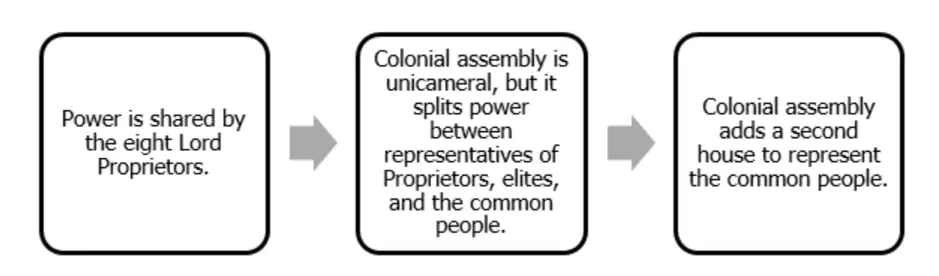
What political trend is evident from this chart?
More and more people were excluded from political participation.
The Lord Proprietors grew more powerful as the colony progressed.
There was an expansion of representation for the average person.
Power was in the hands of a few elites who made all political decisions for the colony.
How did the eight Lord Proprietors persuade more Europeans to settle in South Carolina?
They replaced the practice of indentured servitude with slavery.
They guaranteed that all Christians would be granted the same rights.
They established a way for property owners to share governing duties.
They subsidized large parcels of land for new settlers.
In 1719, after 56 years of being a proprietary colony, South Carolina became a royal colony. How was the colony impacted by this change?
The governor of the colony was appointed by the king.
The colony lost its right to elect representatives to the colonial legislature.
The population of the colony decreased.
The tensions between backcountry farmers and plantation owners lessened.
Why did the colonists want the Carolinas to become a royal colony?
They believed that combining North and South Carolina would strengthen the economy.
They were angry that the Lord Proprietors collected taxes but did not protect the people.
They wanted to return to a government led by a monarch.
They wanted to industrialize the economy of the colony.
Why were there significant differences between white settlers in the Lowcountry and those in the backcountry?
Backcountry settlers blended their cultures with Native American tribes, and Lowcountry settlers followed a strict social hierarchy.
Lowcountry settlers had less representation in the colonial legislature than backcountry settlers.
Backcountry settlers spoke a different language and had a different religious heritage than Lowcountry settlers.
Lowcountry settlers were the elites who lived on the coast, and backcountry settlers were traders and woodsmen.
This time line shows changes to the early colonial government of South Carolina. What event would come next in this time line?
The colonists elected a governor to represent them.
The Lord Proprietors are removed, and the colony becomes a royal colony.
The governor is impeached, and a new one is elected.
The legislature shifts to equal representation in both houses.
Which idea about political power in the colony of South Carolina is true?
The wealthy planters had the most political power despite making up only a small percentage of the population.
Political power was equally divided between the Lowcountry and the backcountry.
The King of England controlled all aspects of the colony and prevented colonists from having any political power.
The political power of backcountry farmers was equal to their percentage of the population.
What was the main reason for the Regulator Movement in South Carolina?
Lowcountry residents had less representation in the colonial government than backcountry farmers.
The colonial courts in the backcountry handed down unfairly harsh sentences for small crimes.
The slave population in the backcountry was higher than the white population.
Backcountry farmers felt they were not represented or protected by the colonial government.
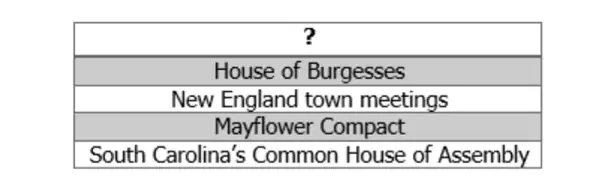
What is the best title for this list?
Governing Bodies Created by Parliament
Start of Self-Government in the British Colonies
Influence of Religious Groups on Colonial Governments
Governments That Allowed Women to Vote
Which individual was most likely to have been a participant in the Regulator Movement?
a Native American who had been forced out of the colony
a slave who had escaped and was trying to leave the colony
a subsistence farmer from the backcountry
a plantation owner from the Lowcountry

Based on the information in this chart, what was most likely the outcome of increased settlement in the backcountry?
decline in the importation and trade of African slaves
shift in political power from the elite to poorer citizens
increased tensions over representation in the government
greater religious diversity in South Carolina
The main difference in a proprietary colony and a royal colony is:
A proprietary colony is ruled by the proprietors and a royal colony is ruled by the king.
A proprietary colony is controlled by the king and a royal colony is controlled by proprietors.
The common people make the laws in a proprietary colony and the king makes the laws in a royal colony.
A proprietary colony only produces manufactured goods while a royal colony only produces raw materials.
How did the creation of townships in colonial South Carolina impact the colony?
It resulted in the establishment of more towns in the low country.
It provided a safe place for Native Americans to live.
It encouraged migration to the back country.
It encouraged African immigrants to come to South Carolina.
Which of the following are results of South Carolina becoming a royal colony? (Choose all that apply.)
Merchants were allowed to sell rice directly to foreign countries.
Townships were established in the back country.
The colonists felt neglected as the king offered little protection.
Plantation owners in the low country grew rich from the sale of rice and indigo.
What helped end the Regulator Movement in the Upcountry?
the passage of the Church Act making the Anglican church the official church of South Carolina
the start of the Yemassee War which caused the colonists to fight the Native Americans rather than each other
the ruling by the governor to allow the French Huguenots citizenship rights including the right to vote
the passage of the Circuit Court Act which established courthouses and sheriff's offices throughout South Carolina
How were colonists able to effectively limit the power of the royal governors?
through violent rebellions whenever they disagreed with the governor
through the 'power of the purse,' meaning the assemblies controlled taxes and the governor's salary
through a bicameral legislature that could overrule the governor's decisions
through freedom of speech and frequent editorials in the newspaper
What is a reason the colonies developed some form of self-government?
The king demanded that all colonists be represented in colonial legislatures.
Government representatives in England were too far away to govern the colonies adequately.
Colonists refused to send goods to England unless they were allowed to vote on laws.
The colonists adopted the government structure used by the Native Americans.
What is one consequence of the Regulator Movement?
It increased tensions between people in the Upcountry and the Lowcountry.
It stopped all crime in the Upcountry of South Carolina.
It served as a model for a police force in the Lowcountry.
It forced the king to replace the governor of South Carolina.
Why did some settlers in the Upcountry of South Carolina start the Regulator Movement?
to control the amount of exports coming into the colony
to provide some law and order in the area
to stop the sale of slaves in South Carolina
to set up schools for people living in the Upcountry
What word best describes the Regulators?
judges
planters
proprietors
vigilantes
Why were South Carolinians in the backcountry angry about the colony's government?
There were fewer people in the backcountry, so they were always outnumbered in elections.
The British government placed strict regulations on the type of government the colonists could set up.
Leadership in the colonial government was based on birthright as it had been in England.
Representation in the government was dominated by wealthy farmers from the Lowcountry.
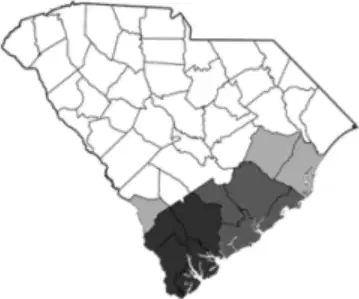
Which statement about the shaded areas of this map is correct?
Wealth and power was concentrated in this area of the colony.
Whites outnumbered Africans in this area of the colony.
Fur trading and timber were the basis of the economy in this area of the colony.
Most new immigrants settled in this area of the colony.

