
 Worksheets
Radioactivity Unit Test remediation
Total questions: 21
Worksheet time: 11mins
Name
Class
Date
1.
All isotopes with an atomic number (number of protons) over 82 are ______________________.
a)
metalloids
b)
radioactive
c)
nonmetals
d)
always stabel
2.
Which of the following statements is TRUE about nuclear fission and nuclear fusion reactions?
a)
Nuclei split during fission and combine during fusion.
b)
Fission forms heavier elements, and fusion forms lighter elements.
c)
Fission generates potential energy, and fusion generates kinetic energy.
d)
Nuclei gain electrons during fission and release electrons during fusion.
3.
If Uranium (U) has an atomic number of 92, then how many neutrons are in the isotope U-238?
a)
92
b)
330
c)
146
d)
238
4.
The process in which an atom loses particles and becomes another element is known as _______________.
a)
fusion
b)
fission
c)
transmutation
d)
chain reaction
5.
Atoms of the same element with different numbers of neutrons are called _________________.
a)
isotopes
b)
metals
c)
metalloids
d)
radioactive elements
6.
Which statement is NOT true about all the isotopes of an element?
a)
They have the same number of protons.
b)
They have different number of neutrons.
c)
They have the same atomic number.
d)
They have the same mass number.
7.
A certain atom has 20 protons, 20 electrons, and 29 neutrons. Its mass number is _______.
a)
20
b)
40
c)
29
d)
49
8.
Thorium-234 has a half life of 24 days. If you started with a 100 gram sample of Thorium-234, how much would remain after 48 days?
a)
50 grams
b)
25 grams
c)
12.5 grams
d)
100 grams
9.
The stability of a nucleus depends on the _____________.
a)
atomic mass
b)
atomic number
c)
proton-neutron ratio
d)
number of neutrons
10.
Which two elements are MOST commonly involved in nuclear fusion reactions?
a)
Hydrogen (H) and Uranium (U)
b)
Helium (He) and Uranium (U)
c)
Hydrogen (H) and Krypton (Kr)
d)
Hydrogen (H) and Helium (He)
11.
Which diagram best represents nuclear fission?
a)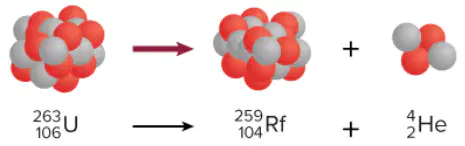
A
b)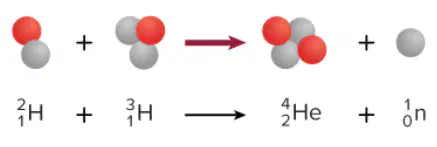
B
c)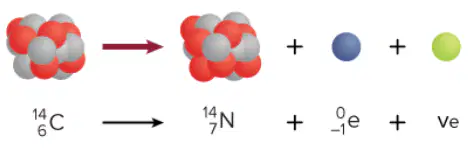
C
d)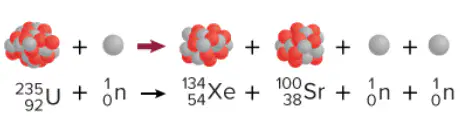
D
12.
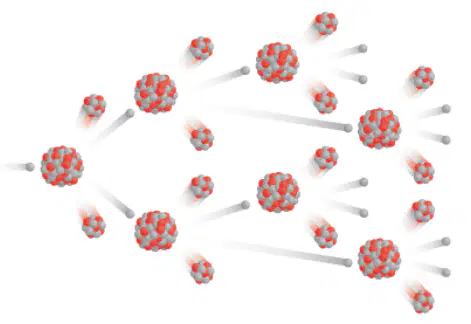
What is shown in the diagram below?
a)
nuclear fusion
b)
nuclear fission
13.
Which process is responsible for the tremendous energy released by the sun?
a)
nuclear fusion
b)
nuclear decay
c)
alpha decay
d)
nuclear fission
14.
What is one DISADVANTAGE of using nuclear fission as an energy source?
a)
It produces a million times more energy per pound than fossil fuels
b)
The waste from the reaction is difficult and expensive to dispose of
c)
It is hard to find compounds to cool down the boiling water
d)
It uses Hydrogen (H) as a fuel
15.
Which of the following statements is TRUE about nuclear fission reaction?
a)
The reaction uses rare Uranium isotopes
b)
The reaction takes place only at very high temperatures.
c)
The reaction releases no energy when nuclei split apart.
d)
The reaction produces radioactive waste.
16.
A sample of francium-212 will decay to 1/16 of its original value after 80 minutes. What is its half-life?
a)
20 minutes
b)
80 minutes
c)
40 minutes
d)
10 minutes
17.
Both fission and fusion reactions __________________.
a)
cause chain reactions
b)
take place at room temperature
c)
use hydrogen as a fuel
d)
produce energy
18.
The half life of Hydrogen-3 is about 12 minutes. You start out with 50 grams of H-3, but only have 12.5 grams left now. How many half lives did H-3 go through?
a)
1
b)
2
c)
3
d)
4
19.

The half-life of Rn-222 is 3 minutes. If you start with 2,000 grams, what number should be in the box labeled “e”?
a)
250 grams
b)
1000 grams
c)
500 grams
d)
125 grams
20.

The half-life of Rn-222 is 3 minutes. If you start with 2,000 grams and now only have 250 grams remaining, what number should be in the box labeled “g”?
a)
4
b)
3
c)
2
d)
1
21.

The half-life of Rn-222 is 3 minutes. If you start with 2,000 grams and now only have 1000 grams remaining, what number should be in the box labeled “c”?
a)
3 minutes
b)
9 minutes
c)
12 minutes
d)
6 minutes
100 %

