
 Worksheets
Cell Movement & Energy Processes Assessment
Total questions: 20
Worksheet time: 10mins
Name
Class
Date
1.
Which substance is released s a waste product during photosynthesis?
a)
Cytoplasm
b)
Glucose
c)
Oxygen
d)
Carbon Dioxide
2.
The green color of tree leaves is due to the green light energy reflected from _______?
a)
Chlorophyll
b)
Carbon Dioxide
c)
Auxins
d)
Gibberellins
3.
Active transport occurs when ______ is used to move substances through a membrane.
a)
Diffusion
b)
Energy
c)
Osmosis
d)
Chlorophyll
4.
Which form of energy is necessary in photosynthesis?
a)
Glycolysis
b)
ATP
c)
Lactic Acid
d)
Light
5.
Respiration is the process in which organisms break down food to release ______.
a)
Nutrients
b)
Sugar
c)
Oxygen
d)
Energy
6.
Materials enter and leave the cell through openings in its ______.
a)
DNA
b)
Membrane
c)
Chromatin
d)
Organelles
7.
Which substance is broken down during glycolysis?
a)
Cytoplasm
b)
Carbon dioxide
c)
Water
d)
Glucose
8.
Photosynthesis is the process in which plants use energy from light to produce ________.
a)
New Cells
b)
Food
c)
Organelles
d)
None of these
9.
Which of the following is NOT involved in cellular respiration or photosynthesis?
a)
Carbon dioxide
b)
Water
c)
Cytokinins
d)
Chlorophyll
10.
The process that releases energy without oxygen is _______.
a)
Respiration
b)
Photosynthesis
c)
Fermentation
d)
Osmosis
11.
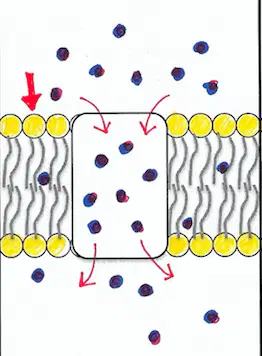
The diagram is an example of _______.
a)
Active transport
b)
Exocytosis
c)
Equilibrium
d)
Osmosis
12.
Photosynthesis occurs at the cellular level. Which organelle is needed for photosynthesis?
a)
Mitochondria
b)
Golgi body
c)
Rough ER
d)
Chloroplast
13.
The passive transport of water through a membrane is __________.
a)
Fermentation
b)
Active transport
c)
Osmosis
d)
Equilibrium
14.
Usually, the largest organelle in a cell is the ________.
a)
Chromatin
b)
Vacuole
c)
Nucleus
d)
Lysosome
15.

The diagram is an example of which process?
a)
Osmosis
b)
Equilibrium
c)
Active transport
d)
Diffusion
16.
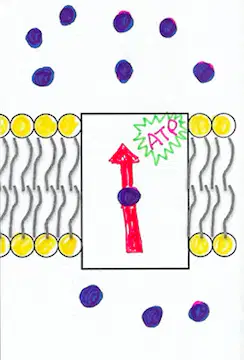
The diagram is an example of which process?
a)
Diffusion
b)
Active transport
c)
Osmosis
d)
Equilibrium
17.
During periods of strenuous activity, muscle cells run low on _________.
a)
Carbon dioxide
b)
Glucose
c)
Oxygen
d)
Lactic acid
18.
What is the main difference between active transport and passive transport?
a)
Passive does NOT use energy and active transport does
b)
Active transport moves in the cell and passive in the cytoplasm
c)
Passive moves large molecules and active forms vesicles
d)
Active moves from high to low and passive from low to high
19.
Substances too large to pass through the cell membrane enter the cell in a process called ______.
a)
Endocytosis
b)
Exocytosis
c)
Passive transport
20.
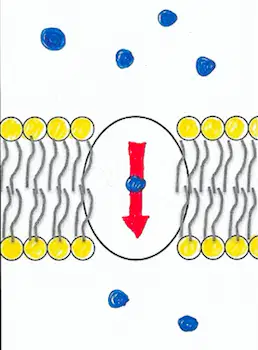
This diagram is an example of which process?
a)
Faciliatated diffusion
b)
Diffusion
c)
Osmosis
d)
Active transport
100 %

