
 Worksheets
Physics Section 1&2 Review Quiz
Total questions: 66
Worksheet time: 2hrs 50mins

When an object is thrown straight up with no air resistance, what is the velocity at the highest point before it falls down?
A. Greater than the initial velocity
B. Lesser than the initial velocity
C Depends on the initial velocity
D. Zero

A car can go from 0m/s to 20m/s in 4.0s. What is the 0m/s in this problem?
vi
vf
a
x
t
A motorcycle went to a full stop with an initial speed of 7.5 m/s in 10 seconds. What was its acceleration?
(a)
A bike was at a speed of 16m/s to 40m/s in 15 seconds. Find the following: acceleration
(a)
If I dropped a couch from a 78m building and it flew for 9 seconds, what is its final velocity? Use a comma to separate answers.
(a)





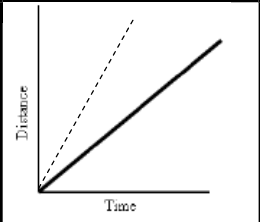



What does the slope of a position-time graph represent?
Distance
Displacement
Velocity
Acceleration

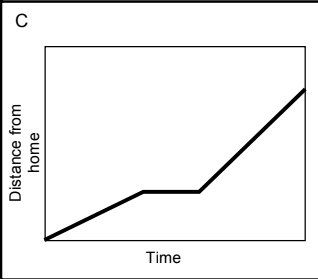
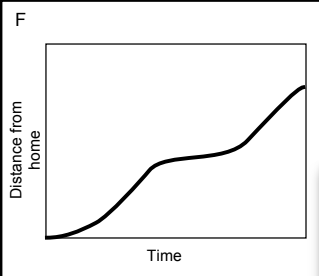
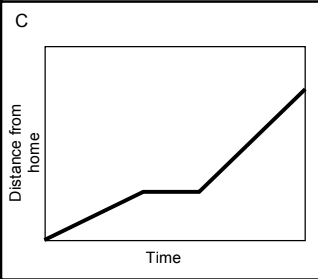
Consider the graph shown below. Which description below is consistent with the graph?
The object moves slowly at a constant speed and then faster at a constant speed.
The object accelerates in the positive direction and then accelerates more rapidly.
The object moves forward, changes direction and then accelerates more rapidly.

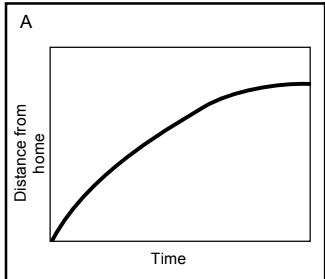
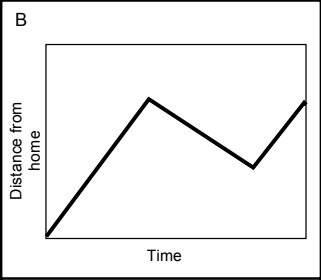
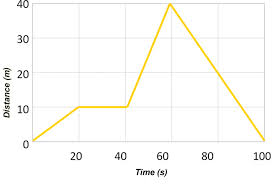
Consider the graph shown below. Which description below is consistent with the graph?
The object accelerates in the positive direction and then in the negative direction.
The object moves upwards, reaches its peak and then falls with an acceleration.
The object moves in the positive direction and then moves in the negative direction.

What is the average velocity of this object? Use slope equation.
+ 0.5 m/s
-0.5 m/s
+ 2 m/s
-2 m/s

Which one of the following graphs describes an object that is moving at a constant speed to the left (- direction)?
a.
b.
c.
d.
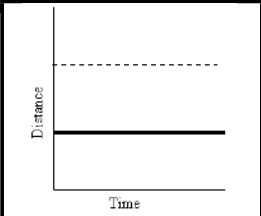
Which one of the following graphs describes an object that is at rest?
a.
b.
c.
d.
Which one of the following graphs describes an object that is moving at a constant speed to the right (+ direction)?
a.
b.
c.
d.

Which one of the following graphs describes an object that is moving to the right and slowing down?
a.
b.
c.
d.
What is the unit for velocity?
m
s
m/s
m/s/s

At 8 s what is the objects position?
2 m
4 m
10 m
20 m


Which line shows the fastest velocity? (choose all that apply)
Line A
Line B
Line C
Line D
None of them

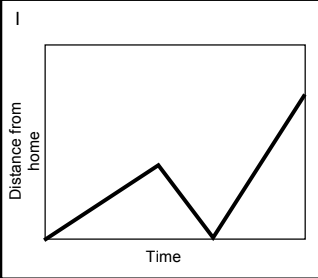
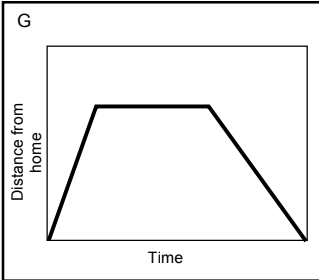
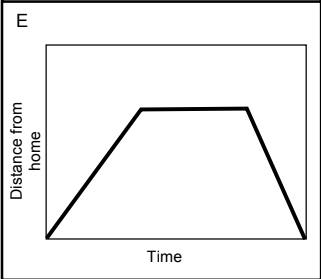
For the graph of the story : a student is walking home from school and stops to talk to a friend. While talking, he realizes that he forgot his bike at school and goes back to get it. He then rides his bike home. Which part matches up with Line segment A?
Walking home from school
Stops to talk to a friend
Goes back to school
Rides his bike home
None of them

Between which time intervals does the object speed up/increase velocity?(velocity moves away from 0 m/s point)
0-10 sec and 40-55 sec
15-30 sec and 40-55 sec
0-10 sec and 30-40 sec
15-30 sec and 30-40 sec
Between which time intervals does the object slow down/decrease velocity?(velocity move towards 0 m/s point)
0-10 sec and 40-55 sec
15-30 sec and 40-55 sec
0-10 sec and 30-40 sec
15-30 sec and 30-40 sec
Match the graph to the description:
"The car is traveling at a constant speed."
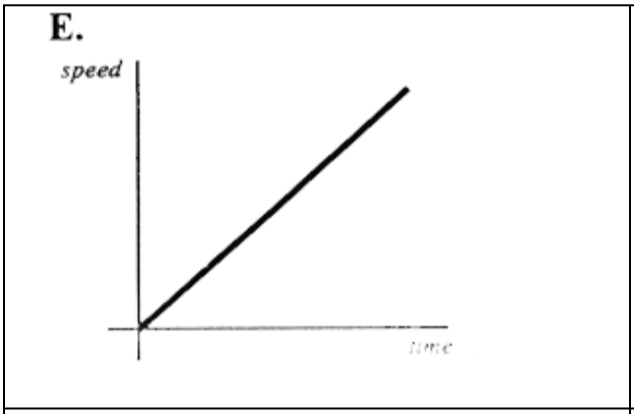
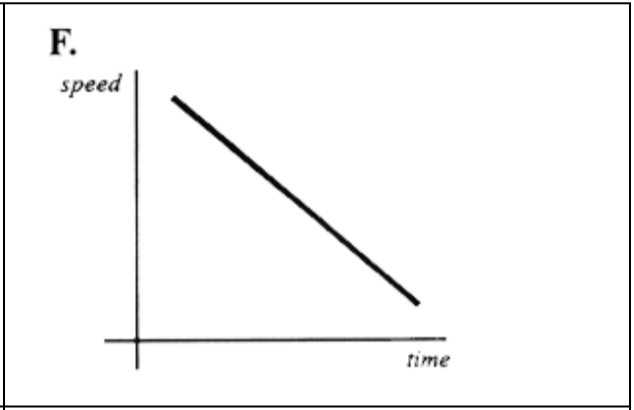
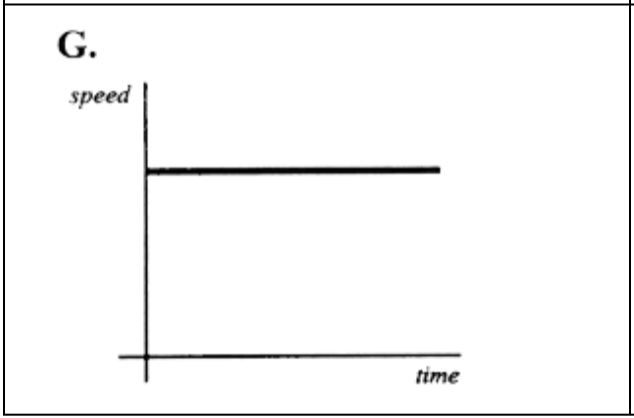
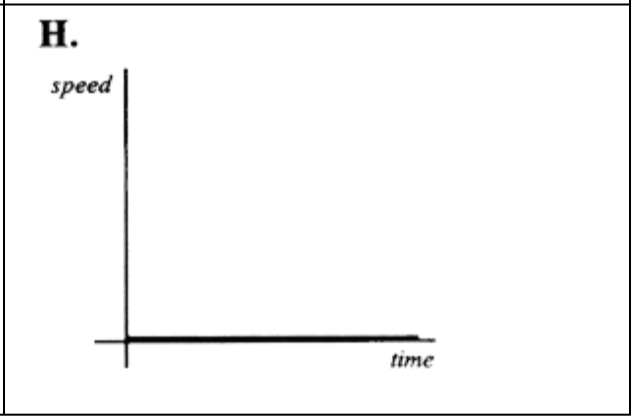
Match the graph to the description:
"The car is slowing down."
If a person is standing still atop a hill, what is the formula for the person's mechanical energy?
Ep = Ek
Em = Ep
Em = Ek
Ek = Em + Ep
What is the formula for mechanical energy?
Ep = Ek + Em
Em = gv + (1/2)hm2
Em = Ek + Ek
Em = (1/2)mv2 + mgh
When is kinetic energy at zero?
A ball speeds downhill at 12m/s
A ball gradually goes uphill at 3m/s
A ball comes to a complete stop at the bottom of the hill
A ball leaves the track flying upward at 2 m/s
If 50N of force is used to push a bow string back 0.1m how much potential energy is stored in the string?
500J
5J
50J
2J
If the work done lifting an 60kg anvil to the top of a tower is 3600J, after being dropped, what is the kinetic energy of the anvil as it hits the ground?
60J
600J
3.6J
3600J
What has more kinetic energy, a 10kg ball moving at 13m/s or a 20kg box moving at 7m/s?
the 10kg ball
the 20kg ball
the 10kg box
the 20kg box
A 5 kg ball is lifted 12 m above the ground. It's gravitational potential energy is
60 J
590 J
17 J
2.4 J

You hold a 5 kg ball from a height of 2 m. How much mechanical energy does it have?
10 J
7 J
98 J
25 J

You drop a 5 kg ball from a height of 2 m. Just before it reaches the ground, what is the ball's velocity?
6.26 m/s
39.2 m/s
4.47 m/s
100 m/s
Energy cannot be created nor destroyed, only transferred from one form to another.
True
False
__________ energy is the energy of motion.
Potential
Kinetic
As the mass of an object increases, its kinetic energy (KE) ________________.
What two factors affect an object's kinetic energy?
area and volume
mass and weight
weight and height
mass and speed
What is the kinetic energy of a 4 kg shotput thrown with a velocity of 13 m/s?
676 J
3.25 J
338 J
What is potential energy?
The energy an object has due to its atomic structure.
The energy an object has due to its position or condition.
The energy an object has due to its chemical composition.
Which object has the most potential energy?
A ball resting on the ground.
A ball being thrown at 100 miles per hour.
A ball resting on the edge of a cliff.
Potential energy depends on the strength of gravity, ________ and ________ of the object.
height and mass
friction and movement
mass and movement
What is the value of the Earth's acceleration due to gravity (g)?
9.8 m/s2
100 m/s2
3.14 m/s2

A football player throws a ball with a mass of 0.34 kg. What is the gravitational
potential energy of the ball when it is 5.0 m above the ground?
17 J
170 J
1.7 J
71J

A 2.0-kg book is on a shelf that is 1.6 m high. What is the gravitational potential
energy of the book relative to the ground?
23J
46J
32J
3.4 J

A 36-kg girl walks to the top of stairs that are 2.0-m high. How much gravitational
potential energy does the girl gain?
560 J
270 J
674 J
720 J

What is the Kinetic Energy of a 150 kg object that is moving with a speed of 15 m/s?
18675J
675J
16875J
18756 J

An object has a kinetic energy of 25 J and a mass of 34 kg , how fast is the object
moving?
1.28 m/s
26 m/s
8.2 m/s
1.82 m/s

An object moving with a speed of 35 m/s and has a kinetic energy of 1500 J, what is the mass of the object.
5. 24 kg
4.25 kg
6 kg
2.45 kg

An object moving with a speed of 67 m/s and has a kinetic energy of 500 J, what is the mass of the object.
22 kg
.22 kg
22.2 kg
10.2 kg

