
Font size
 Worksheets
biology 10A
Total questions: 106
Worksheet time: 53mins
Which statement about atoms is false?
An atom is the building block of matter.
Atoms of different elements have the same number of protons.
An atom has the properties of an element.
An atom consists of smaller subatomic particles.
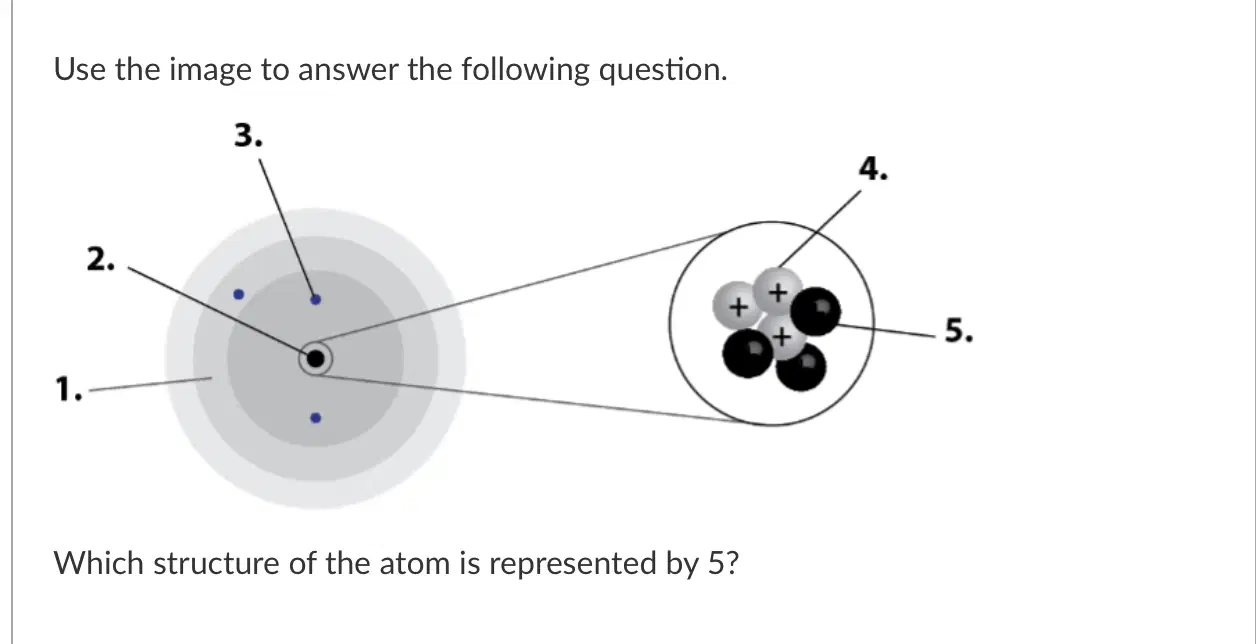
Which structure of the atom is represented by 5?
neutron
proton
nucleus
electron
How do particles with opposite charges interact?
they attract each other
they have no effect on each other
they remain neutral
they repel each other
What is the difference between CO and Co?
CO is an element, cobalt, and Co is a compound, carbon monoxide.
CO and Co are both elements but with different atomic numbers.
CO and Co are the same element with different representations
CO is a compound, carbon monoxide, and Co is and element, cobalt.
Which elements are most commonly found in the chemistry of life?
S,P,O,N,C, and H
S,P,O,N,C, and T
C,H,O, and Cl
S,P,O,Cl,C, and H
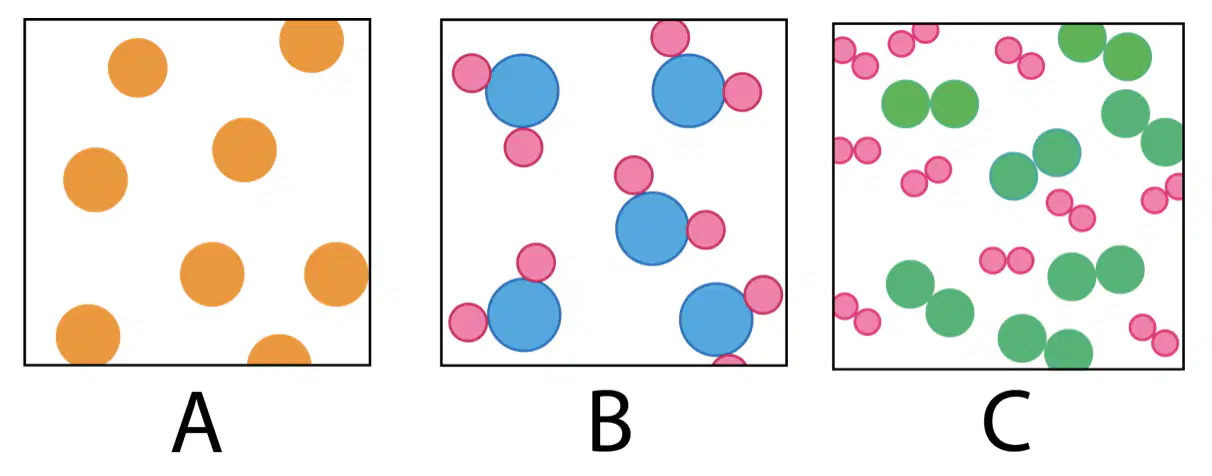
Which model represents a mixture?
A
B
C
B and C
Which of the following is an example of a pure substance?
soil
air
aluminum
saltwater
Which of the following is a compound?
lemonade
helium
gold
water
Which of the following statements about elements is true?
They can be broken down into simpler substances by chemical means.
They consist of only one type of atom.
They are always gases at room temperature.
They always exist in the form of molecules.
Which of the following is a characteristic of a homogeneous mixture?
Its components cannot be easily separated by chemical means.
It has a uniform composition throughout
It has a variable composition.
Its components cannot be easily separated by physical means.
What property of water allows it to dissolve many substances?
surface tension
low density
high specific heat
polarity
What term describes the attraction between water molecules?
adhesion
cohesion
specific heat
surface tension
Three different students talked about what they know about water. Read their thoughts, then choose the best choice below about their thoughts.
Student 1: Water is a polar molecule because it has a partial positive charge on one end and a partial negative charge on the other. This polarity causes water molecules to attract each other through hydrogen bonding.
Student 2: Water is a nonpolar molecule because it is made up of two hydrogen atoms and one oxygen atom, and the electrons are shared equally between the atoms. This lack of polarity means that water does not have any unique properties and behaves like other nonpolar molecules.
Student 3: Water is a unique substance with several distinctive properties. It has a high specific heat, which means that it can absorb a lot of heat energy without changing its temperature much.
Which student is correct?
Student 2 and 3 only
Student 1 and 3 only
Student 1, 2, and 3
Student 1 only
Why does solid water (ice) float on liquid water?
It expands and becomes less dense when it freezes.
It has a higher density than liquid water.
It forms stronger hydrogen bonds than liquid water.
It has a lower specific heat than liquid water.
Why do you smell perfume sooner if you are close to the person wearing it compared to being further away?
The sense of smell is more sensitive up close.
Diffusion is faster at shorter distances.
Perfume molecules move faster in close proximity.
The concentration of perfume is higher closer to the person.
What is diffusion?
the spreading out of substances from high concentration to low concentration
the constant motion of water molecules
the random spreading out of substances from low concentration to high concentration
the movement of molecules throughout living things
What factors can speed up diffusion?
decreasing the temperature, but increasing the concentration and pressure
increasing the temperature, concentration, or pressure
decreasing the temperature, concentration, or pressure
increasing the temperature, but decreasing the concentration and pressure
Which represents the correct depiction of an endothermic reaction?
Reactants + Heat → Products
Reactants → Products + Heat
Products + Heat → Reactants
Reactants + Products → Heat
What is the purpose of the arrow (→) in a chemical equation?
It indicates the direction of the reaction and rearrangement of atoms
It represents the formation of new bonds
It identifies the amount of reactant used.
It shows the rearrangement of atoms and direction of energy.
Which is an example of a catabolic reaction?
the joining of nucleotides in the copying of DNA
making starch from monosaccharides
the breakdown of glucose to release energy
the formation of proteins from amino acids
What is the role of enzymes in biochemical reactions?
They increase the activation energy.
They provide energy to the reaction.
hey slow down the reaction rate.
They speed up the reaction by lowering the activation energy.
Which statement explains why there are millions of carbon compounds?
Carbon can form four bonds.
Carbon atoms form bonds with other carbon atoms.
All statements are true.
Carbon atoms can form single, double, and triple bonds.
What structures make up a nucleotide?
a phosphate group and a nitrogen base
a nitrogen base and a sugar
a sugar and a phosphate group
a sugar, a phosphate group and a nitrogen base
What is a function of proteins?
regulating life processes
making up cell walls
coding genetic information
storing energy
What type of macromolecule includes fats and oils?
lipids
carbohydrates
nucleic acids
proteins
What is the dispersion pattern of herding animals or fish that form schools?
clumped (aggregated)
unpredictable
random
uniform
Which of the following is NOT a standard way that ecologists study populations?
observing populations in a field study
banding or radio collars
avoiding computer simulations because you can’t trust them
using a controlled environment

How would an ecologist describe the distribution of all the trees in this diagram of a forest?
clumped, because they are close together and evenly spaced
random because there is no pattern in the distribution
uniform because they are all perfectly and evenly spaced out
aggregated, because they are close together and clumped
What term describes the geographic distribution of individuals in a population?
range
distribution
density
limiting factor
A ______ is any environmental factor that depends on population size.
growth factor
density-independent factor
climate factor
density-dependent factor
Which of the following is a density-dependent limiting factor?
disease
flood
death of all the trees
volcanic eruption
The ecologist’s reports got mixed up. Help them sort the reports. Here are the 3 reports:
Report 1: Sickness is spreading quickly in the rabbit warren where the rabbits are close together.
Report 2: There are a large number of red-tailed hawks competing for the same rabbit population.
Report 3: A mild winter allowed for some plants to grow that normally are destroyed by freezing temperatures and allowed the rabbit population to thrive.
Which report describes density-independent limiting factors?
Reports 1 and 2
Report 2
Report 1
Report 3
What type of population growth happens when there are few limiting factors?
zero growth
logistic growth
population crash
exponential growth

What type of growth does this graph illustrate?
lag phase
exponential growth
logistic growth
linear growth
How does the logistic model of population growth differ from the exponential model?
the graph of the exponential model is S-shaped.
The logistic model considers the environment's carrying capacity.
The exponential model shows a restricted growth rate.
The graph of the logistic model has a longer lag phase.
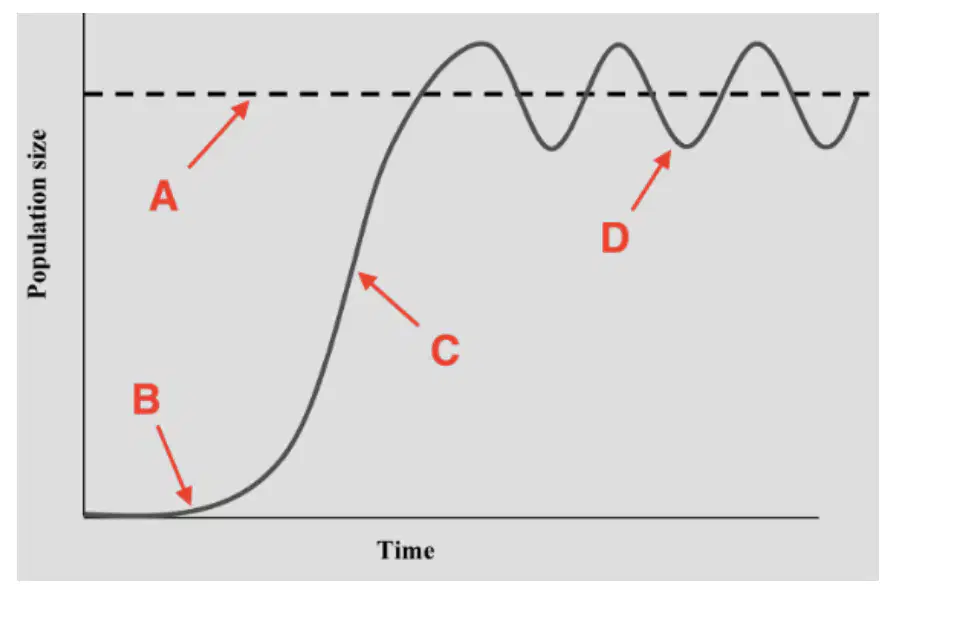
Which letter represents the carrying capacity of the habitat?
D
B
A
C
What are two factors that can cause a decrease in population size?
death and emigration
birth and emigration
death and immigration
birth and immigration
Which of the following lists only r-strategists?
spider, gorilla, locust
mouse, human, spider
mouse, locust, spider
human, whale, gorilla
Which characteristic is typical of a K-strategist?
short life span
generally a small organism
lengthy parental care
produces many offspring
Which survivorship curve is commonly observed in species that produce numerous offspring but have low survivorship among individuals?
Type IV
Type II
Type I
Type III
Which event is correlated with the beginning of growth in the human population size?
the invention of agriculture
the bubonic plague epidemic
the end of the Second World War
the start of the Industrial Revolution
Which statement is true?
Industrially developed countries generally have high population growth rates.
The human population has had a pattern of logistic growth.
Livestock population sizes are growing worldwide.
Wildlife populations are stable.
Which change describes a demographic transition?
a population moves from a low birthrate and death rate to a low birthrate and high death rate
a population moves from a high birthrate and death rate to a low birthrate and low death rate
a population moves from a high birthrate and death rate to a high birthrate and low death rate
a population moves from a high birthrate and low death rate to a low birthrate and death rate
What is likely to be true of a population with an age structure that is pyramid shaped?
It is expected to grow in the future
There are fewer younger people than older people.
It is expected to decline in population size over time.
This age structure is characteristic of zero population growth.
What specific type of biodiversity is shown in the variation of fur color in cats?
ecosystem
genetic
extinction
species
Which of the following is NOT a benefit of biodiversity?
increases the stability of an ecosystem
provides direct economic value
decreases stability during changing environmental conditions
offers beautiful landscapes to view
How does habitat loss affect biodiversity?
It improves the overall health and resilience of ecosystems.
It leads to the fragmentation of ecosystems.
It has no significant impact on species populations.
It increases species diversity.
What is an advantage of habitat corridors?
Corridors increase the fragmentation of a habitat
Diseases can pass easily through a corridor.
Populations can move safely from one area to another.
There is no advantage to a habitat corridor.
All of the following help conserve biodiversity except
protecting biodiversity hot spots
creating protected parks and reserves
using fossil fuels
sustainable production
About half of all animals and plants are found in hot spots. What is a biodiversity hotspot?
places with low biodiversity
places with many habitat corridors
places where there are many endemic species
places that have very warm climates
What type of organism obtains energy directly from the sun?
heterotrophs
carnivores
autotrophs
herbivores
Which of the following is a characteristic of heterotrophs?
They are photosynthetic
They rely on other organisms for food.
They obtain energy from the Sun.
They produce their own food
Which of the following is a consumer (heterotroph)?
producers
chemosynthetic organisms
photosynthetic organisms
detritivores

According to the food chain, which organism is a herbivore?
flower
snake
frog
fly
Which are examples of producers?
plants and photosynthetic insects
lions, bears, and eagles
mice, rabbits, and deer
plants, algae, and cyanobacteria
Which best describes omnivores?
eat only animals
eat only plants
eat or break down dead things
eat both plants and animals
The passage of energy from an energy source to a producer to an herbivore and then to a carnivore occurs in which of the following?
It occurs only in a food web
It occurs in both a food chain and a food web.
It occurs in nutrient cycles and food chains.
It occurs in only a food chain.
Which describes the possible flow of energy in an ecosystem?
caterpillars to trees to frogs to snakes
trees to frogs to snakes to caterpillars
trees to caterpillars to frogs to snakes
snakes to frogs to caterpillars to trees
What is biology?
the study of human beings
the empirical study of all living things in the natural world
the same thing as science
the empirical study of the natural world
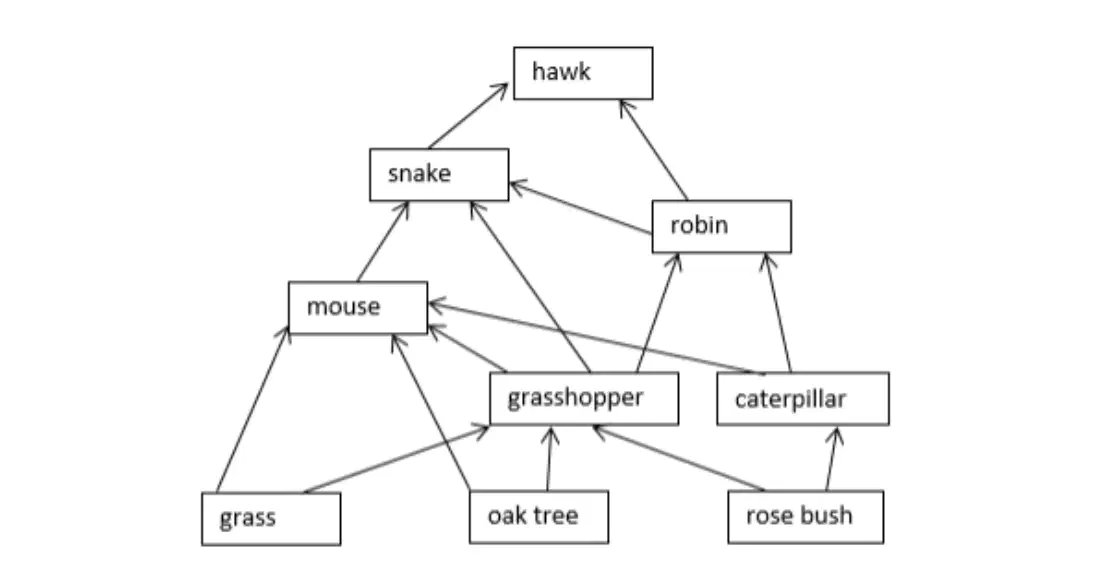
According to the food web, what would happen if the robins were removed from this ecosystem?
The hawks will not be impacted.
The snake population would decrease.
All of the snakes would die.
The mice would have less food to eat.
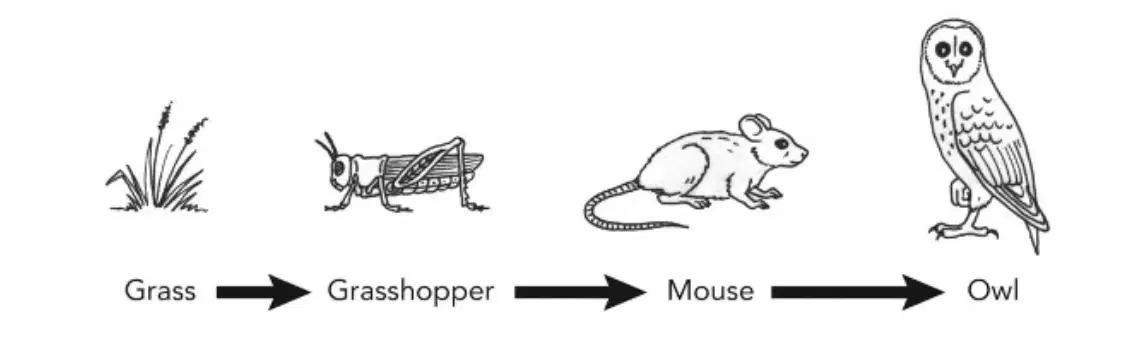
According to the food chain, which organism is affected the most by biomagnification?
grasshopper
mouse
grass
owl

Suppose the rose bush had an extremely productive year. According to the food web above, how would this impact the mice?
The mice will begin to eat more of the rose bush.
The mice will not be affected by the change in the rose bush population.
The mice would have more food because there will be more caterpillars and grasshoppers.
The mice will have less food because there will be fewer caterpillars and grasshoppers.
What is the characteristic of apex predators?
They are found only in Australia.
They are small in size.
They eat several types of prey
They are herbivores
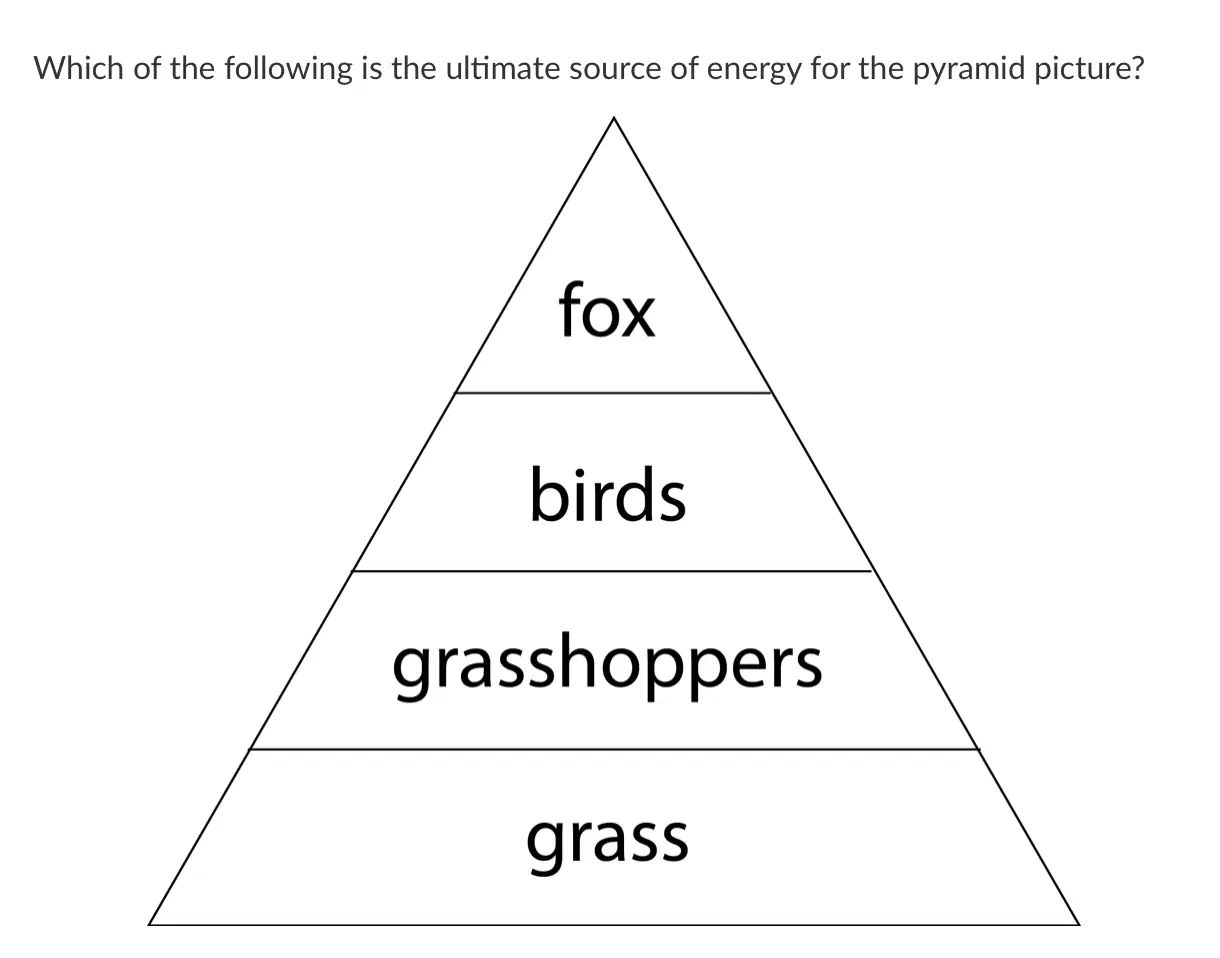
sunlight
water
grass
heat
Which part of the food web contains the greatest amount of biomass?
primary consumers
tertiary consumers
producers
secondary consumers
Which statement best describes a trophic level?
A trophic level is the feeding position of an organism in a food chain or web.
A trophic level is the feeding role of an organism in an ecosystem.
A trophic level is the position of an organism in an ecosystem.
A trophic level is the niche of an organism in an ecosystem.
Why are there more producers than consumers in an energy pyramid?
There is less energy available at higher trophic levels because 10% of the energy is consumed by cellular processes or lost to the environment as heat.
There is more energy available to higher trophic levels because 10% of the energy is consumed by cellular processes or lost to the environment as heat.
There is more energy available at higher trophic levels because most of the energy is consumed by cellular processes or lost to the environment as heat.
There is less energy available at higher trophic levels because most of the energy is consumed by cellular processes or lost to the environment as heat.
Which of these is NOT a branch of biology?
astronomy
ecology
anatomy
botany

4000 kJ
400 kJ
impossible to tell
40 kJ
Which trophic level is usually represented outside the energy pyramid?
decomposers
tertiary consumers
secondary consumers
apex predators
In the carbon cycle, which process removes carbon dioxide from the atmosphere and produces oxygen?
combustion
transpiration
cellular respiration
photosynthesis
What is the term used to describe all the places on Earth where water is found?
lithosphere
biosphere
atmosphere
hydrosphere
What happens when minerals such as fossil fuels are removed from carbon sinks by burning them?
The carbon cycle is balanced.
Oxygen is released into the atmosphere.
The carbon cycle is unbalanced
Carbon dioxide is removed from the atmosphere
Why is nitrogen important to living things?
Nitrogen is found in proteins and nucleic acids.
All organisms breathe in nitrogen.
Nitrogen is necessary for photosynthesis.
Nitrogen is a part of the water cycle.
Which of the following is the best carbon sink?
factories and power plants
cars and trucks
rivers and lakes
trees and other vegetation
Which process describes nitrogen fixation?
animals eat plants containing nitrogen and return it to the soil through urination
bacteria take nitrogen from the air and convert it to a form usable by plants
organisms die and are decomposed into ammonia in the soil
plants take nitrogen from the air and store it in their roots
Which of the following is a human activity that contributes to the increase of nitrogen in the environment?
carbon sequestration
deforestation
use of nitrogen fertilizers
urbanization
Which statement is false about biology?
Botany, virology, and ecology are branches of biology.
The study of life involves learning about the natural world.
Physics, chemistry, and earth science help us understand biology better.
Philosophy is a branch of biology.
Which of the following correctly pairs the branch of life science with what is studied?
microbiology: animals
zoology: plants
botany: microscopic living things
anatomy: parts of living things
Which of the following sequences represents the hierarchy of biological organization from the most complex to the least complex level?
biosphere, ecosystem, community, population, organism
organism, community, biosphere, molecule, tissue, organ
organelle, tissue, biosphere, ecosystem, population
organ, organism, tissue, organelle, molecule
What is the processing of energy in an organism called?
homeostasis
hierarchy of life
adaptation
metabolism
Which of the following is a biotic factor?
air temperature
soil type
amount of sunlight
number of predators
The Cedar Creek Trail System is 36 miles of dirt hiking trail east of Columbia, MO. The trail traverses between deciduous oak-hickory forests and tall grass prairie lands. Some of the trail is gravel roads that are traveled by motorized vehicles. The summers are hot and the winters are cold. What are the abiotic factors of this habitat?
oak- hickory trees, prairie grass, organisms
gravel, hot and cold, motorized vehicles
dirt, oak-hikotry trees, prairie grass
grass prairie land, hiking trail, hot summers
What is the difference between an abiotic factor and a biotic factor?
An abiotic factor can be a limited resource, but a biotic factor cannot be limited.
An abiotic factor is living and a biotic factor is not living.
An abiotic factor is not living and a biotic factor is living.
A biotic factor can be a limited resource, but an abiotic factor cannot be limited.
Which of the following describes a community?
all of the squirrels in a forest
one individual whale in the ocean
all the grass, mice, and birds in a prairie
all the plants, insects, and soil in the rainforest
What is a biological community and all its nonliving components?
biome
community
ecosystem
population
Which choice shows levels of organization in ecology from smallest to largest?
population → ecosystem → community
ecosystem → biome → biosphere
individual → community → population
population → community → ecosystem
What is the definition of a resource in an ecosystem?
anything in an ecosystem that can be replenished within a short period of time
anything in an ecosystem that is sustainable and renewable
anything in an ecosystem that can be used for human purposes
anything in an ecosystem that is nonliving
Which of the following examples represents an ecosystem that is NOT sustainable?
A constant population of mice over many years.
Forest fires occurring at regular intervals in prairie grasslands.
Stream water flow following predictable changes.
Positive feedback loops resulting from industrialization and carbon dioxide emissions.
Which is an example of a nonrenewable resource?
sunlight
trees
soil
fish
What is said about a resource that is able to return to the setpoint over and over so that it can be continuously used?
It is in a positive feedback loop.
It is sustainable.
It is nonrenewable.
It is a resource.
Which statement is true?
All niches are broad, so organisms can always go to a new habitat if theirs is destroyed.
Some niches are broad, some are very narrow.
All niches are narrow, pandas only eat one thing, like most animals.
Narrow niches are always formed when different species gain access to plentiful nutrition.
Use the following passage to answer the question.
Cichlid fish are a type of fish commonly found in warm waters across the globe. They make up nearly 10% of all bony fish species. To avoid being eaten by larger fish, cichlid fish inhabit rocky areas. They have adapted to exploit various rocky shores in warm regions and have a diverse diet consisting of 14 different types of food. Cichlids are also able to coexist with similar fish.
The Venus flytrap is a plant that catches spiders and insects to help it get nutrients. It requires a very specific type of soil and a certain amount of sunlight. It depends on its forest being burned naturally on a regular basis.
Which organisms are most likely listed as “threatened” by the U.S. Endangered Species list and why?
The chiclids fish because they are generalist.
The Venus flytrap because they are generalist.
The cichlids fish because they are specialist.
The Venus flytrap because they are specialist.
What is the primary difference between a habitat and a niche?
A habitat refers to the physical environment, while a niche refers to the biological interactions.
A habitat describes the the physical location while a nice describes the specific role of an organism.
A habitat refers to the abiotic factors, while a niche refers to the biotic factors in an ecosystem.
A habitat is unique to each organism, while a niche is shared by multiple species.
How does competition for resources contribute to the process of evolution?
It ensures a balance between predator and prey populations in an ecosystem.
It restricts the growth and diversity of a population over time
It promotes cooperation and collaboration among different species.
It leads to the development of specialized adaptations through natural selection.
Different birds living in the same ecosystem have evolved different types of beaks, allowing them to feed on different things. What best describes the reason for this phenomenon?
mutualism
keystone species
predator-prey relationship
competitive exclusion principle
Which is an example of a predator-prey relationship?
The relationship between a mouse and field of grass
The relationship between two lions.
The relationship between a hummingbird and a flower.
The relationship between a fox and a rabbit.
In the past, pacific sea otters were hunted to near extinction. Without the otters, kelp forests along the coast started to die because sea urchins, the otter's favorite food, could overgraze them. Once otters became protected, the kelp forests began to recover as the urchins were back in check. Which term best describes sea otters?
prey
specialists
keystone species
parasites
Which statement is true?
Mimicry and camouflage are the same adaptation
Mimicry is used only by predators, and camouflage is used only by prey.
Mimicry is an adaptation that makes it harder for an organism to be seen in their habitat while camouflage is an adaptation that makes an organism look like something else.
Mimicry is an adaptation that makes an organism look like something else. Camouflage is an adaptation that makes an organism harder to be seen in their habitat.
What is a symbiotic relationship in which one organism benefits and the other is unaffected?
mutualism
commensalism
parasitism
competition
You find some mites living on your pet gerbil. The mites are taking nutrients away from the gerbil making the gerbil ill. What type of symbiotic relationship is described here?
mutualism
predation
parasitism
commensalism
A type of bird is known to clean the teeth of alligators. The relationship provides the bird with food, removing parasites and other harmful organisms from the alligator's teeth. What type of symbiotic relationship is described here?
parasitism
predation
commensalism
mutualism
Which of the following is a negative feedback mechanism in maintaining Earth's temperature?
Increased greenhouse gas emissions leading to a rise in global temperatures.
The absorption of carbon dioxide by trees and the ocean.
Ice melt causing a reduction in the reflection of sunlight and further warming.
Deforestation and the release of carbon dioxide into the atmosphere.
What is the difference between global warming and climate change?
Global warming is caused by greenhouse gases, while climate change is influenced by natural processes.
Global warming is the increase in global temperatures, while climate change includes broader long-term changes in temperature and precipitation patterns.
Global warming refers to natural temperature fluctuations, while climate change relates to human-induced variations.
Global warming is the long-term patterns of temperature and precipitation, while climate change refers to the rise in global temperatures.
What is one of the effects of climate change on biomes?
stable weather patterns with no impact on ecosystems
coastal erosion due to higher sea levels
loss of biodiversity as some species go extinct and others compete for resources
increased biodiversity due to species adaptation.
Which statement is false about the greenhouse effect?
It occurs when gases in the atmosphere reflect the sun’s heat back down to Earth’s surface.
The burning of fossil fuels increase the greenhouse effect.
The increase in the greenhouse effect has led to global warming.
Increased carbon dioxided in the atmosphere decreases the greenhouse effect.

