
Font size
 Worksheets
Author's Purpose/Central Idea/Features/Structures/Punctuation
Total questions: 37
Worksheet time: 21mins
The CENTRAL IDEA of a nonfiction text needs to always be supported with..
The reader's opinion
Supporting Details
Concluding sentences
unreliable authors
What is essential for a nonfiction text to maintain its credibility?
Fictional elements
Accurate data
Personal anecdotes
Unverified sources
Which of the following is NOT a characteristic of a strong central idea in nonfiction?
Clear and concise
Supported by evidence
Based on assumptions
Relevant to the topic
In nonfiction writing, what role do supporting details play?
They distract the reader
They provide evidence
They introduce new topics
They conclude the text
What is a topic?
The writer's opinion about the text.
The retelling of a story.
The supporting detail.
The general subject of a text.

A
B
C
D

A
B
C
D
What is another word for SUPPORTING DETAILS used to
identify the CENTRAL IDEA of a text?
Conflict
Text Evidence
Topic
Text Features
What text features can give you a clue of what the main idea is?
Title
Headings
Pictures
All of these.

The part that tells you the name of the book or article is called?
Copyright
Call Number (book's address)
Title

A visual that focuses on the topic within the text is called?
Photo or Image
Caption
Heading

Words below or besides the image that explains how the image is connected to the text are called?
Headings
Captions
Paragraphs

A list of vocabulary words found in the text in ABC order with their definitions in the back of the book is called?
Glossary
Table of Contents
Index

A list at the beginning of the book that demonstrates how the book is organized with chapter titles and page numbers is called?
Headings
Index
Table of Contents

What is a mini-title within the page that labels a specific section of the text to help organize is called?
Headings
Titles
Captions

Print that is thicker than the rest of the text because of it being important is called?
Headings
Bold Print
Titles
What is the purpose of using a colon in a sentence?
To introduce a list, an explanation, or a quotation.
To show emphasis
To indicate possession
To separate two independent clauses
In the sentence 'She had three favorite colors: blue, green, and purple.', where is the colon used?
After the phrase 'favorite colors'
After the word 'blue'
After the word 'colors'
After the word 'three'
Which of the following sentences uses commas correctly in a series?
d) The car is red fast, and expensive.
b) The car is red fast and expensive.
a) The car is red, fast and expensive.
c) The car is red, fast, and expensive.
Which of the following dates is correctly punctuated with commas?
May, 5, 2022
May 5, 2022
May 5 2022
What are the functions of a comma? (Select all that apply)
separates lists of items
can go at the end of a sentence
separates elements of a sentence
separates date
Why would an author use a Rhetorical Question? Select all that apply
Spark curiousity
Make a point
Consider a new perspective
To make the reader consider a new perspective
All of the above
Why would a writer use the dash (-)?
Mark interruptions
Act like a semi-colon
Act like a colon
Act like a parenthesis
Which of the following is NOT an example of a nonfiction text structure?
problem & solution
compare & contrast
narrative
sequence
This type of text structure uses signal words like "first," "after," and "finally."
problem & solution
compare & contrast
cause & effect
sequence
This type of text structure uses signal words like "alike," "unlike," and "as opposed to."
compare & contrast
problem & solution
cause & effect
sequence
You might use a Venn Diagram to analyze this type of text structure.
cause & effect
sequence
compare & contrast
problem & solution
A recipe or instruction manual would best represent which text structure type?
problem & solution
compare & contrast
cause & effect
sequence
"When water is heated, the molecules move quickly, thus, causing the water to boil." This is an example of which text structure type?
problem & solution
compare & contrast
cause & effect
sequence
A news segment features a city-wide donation to the food shelf to combat local poverty and hunger. This is an example of which text structure type?
problem & solution
cause & effect
compare & contrast
sequence
This type of text structure uses signal words like "issue," "idea," and "as a result of."
compare & contrast
problem & solution
sequence
cause & effect

Punctuation is a part of syntax (sentence structure).
True
False

What is diction?
The author's choice of words in a piece of text.
The arrangement of words/phrases to create well-formed sentences.
A question not meant to be answered.
The way the author organizes information in a text.

What is the denotation of a word?
The dictionary definition of a word
The feelings/emotions associated with a word
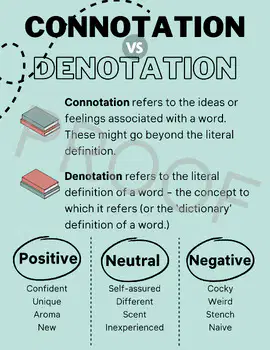
What is the connotation of a word?
The dictionary definition of a word
The feelings/emotions associated with a word

Words can have a __________ connotative feeling to them.
Positive
Neutral
Negative
All of these

Which of the following is a function for a rhetorical question? Select ALL that apply.
To emphasize or clarify a point the author is trying to make
To introduce a new topic/idea
To encourage readers to consider a new perspective on a topic/idea
To separate the elements of a sentence

