
 Worksheets
Reviewing for EOU 1
Total questions: 25
Worksheet time: 19mins

Structure A is ....
nucleus
cell membrane
cytoplasm
mitochondria
ribosome
Structure B is ....
permanent vacuole
cell wall
chloroplast
cell membrane
Structure H is responsible for:
storing water and waste
cell respiration
photosynthesis
directing the making of proteins

Substances move into and out of the cell across my phospholipid bilayer. What part of the cell am I?
cell wall
nucleus
cell membrane
skin

Which organelle is similar to a post office, receiving, modifying, and packaging up molecules for shipment?
nucleus
ER
mitochondria
Golgi
Which of the following is the primary function of ribosomes, and where can they be found?
where proteins are made; rough ER and free-floating in cytoplasm
where lipids are made; rough ER and free-floating in cytoplasm
where proteins are made; smooth ER
where lipids are made; smooth ER
Which of the following is FALSE regarding a nucleus?
has a membrane
where energy is generated
where DNA is stored
protects the 'blueprint' for making proteins
Which organelle is where energy from food is converted into ATP?
Nucleus
Ribosome
Mitochondria
Golgi apparatus
Which of the following structures is responsible for maintaining the shape and structure of a plant cell?
Cell membrane
Cytoplasm
Cell wall
Lysosome
Match the 4 descriptions or examples of the 4 biological molecules (carbon-based compounds) we discussed in Unit 1.
cells like to use these for energy
glucose
cellulose
can be structural; example: some make up the cell walls or organisms
fats
long-term energy storage
a specific type of this molecule forms a bilayer to make up cell membranes
a certain kind can be unsaturated or saturated
these molecules make up AND do the majority of the work in a cell
insulin is an example
their shapes dictate their functions
some act as enzymes
DNA and RNA
ATP is also this type of molecule and the ONLY direct source of energy cells can use
subunits are called nucleotides
subunits are called amino acids
subunits are called monosaccharides
Prokaryotic means before the:
(a)
Match the descriptions or examples of organisms with the correct type of cell:
DNA is free floating
bacteria
lack many membrane-bound organelles
true nucleus
all protists, fungi, plants and animals are made up of these types of cells
have many specialized organelles like the ER, Golgi, mitochondria, vacuoles, etc.
A scientist is comparing ribosomes in a prokaryotic cell and a eukaryotic cell.
What would be true for ribosomes in a eukaryotic cell but not a prokaryotic cell?
Proteins are assembled on ribosomes.
Some of the ribosomes are attached to the cell membrane.
Some of the ribosomes are located on the endoplasmic reticulum.
All of the ribosomes are distributed evenly throughout the cytoplasm.
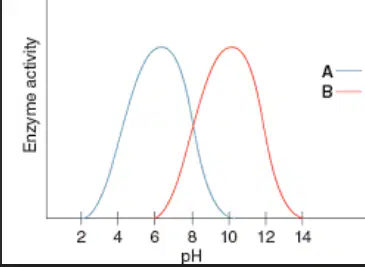
What is the optimum (best) pH for Enzyme A?
2
6
10
12
When comparing plant cells to animal cells, which of the following organelles would you expect to find in BOTH?
mitochondria
central vacuole
chloroplast
cell wall
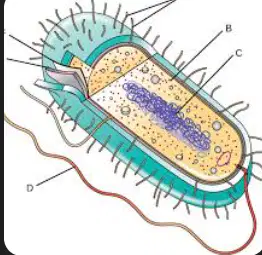
This diagram represents a _____________ cell because _______________.
eukaryotic; I see a nucleus
prokaryotic; there is no nucleus
plant cell; I see a cell wall
animal cell; I see a cell membrane
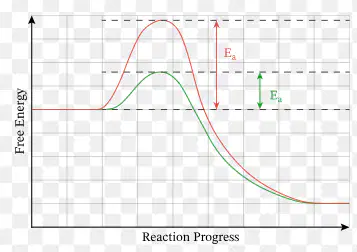
The red line in this diagram represents:
a chemical reaction facilitated by an enzyme since it required more activation energy
a chemical reaction NOT facilitated by an enzyme since the reaction required more activation energy


Drag and drop the labels to the appropriate place on the diagram. You will not use all of the labels.
What is the role of enzymes in a cell?
slow down chemical reactions so they do not get out of control
speed up chemical reactions by lowering the activation energy required for the reaction to start
speed up chemical reactions by raising the activation energy required for the reaction to start
slow down chemical reactions by lowering the activation energy required for the reaction to start
The Cell Theory stated ALL of the following EXCEPT:
Cells are the basic units of structure and function.
All living things are made of 1 or more cells.
Cells can only arise from preexisting cells.
Cells can spontaneously arise from non-living matter.
Which of the following cell organelles transports molecules around the cell (for example, from the ER to the Golgi)?
vacuoles
vesicles
lysosomes
nucleus
What happens when an enzyme is placed outside it's normal environment (where conditions for it to function are ideal)?
It continues to function normally
It functions better
It's function slows or stops

