
 Worksheets
Quarterly 1 Review
Total questions: 13
Worksheet time: 18mins
Which statement describes separation of powers?
Civil servants are not subject to political pressure.
Presidential power is not subject to congressional oversight.
Civilian authorities have control over the branches of the military.
Political authority is divided among the branches of the government.
According to the excerpt, which problem did the Articles of Confederation create?
Plan of Policy for improving the Advantages and perpetuating the Union of the American States. In the first place, there must be a supreme power at the head of the union, vested with authority to make laws that respect the states in general and to compel obedience to these laws. Such a power must exist in every society or no man is safe
a lack of checks on legislative powers
a lack of powers given to state legislatures
the lack of authority to enforce congressional acts
the lack of authority to apportion congressional districts
Which statement describes the intent of checks and balances?
The government receives revenue from the people.
The government receives authority from the people.
No branch of government can become too powerful.
No branch of government can apply concurrent powers.
The excerpt below is from the Declaration of Rights and Grievances of the First Continental Congress on October 14, 1774. ". . . the British parliament, claiming a power of right to bind the people of America by statutes in all cases . . . imposed taxes on them . . . To these grievous acts and measures, Americans cannot submit . . . we have for the present, only resolved to pursue the following peaceable measures: 1) To enter into a non-importation, non-consumption, and non-exportation agreement or association." How did King George III respond to the action described in the excerpt?
He approved the colonists’ decision to use a trade boycott.
He supported the election of colonial representatives to Parliament.
He ignored the colonists’ demands for change in government policy.
He repealed the law declaring Parliament could pass laws for the colonies.
What was the significance of Thomas Paine’s pamphlet Common Sense?
It was a published document outlining personal rights in Great Britain.
It was an influential work calling for independence from Great Britain.
It was a popular almanac instructing colonial farmers.
It was a written framework of colonial government.
The timeline below details a series of events that occurred in the American colonies.
In 1770 British soldiers fire on a crowd of colonists protesting the soldiers’ presence in Boston.
In 1773Colonists protest the Tea Act by dumping tea into Boston Harbor.
In 1775 Shots are fired between the British army and the colonists at Lexington and Concord in the colony of Massachusetts.
Based on this timeline, which conclusion can be drawn about English policies for colonial rule?
English policies attempted to provoke the colonists into a war against the king.
English policies compelled the colonists to acknowledge the sovereignty of the king.
English policies were unable to address the economic downturn experienced by the colonies
English policies were unable to peacefully resolve the growing political tensions in the colonies.
Which document was an agreement by early American settlers that provided for self-government?
The U.S. Constitution
The Mayflower Compact
The Articles of Confederation
The Declaration of Independence
The excerpt below is from Article II of the U.S. Constitution.
The President, Vice President and all civil Officers of the United States, shall be removed from Office on Impeachment for, and Conviction of, Treason, Bribery, or other high Crimes and Misdemeanors.
How has the excerpt affected society in the United States?
No one is outside the law.
No one is without legal representation.
Everyone is subject to a grand jury indictment.
Everyone is guaranteed equal representation in government.
The actions described below are from the Declaration of Independence.
He has called together legislative bodies at places unusual, uncomfortable, and distant . . . He has dissolved Representative Houses repeatedly . . .
How did these actions affect the colonists?
Colonists were unable to pay their taxes
Colonists were unable to petition the king.
Colonists were unable to participate in their government.
Colonists were unable to play a part in community service.
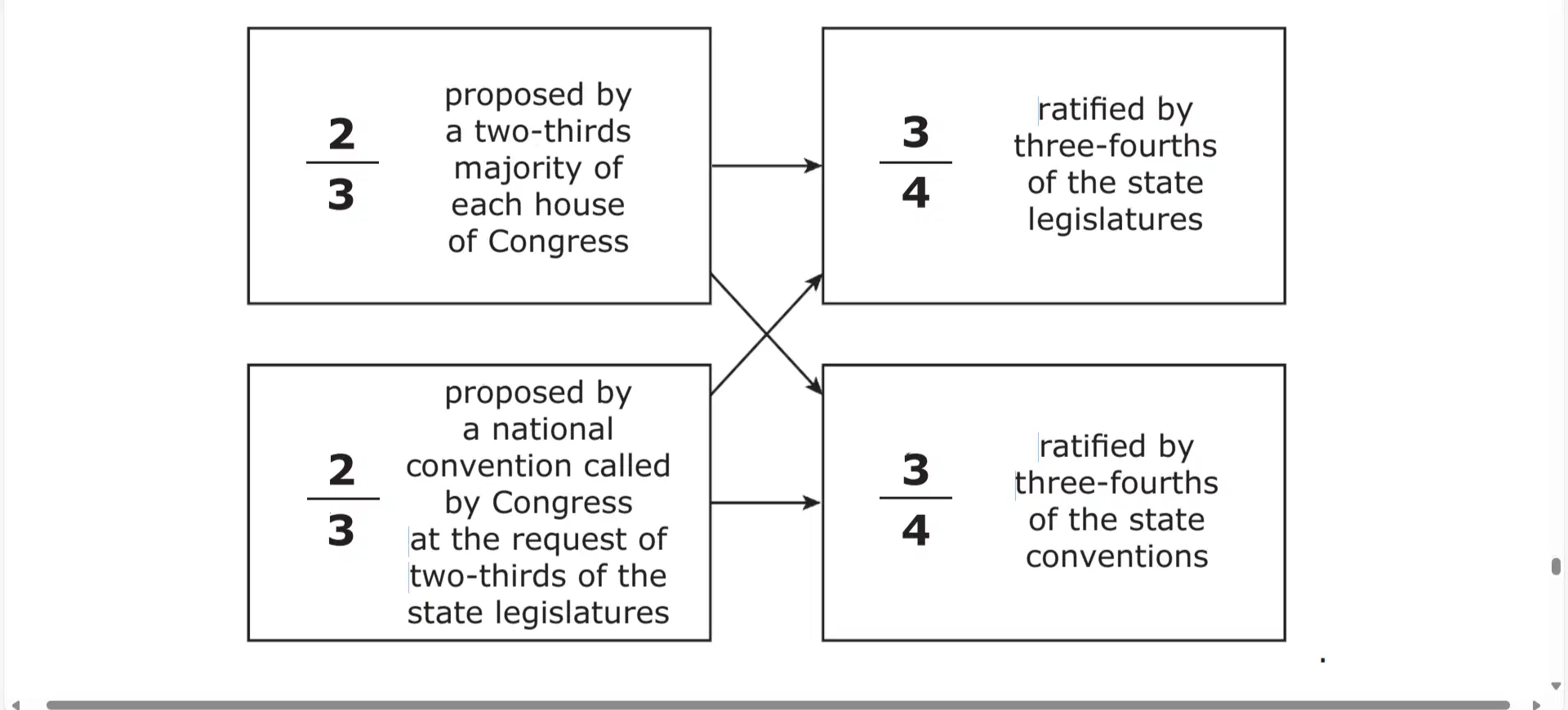
The diagram illustrates a process outlined in the U.S. Constitution.
Which title describes this process?
The Amendment Process
The Nomination Process
The Lawmaking Process
The Appellate Process
During the ratification process, which complaint did the Anti-Federalists have with the U.S. Constitution?
It failed to protect individual rights.
It failed to recognize regional differences.
It failed to provide for fair local representation.
It failed to create a strong central government.
The excerpt below was published by Montesquieu in 1748.
When the legislative and executive powers are united in the same person . . . there can be no liberty . . . Again, there is no liberty, if the power of judging be not separated from the legislative and executive powers.
How did these ideas influence the writers of the U.S. Constitution?
The Constitution establishes a two-house legislature.
The Constitution grants executive power over foreign policy.
The Constitution makes the legislature the strongest branch of government.
The Constitution distributes power among the three branches of government.
Which purpose of the government as stated in the Preamble to the U.S. Constitution influenced the creation of a national court system?
establish justice
insure domestic tranquility
promote the general welfare
secure the blessings of liberty

