wayground logo

Free Printable Worksheets

Font size

S
M
L
XL
Worksheets

Muscular System Review Quiz

Total questions: 95

Worksheet time: 1hrs 6mins

Name
Class
Date
1.
What type of muscle is responsible for movement?
a)
Smooth
b)
Cardiac
c)
Skeletal
d)
involunatry
2.
What is fibromyalgia?
a)
Chronic pain in joints, muscles, and tendons
b)
Creaking of muscles
c)
Shortening of muscle
d)
Trauma to a ligament
3.
what does the endomysium surround?
a)
Muscle Fibers
b)
Fascicle
c)
myofibril
d)
Perimysium
4.
Which muscle is the prime mover for kissing?
a)
Buccinator
b)
zygomaticus
c)
orbicularis oris
d)
orbicularis oculi
5.
What is the zygomaticus main nomenclacture?
a)
Shape
b)
Location
c)
Origin
d)
It is what it is
6.
WHat muscle allows for knee extension and hip flexion?
a)
Masseter
b)
Rectus Femoris
c)
Gastrocnemius
d)
Gracilis
7.
What are two causes of torticollis?
a)
Neck muscle spasm and Neck muscle injury at birth
b)
Neck muscle injury at birth and breaking your neck
c)
Neck muscle spasm and sitting in a wrong position
d)
breaking your neck and sitting in an awkaward position
8.
What is the smallest unit of muscle orientation?
a)
muscle fiber
b)
myofibril
c)
sarcomere
d)
fascicle
9.
What is the origin and insertion of the Pectoralis Major?
a)
Sternal through the clavicle end
b)
Manubrium through Xiphoid Process
c)
Humerus through sternal
d)
Clavicle through sternum
10.
1. What is bundles of Muscle fibers called
a)
Sarcolema
b)
Muscle Fiber
c)
Myofibrils
d)
Muscle Fascicle
11.
Which type is fast twitch muscle?
a)
Type 1A
b)
Type 2A
c)
Type 1
d)
Type 2B
12.
Which muscle is used for smiling?
a)
Zygomaticus
b)
Orbicularis Oris
c)
Buccinator
d)
Masseter
13.
What 2 muscle pairs and non-paired muscle helps to create inspiration and expiration?
a)
A. Internal/external obliques and transfers abdominus
b)
B. Diaphragm and Internal/external obliques
c)
C. Internal/external intercostals and diaphram
d)
D. transverse abdominus and diaphram
14.
which type of muscle type makes up the heart
a)
smooth
b)
cardiac
c)
skeletal
d)
none of the above
15.
What is a hernia?
a)
A: Trauma to a muscle
b)
B: Loss of tissue
c)
C: Weakening of the abdominal wall
d)
D: Muscle bruise
16.
What muscle flexes the forearm at the elbow?
a)
Triceps brachii
b)
Biceps brachii
c)
Biceps femoris
d)
brachioradialis
17.
What nomenclature goes with the platysma?
a)
Function
b)
Location
c)
It is what it is
d)
orientation of muscle fibers
18.
What is the prime mover for the masseter?
a)
Chewing
b)
Temporalis
c)
Whistling
d)
All of the above
19.
What autoimmune condition causes muscle weakness and loss of muscle tissue?
a)
Muscular Dystrophy
b)
Tendinitis
c)
Myasthenia Gravis
d)
Rhabdomyolysis
20.
What is tendinitis?
a)
Inflammation of the muscle
b)
Inflammation of the tendon
c)
It is a spasm of the tendon
d)
It is a contraction of the muscle
21.
William is working out and is doing a Russian twist, which muscles is he using?
a)
rectus abdominus
b)
obliques
c)
erector spinae
d)
transverse abdominus
22.
What muscles makeup the quadriceps group?
a)
Rectus femoris, Biceps femoris, Adductor Magnus
b)
Vastus lateralis, Sartorius, Adductor Magnus
c)
Rectus femoris, Vastus medialis, Vastus lateralis
d)
Biceps femoris, Adductor magnus, Vastus lateralis
23.
What is the nomenclature for gastrocnemius
a)
Location
b)
Both C and D are correct
c)
It is what it is
d)
Shape
24.
What is the primary nomenclature of rectus femoris?
a)
Function
b)
Orientation of Fibers
c)
Location
d)
Origin and Insertion
25.
How many muscles make up the Hamstrings?
a)
5.0
b)
7.0
c)
3.0
d)
4.0
26.
What is the severe atrophy of muscles caused by no use?
a)
contracture
b)
osteoporosis
c)
crepitus
d)
myasthenia gravis
27.
What is the basic unit of of muscle called
a)
fiber
b)
cell
c)
tissue
d)
organ
28.
A condition in which the kidneys become damaged after serious muscle injury
a)
A: Fibromyalgia
b)
B: Muscular Dystrophy
c)
C: Myasthenia Gravis
d)
D: Rhabdomyolysis
29.
What muscle extends the elbow at the forearm?
a)
Brachioradialis
b)
Biceps brachii
c)
Pronator teres
d)
Triceps brachii
30.
What is the role of the sternocleidomastoid
a)
coughing
b)
moving head side to side
c)
pulling lower lip down
d)
rotating shoulders
31.
What role helps the muscle in it's main movement?
a)
Antagonist
b)
Synergist
c)
Fixator
d)
Prime mover
32.
A track athlete is preparing to run a 100m Sprint. What type of muscles will they need to this action?
a)
Slow Twitch (red)
b)
Intermediate Twitch (pink)
c)
Fast Twitch (white)
d)
Both red and pink
33.
What is the difference between a sprain and a strain?
a)
The only difference between the two is how they are spelled.
b)
A strain is trauma to the joint that causes injury to the ligament while the sprain causes injury to the muscle.
c)
There is no difference between the sprain and a strain
d)
A sprain is trauma to the joint that causes injury to the ligament while the strain causes injury to the muscle.
34.
Which muscles are classified as the adductor muscles in the thigh?
a)
Longus, brevis, magnus
b)
Sartorius, gracilis, iliopsoas
c)
Rectus femoris, vastus medialis, vastus lateralis
d)
Teres minor, supraspinatus, latissimus dorsi, biceps brachii
35.
Which of the following muscles is attached to the muscle and skin?
a)
rectus abdominis
b)
zygomaticus
c)
orbicularis oris
d)
frontalis
36.
What does PRICE mean
a)
Protect Repeat Ice Contract Evaluation
b)
Protest Rest Identify Compress Elevate
c)
Protect Rest Ice Compress Elevate
d)
Pray Ragged Ice Cry Enervate
37.
Which muscle is the synergistic for jaw closure?
a)
Temporalis
b)
Masseter
c)
Buccinator
d)
Orbicularis Oris
38.
What type of muscles are affected by Myasthenia Gravis?
a)
Involuntary Muscles
b)
Voluntary Muscles
c)
Both Voluntary and Involuntary muscles
d)
None of the above
39.
What muscles are affected by Myasthenia gravis?
a)
intestinal muscles
b)
leg and arm muscles
c)
abdominal muscles
d)
facial muscles
40.
What muslce group has 3 different muscles?
a)
Hamstrings
b)
Quadricpes
c)
Biceps Brachii
d)
Triceps brachii
41.
What does the biceps femoris do?
a)
it flexes the gastrocnemius
b)
It flexes the knee
c)
it flexes the forearm
d)
it abducts the knee
42.
Which muscle is lateral to the adductor muscles?
a)
A. Vastus lateralis
b)
B. iliopsoas
c)
C. gracilis
d)
D. sartorius
43.
Whats unique of the face muscles
a)
They are the toughest muscles
b)
They are attached directly to the bones
c)
They are in the knee
d)
They are blue
44.
What is Crepitus?
a)
Chronic pain in joints
b)
Grating sounds made by movement
c)
Connective tissue in muscle, joint, etc that prevents movement
d)
Trauma cause to the ligament
45.
What is the anatgonist to the zygomaticus?
a)
Buccinator
b)
Obicularis Oris
c)
Masster
d)
Temporalis
46.
What is the origin of rectus femoris?
a)
AIIS
b)
ASIS
c)
ASSI
d)
AISS
47.
which muscle is the antagonist to the biceps femoris?
a)
Triceps brachii
b)
quadriceps femoris
c)
Rectus femoris
d)
Adductor muscles
48.
How do muscles move you
a)
They pull the bones
b)
They create bones
c)
It pushes bones
d)
The muscles like the bones and attract them
49.
What is the muscle that helps you blow air?
a)
Latissimus dorsi
b)
Orbicularis Oris
c)
Zygomaticus
d)
Buccinator
50.
How many nomenclatures are for the rectus femoris?
a)
1.0
b)
3.0
c)
2.0
d)
4.0
51.
What is the nomenclature for the gastrocnemius?
a)
Location
b)
Size
c)
Shape
d)
It is what it is
52.
Which muscle is the largest muscle in the quadriceps group?
a)
vastus lateralis
b)
Rectus femoris
c)
Gastrocnemius
d)
Vastus medialis
53.
What is the smallest part of muscle
a)
Biceps brachii
b)
Epimysium
c)
Perimysium
d)
Actin/myosin
54.
What is NOT a nomenclature identifier?
a)
Shape
b)
Origin/Insertion
c)
Age
d)
Location
55.

The epimysium covers

a)

the entire muscle

b)

the fascicle

c)

the muscle fiber

d)

the myofibril

56.

What muscle is highlighted?

a)

Hamstrings

b)

Quads

c)

Calves

d)

Gluteus

57.

What muscle is highlighted?

a)

Abdominals

b)

Quads

c)

Gluteus

d)

Hamstring

58.

What muscle is highlighted?

a)

Hamstrings

b)

Quads

c)

Gastrocnemius

d)

Gluteus

59.

What muscle is highlighted in the picture?

a)

Triceps

b)

Biceps

c)

Quads

d)

Deltoids

60.
Tendons connect __________ to bone.
a)
Cartilage
b)
Bone
c)
Muscle
d)
Ligaments
61.
Which of the following is defined as the ability of an object to quickly return to the original shape and size?
a)
Elasticity
b)
Excitibility
c)
Flexibility
d)
Extensibility
62.
Which of the following describes the sarcomere? 
a)
The basic unit of muscle’s cross-striated myofibril
b)
. A protein band which defines the boundary between one sarcomere 
c)
 Various muscle proteins 
d)
Contains the protein, actin
63.

What part of skeletal muscle attaches to the bone that moves when a muscle contracts?

a)

Origin

b)

Body

c)

Insertion

64.

This autoimmune disease causes muscle weakness and immobilization of your limbs.

a)

Carpel tunnel syndrome

b)

Duchenne Muscular Dystrophy

c)

Myasthenia gravis

d)

Polio

65.

Genetic disorder that progressively replaces muscle with fat and fibrous tissue leading to muscle wekaness

a)

Fibromyalgia

b)

Duchenne Muscular Dystrophy

c)

Myasthenia gravis

d)

Polio

66.

Group of muscles that runs the length of the vertebral column and keeps the back straight

a)

latissimus dorsi

b)

erector spinae

c)

deltoid

d)

pectoralis major

67.

The prime mover in dorsiflexion

a)

quadriceps femoris

b)

tibialis anterior

c)

quadriceps femoris

d)

adductors

68.

The main muscles of the inner thighs

a)

triceps brachii

b)

adductors

c)

quadriceps femoris

d)

hamstrings

69.

The large triangular muscle in the lower back

a)

adductor

b)

epicranius

c)

latissimus dorsi

d)

adductor

70.

The prime mover for inhalation

a)

diaphragm

b)

latissimus dorsi

c)

adductors

d)

erector spinae

71.

The brachioradialis is the synergist to this muscle in flexion

a)

biceps brachii

b)

triceps brachii

c)

adductors

d)

tibialis anterior

72.

The prime mover in forearm extension

a)

biceps brachii

b)

triceps brachii

c)

adductors

d)

tibialis anterior

73.

Point of origin refers to .......

a)

the place where the muscles attach to the bone, but no movement occurs

b)

the place where the muscles attach the and movement occurs

c)

where a muscle attaches to another muscle

d)

the membrane the covers and supports muscles

74.

sudden, involuntary contraction of single muscle in large group

a)

fasciculation

b)

fibrillation

c)

spasm

d)

tic

75.

Muscle fatigue is primarily due to a build-up of ______ during anaerobic respiration.

a)

acetylcholine

b)

ATP

c)

creatine phosphate

d)

lactic acid

76.

wasting away of muscle tissue

a)

atrophy

b)

hypertrophy

c)

lactic acidosis

d)

unfused tetanus

77.
A ______ is a strong connective tissue that attaches muscle to bone.
a)
Tendon
b)
Ligament
c)
Cartilage
78.

____________ attaches to actin to form the cross bridge.

a)

Troponin

b)

Tropomyosin

c)

Myosin

d)

Calcium

79.

Which of the following words means "the ability to recoil or bounce back to the original shape"?

a)

elasticity

b)

extensibility

c)

excitability

d)

contractibility

80.

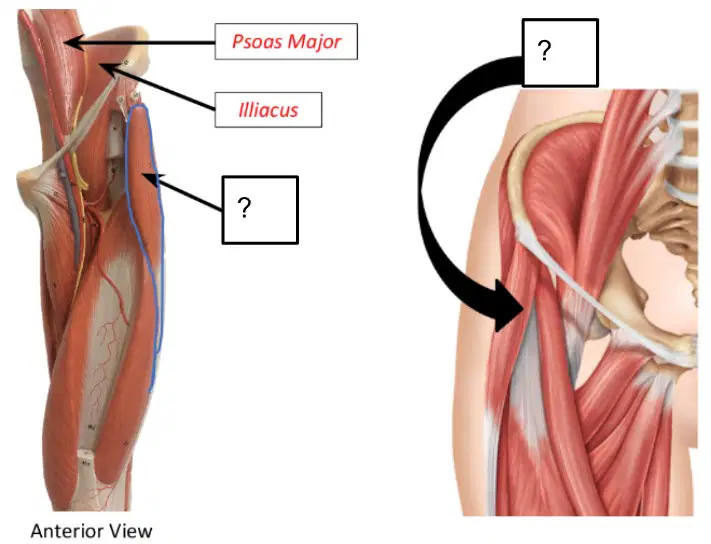
These two muscles are collectively called iliopsoas group. Label the 2 muscles that make this group.

81.

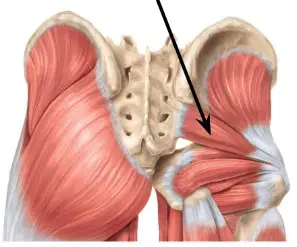
Label the muscles of the posterior hip region

82.

These are the muscles that are found on the inside thigh. Label them.

83.

This deeper muscle is a ballet dancer's best friend.

(a)  
84.

What is the name of the muscle shown here?

(a)  

85.

These muscles are found on the anterior aspect of the thigh. They are commonly referred to as the quadriceps. Label them.

86.

This is the posterior aspect of the thigh, otherwise known as the hamstrings. Label the muscles that make them up.

87.

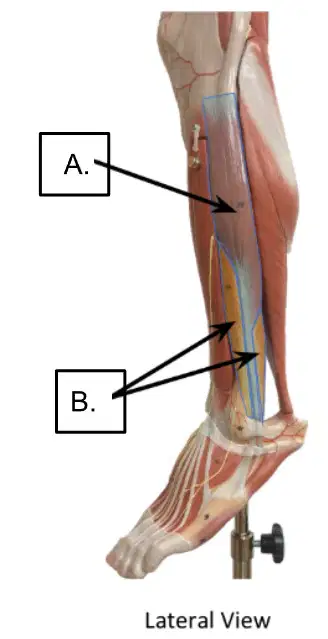
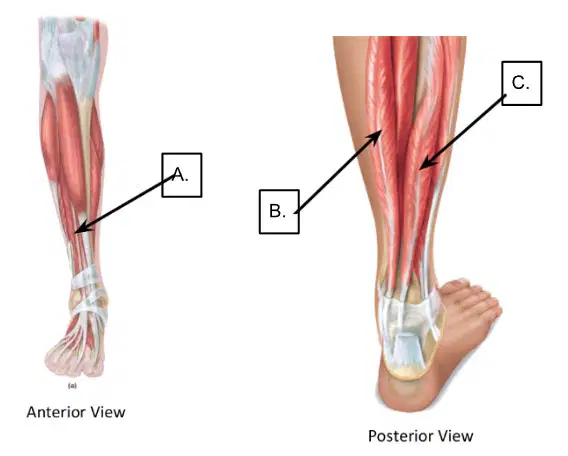
These 2 muscles run down the lateral side of the lower leg. They are responsible for moving the foot and named for the bone they run along. Muscle A is the ​ (a)   and Muscle B is the ​ ​ (b)  

Choose from the below words
fibularis longus
fibularis brevis
tibialis anterior
tibialis posterior
88.

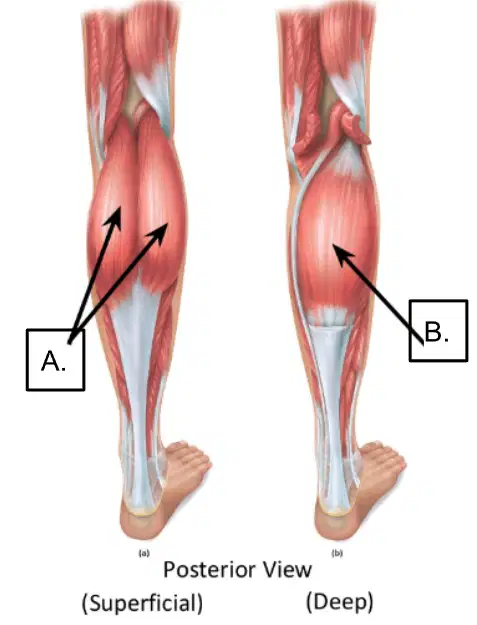
This shows the muscles on the back of the lower leg. Muscle A is the ​ (a)   and muscle B is deeper than muscle A and is called the ​ (b)  

Choose from the below words
gastrocnemius
soleus
tibialis anterior
calf muscle
89.

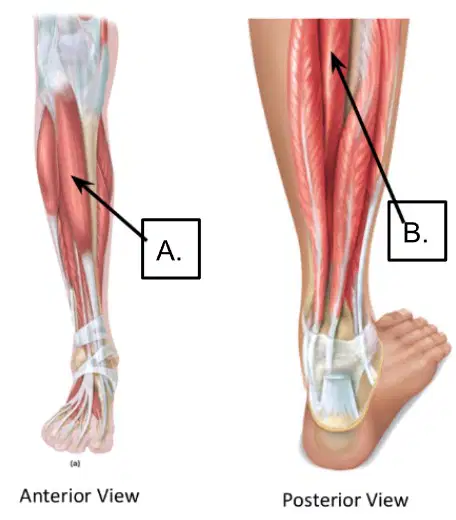
Muscle A runs right down the shin and is called the ​ (a)   . Muscle B is deeper and is actually behind the bone that muscle A lies on top of. Muscle B is the ​ (b)  

Choose from the below words
tibialis anterior
tibialis posterior
fibularis longus
fibularis brevis
90.

These 3 muscles are responsible for the movements of the foot and toes. Much the way seen in the arms, flexors are found on one side and extensors on the other. Label the muscles.

91.
Question Image

Match the following functions with their muscles

a)

Extensor Digitorum Longus

1.

Extend toes 2-5

b)

Flexor Digitorum Longus

2.

Flex toes 2-5

c)

Flexor Hallucis Longus

3.

Flex the big toe

92.

Match the following leg muscles with their functions

a)

tibialis anterior

1.

dorsiflex and invert the foot

b)

tibialis posterior

2.

plantar flex and invert the foot

c)

gastrocnemius

3.

flex the leg & plantar flex foot

d)

soleus

4.

plantar flex the foot

e)

fibularis longus & fibularis brevis

5.

everts & plantar flexes foot

93.

Sort the muscles of the thigh (both anterior and posterior) by their function.

Categorize the following

Adductor Magnus

Adductor Longus

Gracilis

Sartorius

Rectus femoris

Vastus medialis

Vastus lateralis

Vastus intermedius

Semitendinosus

Semimembranosus

Biceps femoris

Piriformis

Flexes the leg
Extends the leg
Abducts & laterally rotates
Adducts and medially rotates
94.

Sort the following muscles based on their functions.

Categorize the following

Psoas Major

Tensor Fascia Latae

Gluteus maximus

Gluteus medius

Gluteus minimus

Illiacus

Flex & laterally rotate
Abducts & medially rotates
Extends & laterally rotates
Flexes & abducts the thigh
95.

Lable the muscle tissue types.