
 Worksheets
Algebra 2 MP1 Review
Total questions: 129
Worksheet time: 22hrs 30mins
What is the first step to solve the following equation?
-2|x + 3| = -10
Set up 2 equations
-2(x + 3) = 10
-2(x + 3) = -10
Add 2 to both sides
Subtract 3 from both sides
Divide by -2 on both sides
No Solution
When do you set up 2 equations?
|x + 2| + 3 = 4
That is the first step.
After you subtract 3 from both sides.
After you add 2 and 3.
What is the first step to solve the following equation?
|2x - 1| = -5
Add 1 to both sides
Set up 2 equations:
2x - 1 = 5
2x - 1 = -5
No Solution
Divide by 2 on both sides.
Solve. Select BOTH solutions.
∣10x−8∣=38
3
−3
523
519
Is this an "and" or an "or" problem?
Is this an "and" or an "or" problem?
Which is the correct first step?
Solve: -3 ≤ 2x - 1 ≤ 5
-1 ≤ x ≤ 3
-2 ≤ x ≤ 6
-3 ≤ x ≤ 3
1 ≤ x ≤ 3

What inequality is graphed?
x > 2 and x < 4
2 ≤ x ≤ 4
x > 2 or x < 4
x ≥ 2 or x ≤ 4

-9 < x ≤ -4


What is the missing step for solving the equation?
−14x−2=5x+34
−14x+2=5x+34
14x−2=5x+34
14x−2=−5x−34
Solve for w:
52w−9=11
w=50
w=10
w=32
w=23
t −32=94
t=1 91
t=92
t=21
t=1 126
Solve for x:
50=45(3x−8)
x=316
x=16
x=4
x = 415
−43=72+145x
(a)
52x−107=3023
(a)
6x+10>5x-12
Determine the number of solutions to the equation:
2(x - 1) = x + x - 3
one solution
no solution
infinitely many solutions
Determine the number of solutions to the equation:
5x + 8 - 7x = -4x + 1
one solution
no solution
infinitely many solutions
Determine the number of solutions to the equation:
-4x - 7 + 10x = -7 + 6x
one solution
no solution
infinitely many solutions
x2 + 9x - 36
Factor:
4h² - 12h + 9
(2h - 3)(2h - 3)
4(h + 9)(h + 1)
(2h - 3)(2h + 3)
(h - 9)(4h - 1)
Factor: 25x2 - 9
(5x + 3)(5x - 3)
(x + 5)(x - 3)
(x - 3)(x + 5)
(5x + 3)(3x + 5)
x2 - 25
4m2 - 100 = 0
m=25, -25
m=96
m=5, -5
m=-96
a2 + 2a - 24 = 0
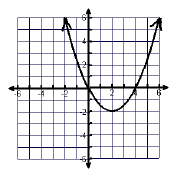
The solutions, roots, x-intercepts, and zeros of a quadratic equation are all the same thing.
2x2 + 17x + 21 = 0
x2 + 44 = -15x
{-8, 2}
{-7, 5}
{-11, -4}
{-11}
(x-11)(5x+1) = 0

2i√6
8i√3
-2√6
-2i√6

6i√5
-8√5
8i√5
-8i√5

i
-1
1
-i

6
-6
6i
6i2

√2
i√2
i2√2
-√2

30
30i
-30
-30i
x2 + 36 = 0
x = ±6
x = 6i
x = -6
x = ±6i
33 = 18 - 3x2
x = ±5i
x = ±i√5
x = ±√5
x = i√5
2(x - 8)2 + 40 = 16
x = 8 ± 2i√3
x = 8 ± √-12
x = -8 ± 2i√3
x = 8 ± 3i√2
2i(4 - 3i)
-3i(4 + 2i)
(2 - 3i)(5 + 4i)

Match the following imaginary variables to their equivalent form.
−1
i
-1
i2
−i
i3
1
i4
Match the decimal remainder (after dividing the exponent by 4) to the corresponding value
0.25
i
0.5
-1
0.75
-i
Whole number
1
i10
-1
1
i
-i
i21
-1
1
i
-i
i36
-1
1
i
-i
i45
-1
1
i
-i
Solve for x: x2− 4x+5
x = {-4, -1}
x = {-1, -4}
x = {2+i, 2-i}
x = {-2+i, -2-i}
Solve for x: x2−5x+8
x=27±5i
x=25±7i
x=28±7i
x=2−5±−7i
Solve for x: 3x2−6x+6
x = 1±i
x=3, −6
x=2±2i
x = −i ±1

How many REAL solutions does this quadratic have?
Infinitely Many
One
Two
None

How many REAL solutions does this quadratic have?
Infinitely many
One
Two
None
What is the solution set for the equation x2+49=0 ?
x=±7
x=±7i
x=±14i
x=±49i
Solve for x: x2+6x+13
x=−3±2i
x=7,6
x=2±3i
x=2±3i
Find the roots: x2+3x+17=−x+4
x=−2±3i
x=3+4i, 4+3i
x=1±5i
x=5±3i
Which of the following have complex roots?
f(x) = 4x2+7x+8
g(x) = 2x2−17x−29
h(x) = x2 +2x +9
f(x)
f(x) and h(x)
h(x)
g(x) and h(x)
Which phrase correctly describes the roots of the following function?
f(x) = 3x2 + 3x + 3
2 Real Roots
2 Imaginary Roots
1 Real Root
1 Imaginary Root
5 + 7i
-4 − 8i
Solve the quadratic inequality: x2+11x+10≥0
x≤−10 , x≥−1
x≥1 , x≤10
1≤x≤10
−1≤x≤11

Which of the following is the solution of the given Quadratic Inequality?
y ≥ -2 or y ≤ -5/2
y ≤ -2 or y ≥ -5/2
y ≥ 2 or y ≤ 5/2
y ≤ 2 or y ≥ 5/2

Which of the following is the solution of the given Quadratic Inequality?
1/2 ≤ x ≤ 2
-1/2 ≤ x ≤ 2
-2 ≤ x ≤ -1/2
-2 ≤ x ≤ 1/2

Which of the following is the solution of the given Quadratic Inequality?
5 < y < 12
7 < y < 10
8 < y < 9
6 < y < 11
(3y2 + y3 - 5) + (4y2 -4y + 2y3 + 8)
(5b - 3b3 - 8b2) - (2b3 - 4b2 + 6b - 3b4)
(3y2 + y3 - 5) + (4y2 -4y + 2y3 + 8)
-3x2(7x2 - x + 4)
(3x - 5) ( 4x2 - 2x - 3)
Find the product:
(2x + 7)2
4x2 + 49
4x2 + 28x + 49
4x2 + 14x + 49
(3x - 5) ( 4x2 - 2x - 3)
Determine whether x−4 is a factor of f(x)=x5−2x3+4x+1
Yes, because the remainder is 0
Yes, because the remainder is not equals to 0
No, because the remainder is 0
No, because the remainder is not equals 0

Is (x−2) a factor of f(x)=x3−8x2+14x−4 ?
Yes, (x-2) is a factor.
There is a remainder.
No, (x-2) is not a factor.
The remainder is zero.
Yes, (x-2) is a factor.
The remainder is zero.
No, (x-2) is not a factor.
There is a remainder.
Divide using synthetic division (2x3+4x2−5)÷(x+3)
2x² + 2x - 4 R(-12)
2x² - 2x + 6 R(-23)
2x² - 2x + 8 R(-20)
2x² - 4x + 1 R0
Multiply:
(x + 1) (x - 6) (x + 4)
x3 - x2 - 26x - 24
x3 - 9x2 - 14x - 24
x3 - 11x2 - 24x - 24
x2 - 5x - 6
Find the difference:
(3 – 2x + 2x2) – (4x – 5 +3x2)
x2 + 6x + 8
2x2 + 5x – 7
-x2 – 6x + 8
-2x2 + 11x – 4
Multiply:
(5x + 2) (x2 – 3x + 6)
5x3 – 17x2 + 24x + 12
5x3 + 17x2 – 24x + 12
5x3 – 13x2 + 24x + 12
5x3 + 13x2 – 24x – 12

Factor:
(x−5)(x2+5x+25)
(x+5)(x2−5x+25)
x−5
(x2−5x)(x−5x+25)
8x3-27
27x³-64
216x3+125
64x3 + 125
(4x - 5)(16x2 + 20x + 25)
(4x + 5)(16x2 - 20x + 25)
(4x - 5)(16x2 + 20x - 25)
(4x + 5)(16x2 - 20x - 25)
Which expression is an example of a Difference of Cubes?
x2−16
8x3−27
x3−x2−x−1
x3+1000
216x3+125
factor 10x2y – 30xy2
xy(10 - 30)
10xy(x - 3y)
10x2y(3y)
10xy2(x)
80x5-70x2-60x7
Factor the GCF
10x2 + 15x-5
25(10x3+45x-15)
5(2x3 + 3x2-x)
x(10x3+15x-5)
5(2x2+3x-1)
2n2+16n+12
80x5-70x2-60x7
80x5-70x2-60x7
x2 - 5x
Factor by grouping
x3 - 4x2 - 4x + 16
(x+4)(x+2)
(x-4)(x2 -4)
(x+4)(x2 -4)
(x-4)(x-2)
x3 - 343
P(x) = 3x4+4x-8 have?

What are the zeros of the function?
4,1
3,1,-2,-5
-3, -1, 2, 5
-2,4
How many x-intercepts does x4+6x2+9= 0 have?
2
1
4
None
To determine how many x-intercepts the polynomial has, look at the …
Degree of the function
End behavior
Coeffients
Y-intercept
What are the solutions to the equation
2x3+x2=8x+4
x=2, x=-2, x=-1/2
x=4, x=-4, x=-1/2
x=2, x=-1, x=-1/2
x=1, x=-2, x=-1/2
y = 3 (x + 4) (x + 1) (x - 3)?
Solve by finding the Zeros
2x3 - 11x2 + 12x + 9 = 0
-1, 1, 3
-1, 3/2, 3
-1/2, 3, 3
-1/2, 1, 3

What are the zeros of the polynomial function?
y = (x + 2)(x - 7)3
-2, 7 multiplicity 3
-2, 7, 3
2, -7 multiplicity 3
2, -7, 3
Find all complex roots of the polynomial. x3+2x2+4x+8=0
{2, 2i, −2i}
{−2, 2i, −2i}
{−2, 2, −2i, 2i}
{2, 2i}
Find all complex roots.
f(x)=x3−2x2+x−2
{2, 1}
{−2, 2, −1, 1}
{2, 1 , 1}
{2, 1, −1}

