
NEW
Font size
 Worksheets
Ancient China Review
Total questions: 50
Worksheet time: 29mins
What mountain ranges separates China from India?
The Alps
The Himalayas
The Andes
The Urals
How was Chinese civilization affected by mountains and deserts?
They became wealthy.
They made it easier to travel.
They were isolated from other civilizations.
They made China easy to be attacked.
The belief that the Chinese king’s right to rule came from the gods
Confucianism
dynasty
Mandate of Heaven
Daoism
This belief stressed that people were bad by nature, and needed to be controlled and punished.
Confucianism
Legalism
Daoism

What is the central idea of Daoism
Duty to community
Living in harmony with nature
Enforcing laws with harsh punishments
Humans are naturally evil
How did the Zhou dynasty justify their right to overthrow the Shang dynasty?
They claimed that the gods had given the Zhou the Mandate of Heaven.
They said the Shang king no longer honored his ancestors
They claimed that the oracle bones proved them to be the proper kings
They said there would be no more floods or famines under their rule.
Why did the Chinese honor their ancestor's spirits?
They believed that their ancestors became part of Shang Di when they died.
They believed that their ancestor's spirits could bring good fortune to their families.
Honoring their ancestors would help maintain the balance of yin and yang.
Honoring their ancestors means they would not have to help build the Great Wall.
Confucius taught the Chinese people that their most important duty was
loyalty to the state
respect for elders
care of the poor
achieving salvation
China's cultural isolation throughout its early history was mostly the result of
Japanese invasions
Confucian values
natural geographic barriers
. large river systems
Confucius believed the best ruler was
someone who would pass strict laws
a man with little education
a great military hero
a virtuous man who led by example
According to Legalism, the way to achieve order was to
provide a ruler who set a good moral example
pass strict laws and enforce them with harsh
punishments
live by the natural balance of yin and yang
appeal to man’s natural goodness
Which of these was the most important in Chinese society according to Confucius?
families
empires
kingdoms
cities
Who was the first emperor of China?
Zhou Cho
Shi Huangdi
What is the dynastic cycle?
when emperors die and their heir takes over
when one dynasty comes in strong and problems arise and another takes them over when aged and weak
Which dynasty used legalism, strict laws, a centralized government, and expanded the territory of Ancient China?
Qin
Shang
Zhou
Han
Feudalism is a system of relationships where ______________ was exchanged for ______________.
Land; loyalty
Money; money
Food; loyalty
Soldiers; money
Which statement best matches the values of Confucianism?
belief in the goodness of humanity, following rules, respect for elders, and fairness
monasteries and places of worship were built to support the participation of religion
worshipped many gods and ancestors, believe everything is one, believed in "chi" energy in the body
the idea of living or lasting forever

How did the Silk Road contribute to the development of classical civilizations such as China, Persia, India, and Arabia?
The Silk Road provided employment opportunities across many civilizations as it was being constructed.
The Silk Road promoted a cultural exchange between China and the West and helped spread Chinese inventions.
The Silk Road helped to strengthen military protection for these ancient civilizations by creating a network of walls.
The Silk Road promoted travel for the masses among these civilizations. Men, women, and children began exploring the world.

The period from 475 BC until the unification of China under the Qin dynasty, characterized by lack of centralized government in China. It followed the Zhou dynasty.
Daoism
Han Dynasty
Warring States Period
Shane Dynasty

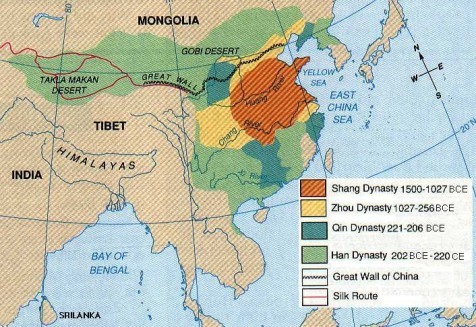
World's longest man made structure built to keep invaders from the north out of China, started by the Qin Dynasty, expanded by the Han Dynasty.
Qin Dynasty
Gobi Desert
Shang Dynasty
Great Wall of China
During the Warring States Period, who was at war?
China and Mongolia
China and India
Different Chinese warlords and kingdoms
China and The United States
How did the Han Dynasty end?
Revolts over heavy taxes, forced labor, and cruel policies.
The last leader was corrupt.
Weak rulers could no longer control powerful warlords.
It did not end.
What did the Qin build to improve China's water system?
Roads
Dams
Canals
Harbors
What are some accomplishments of the Qin Dynasty?
A network of roads and canals, a uniform writing & measurement system, and the Great Wall of China
A civil service exam and the Silk Roads
Establishing the Mandate of Heaven
Patriarchy is the belief that:
God rules over all
Male is the head of the family
Women are the head of the family
All should be equal
Parrots rule the world
A ruler could lose the "mandate of heaven" if he or she
became immoral or unjust
did not follow the teachings of the Buddha
would not enforce the ideas of Confucius
did not bring forth heirs
China is on which continent?
Asia
Africa
Australia
America
Antartica
What is contribution from the Ancient Chinese?
wheelbarrow
fireworks
gunpowder
All of them
Paper

Leaders of China were chosen through the
education system
Pharaoh
Mandate of Heaven
power of the people
The Han Dynasty developed the Civil Service Exam which
was a test for all students in college
was a test for government jobs
was a test for each dynasty
was the mandate of heaven
What is not a natural barrier in Ancient China?
Himalaya Mountains
Gobi Desert
The Great Wall of China
Pacific Ocean
How long can a dynasty lead China
10 years
a century
as long as they have the mandate of heaven
as long as they control the rivers
Examination used to select people for highly desirable government jobs; similar exams still used in governments around the world today.
Civil service exam
Mandate of Heaven
Four Noble Truths
Eightfold Path
System of the rise and fall of Chinese ruling families.
Dynastic cycle
Mandate of Heaven
Caste system
Nirvana
Political idea that a Chinese emperor remained in power as long as he governed as a just ruler; new dynasty was founded if the emperor was not just.
Mandate of Heaven
Dynastic cycle
Oracle bones
Moksha
Who was the first emperor of China?
Shi Huangdi
Siddhartha Gautama
Brahma
Abraham
Major trade route that linked China to the west.
Silk Road
Khyber Pass
Mesopotamia
Eightfold Path
The fall of the Qin Dynasty in 206 BCE was immediately followed by
A brief period of civil strife
The Warring States period
The Zhou Dynasty
The Shang Dynasty
In order to choose government officials based on merit, the Han administered the first
Government service lottery
Civil Service Exam
Confucius hoped to persuade rulers to _________their ways and bring ___________ to China.
What is the significance of the ruler-subject relationship in Confucian governance?
It promotes the idea of democracy.
It emphasizes the ruler's responsibility to be just and the subject's duty to be loyal.
It encourages subjects to overthrow unjust rulers.
It suggests that subjects should have more power than rulers.
Which of the following was NOT something reinforced by the "Five Relationships?"
patriarchy
social hierarchy
importance of family
strict punishments
One way that a person in China could move up the social ladder was through
education
increased wealth
demonstrating superior warrior skills
trade

