
 Worksheets
Quiz- Static Electricity
Total questions: 16
Worksheet time: 35mins
William has a toy that is positively charged, containing all protons and no electrons.
TRUE
FALSE
James has a toy that is electrically neutral. He believes it contains only neutrons.
TRUE
FALSE
During a science experiment, Liam noticed that when a balloon is rubbed against his hair, it becomes charged and can attract small pieces of paper. This phenomenon is known as polarization.
TRUE
FALSE
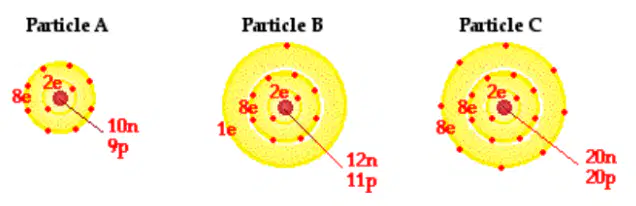
Rohan is conducting an experiment in his physics class where he needs to identify the following particles as being charged or uncharged. If charged, he must indicate whether they are charged positively or negatively. (n = neutron, p = proton, e = electron)

Consider the graphic of a neutral oxygen atom in a science lab where Aria is conducting an experiment. Explain what must happen in order for the oxygen atom to become negatively charged.

Harper is studying the behavior of atoms in her chemistry class. She learns that in order for the oxygen atom to become positively charged, it must lose one of its electrons. Can you explain what must happen for this to occur?

Noah enters the classroom and observes two balloons suspended from the ceiling. He notices that instead of hanging straight down vertically, the balloons seem to be repelling each other. He can conclusively say ...
Both balloons have a negative charge.
Both balloons have a positive charge.
One balloon is charged positively and the other negatively.
Both balloons are charged with the same type of charge.
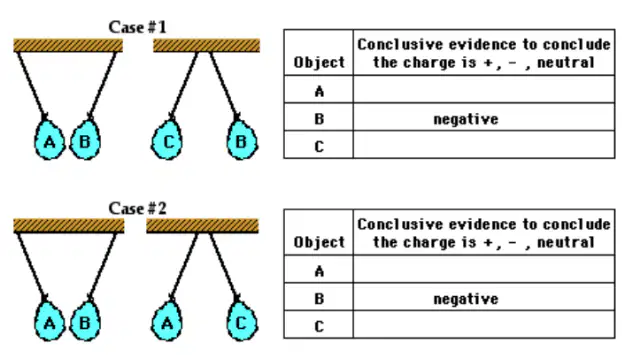
On two occasions, the charge interactions between balloons A, B and C are observed as shown in the diagram. In each case, it is known that balloon B is charged negatively. Based on these observations, what can you conclusively confirm about the charge on balloon A and C for each situation?
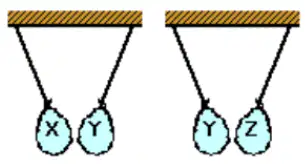
Balloons X , Y and Z are suspended from strings as shown at the right. Negatively charged balloon X attracts balloon Y and balloon Y attracts balloon Z. Balloon Z ____. List all that apply.
must be negatively charged
must be positively charged
may be neutral
may be negatively charged
may be positively charged
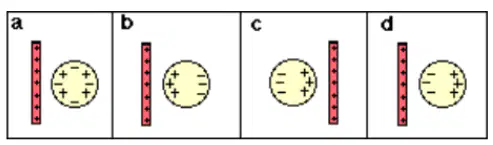
Which of the diagrams below best represents the charge distribution on a metal sphere when Samuel places a positively charged plastic tube nearby? Why?
A
B
C
D
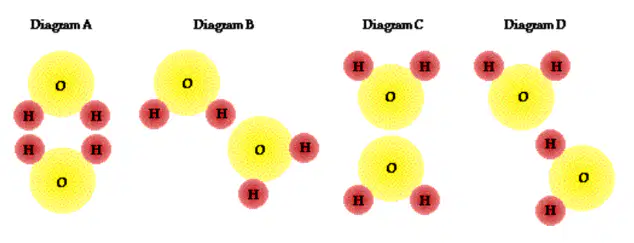
In a science class, Jackson is learning about the distribution of electric charge in a H2O molecule. He discovers that the more electronegative oxygen atom attracts electrons from the hydrogen atom. As a result, the oxygen atoms acquire a partial negative charge while the hydrogen atoms acquire a partial positive charge. This makes the water molecule 'polarized.' Which diagram(s) below correctly portray(s) a pair of H2O molecules? Choose one of the options.
Both A and B
B
C
D
Both B and D
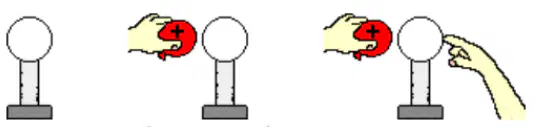
Henry is conducting an experiment where a positively charged balloon is brought near a neutral conducting sphere. While the balloon is near, the sphere is touched (grounded). At this point, there is a movement of electrons. Electrons move ____.
from the ground through the sphere to the balloon
into the sphere from the balloon
into the sphere from the ground (hand)
out of the sphere into the ground (hand)
out of the sphere into the balloon
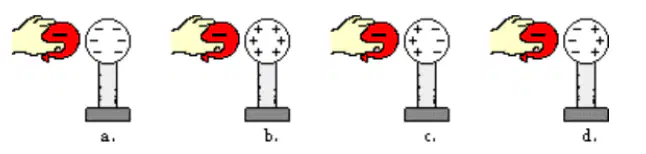
Lily has a negatively charged balloon that she brings near a neutral conducting sphere during a science experiment. As the balloon approaches, the charge within the sphere will distribute itself in a very specific manner. Which one of the diagrams below properly depicts the distribution of charge in the sphere?
A
B
C
D
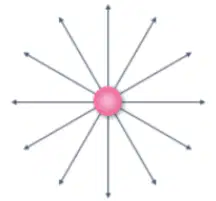
James is conducting an experiment with a charged particle that generates an electric field. What would happen to the following particles if they were placed in the electric field: a) an electron? b) a proton?
(a) Abigail wants to determine which of her two appliances is more energy-efficient: her 150W microwave that operates for 10 minutes each day, or her 2000W toaster that she uses for 30 minutes to prepare breakfast. Calculate the energy consumption for both appliances and identify which one uses more energy.
(b) Given that the cost of electricity is 6.25 cents per kWh, what would be the estimated monthly expense for running these appliances daily? Provide your calculations.
(a) Abigail wants to determine which of her two appliances is more energy-efficient: her 150W microwave that operates for 10 minutes each day, or her 2000W toaster that she uses for 30 minutes to prepare breakfast. Calculate the energy consumption for both appliances and identify which one uses more energy.
(b) Given that the cost of electricity is 6.25 cents per kWh, what would be the estimated monthly expense for running these appliances daily? Provide your calculations.

