
 Worksheets
PRESSURE CHANGE MEASUREMENT TESTING METHOD I
Total questions: 55
Worksheet time: 28mins
Name
Class
Date
1.
A pressure change measurement test performed at a pressure above atmospheric pressure is also referred to as a:
a)
pressure hold test
b)
Pressure decay test.
c)
pressure loss test,
d)
Any of the above.
2.
Gage pressure plus barometric pressure is:
a)
absolute pressure,
b)
Atmospheric pressure.
c)
Differential pressure.
d)
Partial pressure.
3.
Standard atmospheric or barometric pressure at sea level is equivalent to:
a)
29.96 in. Hg.
b)
14.7 psia.
c)
760 mmHg.
d)
All of the above.
4.
A pressure of 66 psig, in terms of absolute pressure at sea level and standard temperature, would be about:
a)
96 psia,
b)
80.7 psia.
c)
51.3 psia.
d)
36 psia,
5.
When reading an ordinary pressure gage, the value indicated will be the:
a)
Partial pressure.
b)
Incremental pressure.
c)
Gage pressure.
d)
Absolute pressure.
6.
A pressure change measurement test of a very large volume structure, such as a nuclear containment system, is usually referred to as a:
a)
Leakage rate test.
b)
Verification test.
c)
Mass flow test.
d)
Structural integrity test.
7.
Which of the following gases is most practical as the pressurizing medium for a pressure change measurement test?
a)
Argon.
b)
Hydrogen.
c)
Air.
d)
All of the above.
8.
Surface thermometers for a pressure change measurement test may be held on the test surface
with:
a)
Tape.
b)
Magnets.
c)
Coupling adhesive.
d)
any of the above,
9.
The Pascal (Pa) is the:
a)
Minimum size volume required for the test.
b)
Basic unit of mass flow.
c)
International System of Units (SI) unit of pressure.
d)
Metric equivalent of standard barometric pressure.
10.
As the elevation above sea level increases, the barometric pressure:
a)
Decreases.
b)
Remains the same.
c)
Increases.
d)
None of the above.
11.
What are the parameters that can or do change during a pressure change measurement test?
a)
Pressure.
b)
Temperature.
c)
Time.
d)
All of the above.
12.
When conducting a long duration pressure change measurement test, it is necessary to either measure absolute pressure or measure gage pressure plus barometric pressure, since the barometric pressure will:
a)
Always fall.
b)
Always rise.
c)
Remain constant.
d)
Tend to vary.
13.
The term used to indicate pressure above the zero value corresponding to a perfect vacuum is:
a)
Gage pressure.
b)
Air pressure.
c)
Absolute pressure.
d)
Water pressure.
14.
Extending the length of a pressure change test will normally cause an increase in the:
a)
System leakage rate.
b)
Reliability of the test results.
c)
Deviation of the test results.
d)
Moisture content of the test gas.
15.
For a pressure change measurement test, the allowable pressure loss for a test system with a maximum allowable leakage rate must be for a specific:
a)
Test pressure.
b)
Test volume.
c)
Period of time.
d)
All of the above.
16.
Indicating dial and recording pressure gages used in pressure change measurement testing should preferably have dials graduated over a range of about double the intended maximum test pressure, but the range should not be less than one and one half or more than four times the test pressure because;
a)
These bourdon tube or diaphragm type gages are usually less accurate in the upper and lower ends of their range.
b)
These gages always have larger more readable pressure increments in the middle of their range.
c)
It provides the operator with a means of reading the pressure when the system is
overpressurized.
d)
All of the above.
17.
Pressure change measurement testing is performed for which of the following reasons?
a)
To determine that total leakage rate is acceptable after performing nonquantitative preliminary leak testing methods.
b)
To prevent material loss by leakage, prevent contamination, creation of hazardous
conditions or disfigurement caused by product leakage.
c)
To detect faulty components and control the reliability of the product.
d)
All of the above.
18.
The "psi" abbreviation for pressure means the same as the abbreviation:
a)
psia.
b)
psid.
c)
psig.
d)
None of the above.
19.
Absolute temperature in degrees rankine (°R) is determined by adding temperatures in degrees Fahrenheit (°F) to a value of:
a)
460
b)
273
c)
212
d)
32
20.
Assuming no leakage, if the temperature increases during a pressure change measurement test, the absolute pressure in the system will:
a)
Remain the same.
b)
Increase.
c)
Decrease.
d)
Oscillate.
21.
The purpose of a mirror reflector on the face of a dial pressure gage is to:
a)
Make it possible to read the gage indicator needle from any angle of reflection.
b)
Increase the light gathering capability of the gage to make it easier to read the indicator needle.
c)
Magnify the graduations on the face of the gage to make them more visible and easier to read.
d)
Reduce human reading error by providing a method in which the reading is taken by lining up the indicator needle over the reflection of the indicator needle in the mirror.
22.
A pressure change measurement test performed at a pressure below atmospheric pressure is also referred to as a:
a)
Pressure rise test.
b)
Vacuum retention test.
c)
Pressure gain test.
d)
Any of the above.
23.
Assuming no leakage, which of the following will cause a pressure decrease to be observed shortly after pressurizing and isolating a rigid volume container?
a)
Internal gas temperature decrease.
b)
Barometric pressure decrease.
c)
Atmospheric air temperature decrease.
d)
Internal gas dewpoint temperature increase.
24.
Which one of the following should not be used as a preliminary test method prior to performing a pressure change measurement test?
a)
Halogen sniffer test.
b)
Hydrostatic test.
c)
Visual test.
d)
Helium sniffer test.
25.
Assuming no leakage and uniform temperatures during a pressure change measurement test, as barometric pressure increases, gage pressure will:
a)
Increase.
b)
Remain the same.
c)
Decrease.
d)
Tend to vary.
26.
Absolute temperature in degrees Kelvin (K) is determined by adding temperature in degrees celsius (°C) to a value of:
a)
460.
b)
273.
c)
212.
d)
180.
27.
For a given time period, pressure change measurement testing sensitivity is greater for
systems with:
a)
Larger contained volumes at test pressure.
b)
Larger surface areas.
c)
Fewer numbers of penetrations or fittings.
d)
Smaller contained volumes at test pressure.
28.
The purpose of measuring the internal gas dewpoint temperature during a pressure change
measurement test of a very large volume system is to determine the:
a)
Moisture level in the system to prevent an electrical short of the circulating and cooling fans.
b)
Effect of the water vapor on the temperature.
c)
Water vapor partial pressure.
d)
Amount of moisture coming from any recently poured green concrete within the system.
29.
One way to increase the accuracy and reliability of the results of a pressure change measurement test is to;
a)
Extend the time period of the test.
b)
Use a more reliable person to record the gage readings.
c)
Decrease the allowable pressure change for the same time period.
d)
Increase the contained test volume by increasing the test pressure.
30.
When a very short duration pressure change measurement test of a small volume interspace
requires measuring gage pressure p and time tt which one of these equations should be used to
determine the rate of pressure change for the lime of the test?
a)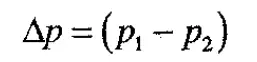
a)
b)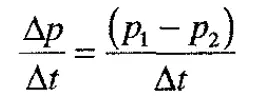
b)
c)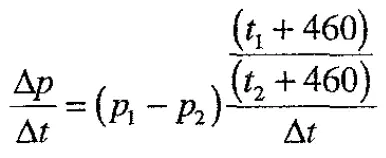
c)
d)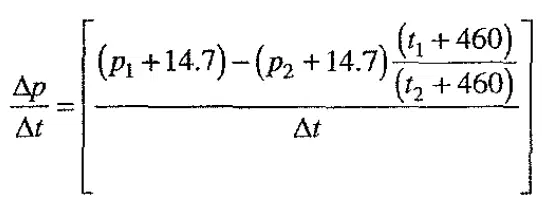
d)
31.
The leakage rate for a pressure change measurement test of a system is dependent on
which of the following source or sources of error?
a)
Calculation of the volume of the system, particularly if it is large and complex in
configuration.
b)
Measurement of internal temperature variation of the system.
c)
Minimum detectable pressure change (resolution) of the pressure measuring instrument or gage.
d)
All of the above.
32.
For pressure change measurement tests of short duration, such as 0.25 to 1 h, it is usually not necessary to:
a)
Measure gage pressure.
b)
Perform any preliminary testing.
c)
Measure barometric pressure.
d)
Disconnect the pressurizing line and leak test this connection.
33.
As soon as an evacuated system is isolated from the vacuum pumps for a pressure change
measurement test, there is an initial rapid rise of pressure that eventually slows to a much smaller steady pressure rise value. This initial rapid pressure rise is caused mostly by:
a)
Cooling of the back streamed diffusion pump oil within the system.
b)
Large torturous path leakage in the system.
c)
Outgassing of adsorbed gases from the system surfaces.
d)
The nature of numerous virtual leaks inherent in all vacuum systems.
34.
Pressure change measurement test techniques can be used for:
a)
Leakage measurement or monitoring.
b)
Leak location and measurement.
c)
Leakage monitoring and leak location.
d)
Either bore.
35.
The flow measurement technique of pressure change measurement testing is performed on rigid volume systems by:
a)
Heating or cooling the system to maintain a constant system absolute pressure and
measuring the resulting or cooling rates as a factor of the system total volume.
b)
Measuring the gas quantities added to or removed from the system in order to hold the system absolute pressure constant.
c)
Measuring the tracer gas leaking from the system using a residual gas analyzer.
d)
Connecting flow meters to the sources of leakage in the system and totaling the monitored flow readings.
36.
When the flow measurement technique of pressure change measurement testing is
performed on a variable volume system, such as a tank with a flexible diaphragm, the test factor that remains constant is the:
a)
System gage pressure.
b)
System internal gas temperature.
c)
Flow measurement into or out of the system.
d)
Contained volume in the system at test pressure.
37.
For a pressure change leakage rate test of a large volume system, use of an absolute pressure gage provides test pressure data that is independent of variations in:
a)
System internal gas temperature.
b)
System internal dewpoint temperature.
c)
Contained mass or volume in the system.
d)
Barometric pressure.
38.
Dewpoint temperature is that temperature at which the gas in a test system would:
a)
Contain no water vapor.
b)
Be capable of holding no more water vapor and condensation in the form of dew would occur.
c)
Be capable of evaporating free standing water in the system.
d)
Be sufficiently stabilized after pressurization to meet the criteria required for starting a pressure change leakage rate test.
39.
For the pressure change leakage rate test of a large volume system, the water vapor partial
pressure of the internal gas is usually determined with the system:
a)
Dewpoint temperature and percent relative humidity.
b)
Drybulb temperature and steam tables.
c)
Dewpoint temperature and steam tables.
d)
Drybulb temperature and percent relative humidity.
40.
For pressure change measurement tests of large volume evacuated systems exposed to ambient temperature and weather variations during testing, it is difficult to determine a true leakage rate because of the:
a)
Effect of outgassing vapors that do not obey the general gas laws for ideal gases.
b)
Trapped air pockets behind welds inherent in most vacuum systems.
c)
Large physical change in volume caused by the expansion and contraction of the system.
d)
The effect of the back streamed pump oil and other numerous hydrocarbons present in vacuum systems.
41.
When a liquid U tube manometer is used to measure gage pressure for a pressure change
measurement test, the pressure should be read at the difference in the liquid level in both columns of the manometer. The pressure should never be read as double the reading of the liquid height in one column for which of the following reasons?
a)
At zero gage pressure, the manometer liquid may not have been adjusted to zero on the scale.
b)
On a hot day, the manometer fluid (particularly water) may evaporate during a
long duration test, changing the original zero scale reading at zero gage pressure.
c)
Any zero error is doubled.
d)
Any of the above.
42.
In lieu of air, which one of the following gases would be the best choice as the pressurizing medium for a pressure change measurement test?
a)
Oxygen.
b)
Nitrogen.
c)
Hydrogen.
d)
Carbon monoxide.
43.
After pressurizing a system for a pressure change measurement test, before starting the test the pressurizing line should be disconnected from the system isolation valve in order to:
a)
Prevent possible inleakage from the pressurizing line in the event of a leak through
the seat of the isolation valve.
b)
Allow the seat of the isolation valve to be bubble emission leak tested.
c)
Prevent possible outleakage from the seat of the isolation valve in the event it is leaking.
d)
All of the above.
44.
For pressure change measurement test systems where the pressure is measured with a mercury manometer, for the most consistent test results the pressure reading point for the manometer should be at:
a)
The bottom of the meniscus.
b)
The midpoint of the meniscus slope.
c)
The top of the meniscus.
d)
Any point on the meniscus as long as it is always in the same position.
45.
For pressure change measurement tests of evacuated systems, the measurement of pressure
in units of torr is equivalent to measuring the pressure in which of the following units?
a)
mm Hg.
b)
microns Hg.
c)
cmHg.
d)
pascals.
46.
When the test results for a pressure change measurement test are on the borderline of being within the specified allowable, the most economical next step would be to:
a)
Immediately vent the system, perform another leak location test and repeat the pressure change test.
b)
Continue the test since the more reliable and more accurate results of a longer test may be within the allowable.
c)
Sell the test to the customer.
d)
Perform the pressure change test again the following day using a different pressure gage.
47.
When using thermocouples to measure the system temperature during a pressure change measurement test, the thermocouple electromagnetic field output measured with a potentiometer is read either directly as a temperature or as:
a)
Milliohms.
b)
Milliamperes.
c)
Millivolts.
d)
Microamperes.
48.
For pressure change measurement test systems where the pressure is measured with a water manometer, for the most consistent test results the pressure reading point for the manometer should be at:
a)
The bottom of the meniscus.
b)
The midpoint of the meniscus slope.
c)
The top of the meniscus.
d)
Any point on the meniscus so long as it is always in the same location.
49.
When a very short duration pressure change measurement test of a small system is conducted under varying temperature conditions and requires measurement of both gage pressure and temperature, but does not require measurement of barometric pressure, which one of the following equations should be used to determine the pressure change for the time of the test?
a)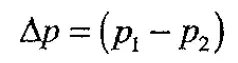
a)
b)
b)
c)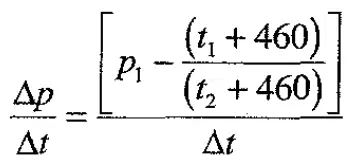
c)
d)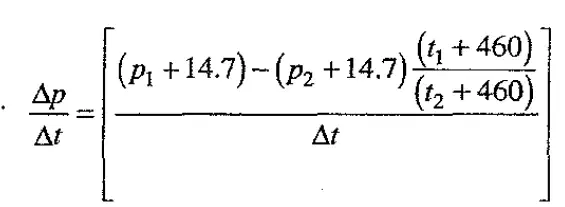
d)
50.
The pressurizing gas used for pressure change measurement tests of pressurized systems should always:
a)
Be capable of supporting human life.
b)
Obey the laws for ideal gases.
c)
be capable of supporting combustion,
d)
Contain a small amount of water vapor in order to validate dewpoint sensor readings.
51.
Which one of the following is the correct relationship for converting temperature in
degrees Fahrenheit (°F) to temperature in degrees rankine (°R)?
a)
°R = (5/9) °F.
b)
°R = 460 + °F.
c)
°R = 273 + °F.
d)
°R = (5/9)(°F-32).
52.
Which one of the following is the correct relationship for converting temperature in
degrees Celsius (°C) to temperatures in degrees Kelvin (K)?
a)
K = (5/9) °C.
b)
K = 460 + °C.
c)
K = 273 + °C.
d)
K = (5/9)(°C) + 273.
53.
Which one of the following is the correct relationship for converting temperature in
degrees rankine (°R) to temperature in degrees Kelvin (K)? .
a)
K = (5/9) °R.
b)
K = 5/9(°R) + 273.
c)
K = 460 + °R.
d)
K = 273 °R,
54.
When initial system temperature and pressure are 60 °F and 80 psia and final system temperature is 86 °F, if there was no measurable pressure change caused by leakage, what would be the final system pressure?
a)
67 psig.
b)
84 psia.
c)
95 psig.
d)
115 psia.
55.
A rigid constant volume system contains 100 ft3 of air mass (quantity) at atmospheric pressure. Assuming uniform standard temperature and standard atmospheric pressure as 15 psia, how much air mass would the system contain at 30 psig?
a)
100 ft3.
b)
200 ft3.
c)
300 ft3.
d)
400 ft3.
100 %

