
 Worksheets
lower extremity
Total questions: 10
Worksheet time: 50mins
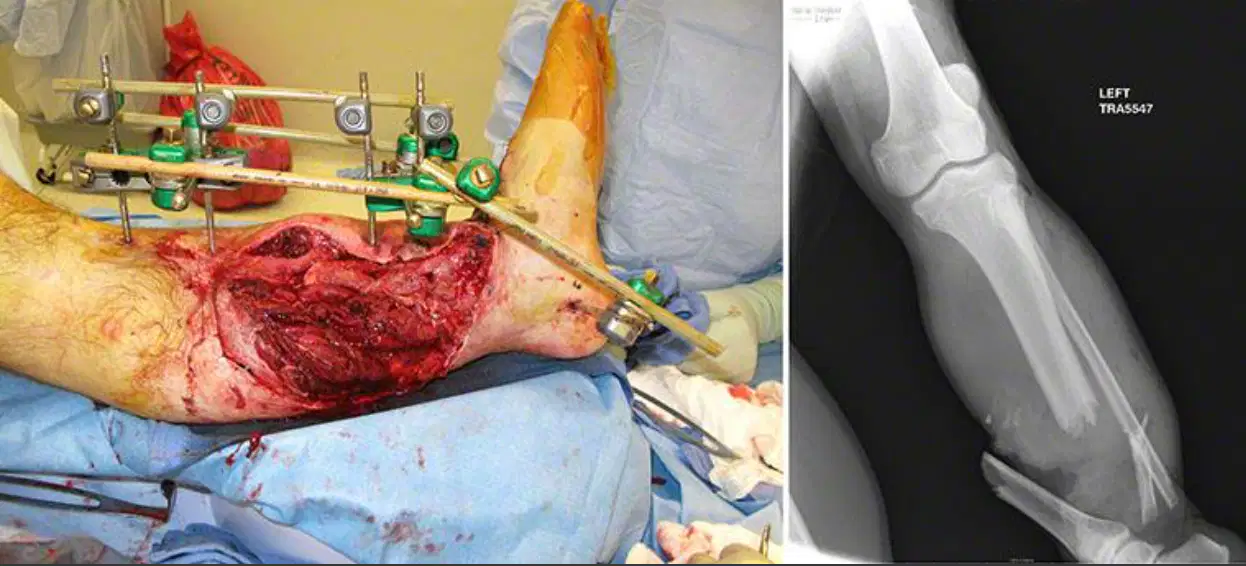
A 55-year-old man is evaluated in the emergency department for foot salvage after he was involved in a motorcycle collision. Flow is restored after 6 hours from the time of injury. On examination, the foot is cold, and no plantar sensation is noted. The posterior tibial nerve is disrupted. A temporary external fixator is placed. A photograph and an x-ray study are shown. Which of the following is the most appropriate classification of this injury and recommendation for management?
Gustilo type IIIB; amputation
Gustilo type IIIB; reconstruction
Gustilo type IIIC; amputation
Gustilo type IIIC; reconstruction
Which of the following compartment pressure measurements is the minimum threshold that is most consistent with compartment syndrome?
10 mmHg
20 mmHg
30 mmHg
40 mmHg
50 mmHg
When a pedicled sural flap is raised to the heel, which of the following is the origin of the arterial blood supply?
Descending genicular artery
Lateral sural artery
Medial femoral circumflex artery
Medial plantar artery
Peroneal artery
A 40-year-old man sustains an avulsion of the weight-bearing portion of the medial heel. Coverage with an instep flap is planned. Sensation to this flap is provided by which of the following?
Lateral plantar nerve from the deep peroneal nerve
Lateral plantar nerve from the superficial peroneal nerve
Lateral plantar nerve from the sural nerve
Medial plantar nerve from the deep peroneal nerve
Medial plantar nerve from the tibial nerve
A 50-year-old man comes to the office because of a persistent nonhealing wound 6 months after he underwent open reduction and internal fixation of an open ankle fracture. Examination shows palpable pedal pulse with retained protective sensation of the foot. Which of the following is the most appropriate initial step in management of this patient?
Application of collagenase ointment
Core needle bone culture
Coverage with a free flap
Operative debridement
Referral for hyperbaric oxygen therapy
A 62-year-old man is brought to the emergency department by helicopter after sustaining severe injuries to the head, neck, and right femur during a motor vehicle collision. The patient's condition is stabilized, and the femur is temporarily reduced and splint immobilized. Peripheral pulses in the right leg are not palpable and capillary refill is noted; handheld Doppler shows weak pulses. Which of the following is the most appropriate next step to establish lower extremity vascular injury in this patient?
CT angiography
Doppler ultrasonography
Measurement of ankle brachial index
Serial physical examinations
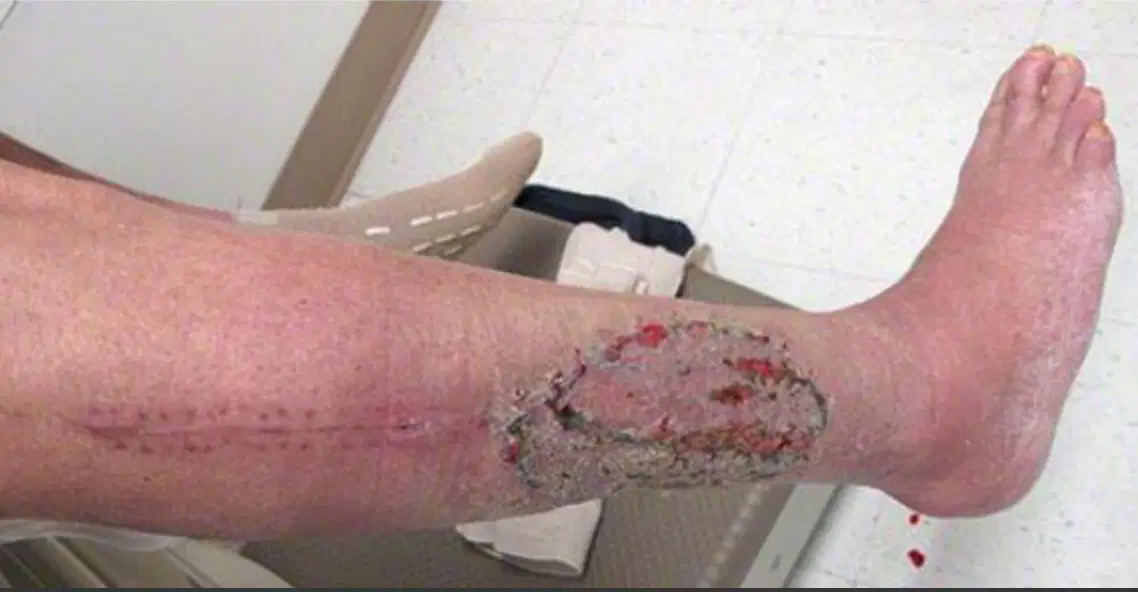
A 57-year-old man comes to the office 4 weeks after undergoing a free osseocutaneous fibula flap. He says he has pain with walking. A photograph is shown. X-ray studies show 6 cm of fibular bone remains proximally and distally. Sensation of the right foot shows no abnormalities; pain is noted on plantar flexion. Which of the following is the most appropriate next step in management?
Cast immobilization of the lower extremity (above the knee)
Cast immobilization of the lower extremity (below the knee)
Operative exploration and bone grafting
Operative exploration and nerve grafting
Reassurance that the pain is self-limiting
A 63-year-old man presents to the office with a 4 × 4-cm heel defect. A local podiatrist has debrided the calcaneus, and there is healthy granulation tissue present. After extensive discussion with the patient, it is decided to proceed with a distally based sural fasciocutaneous flap for coverage. Which of the following risk factors is associated with the highest rate of flap-related complications?
Coronary artery disease
Diabetes mellitus
Hypertension
Obesity
Venous insufficiency
A 25-year-old man is brought to the emergency department with a large degloving injury with exposed tibia and ankle joint (Gustilo Type IIIB) sustained during a motorcycle collision. After multiple debridements, the plastic surgeon is consulted 6 days later. Routine laboratory testing shows a platelet count of 1.5 million/mL, increased from normal range on admission. Free flap reconstruction is planned. Which of the following is the most appropriate next step in management in this patient?
Consult hematology for bone marrow biopsy
Delay reconstruction until platelet count is within normal range
Initiate antiplatelet therapy
Proceed with free tissue transfer
A 35-year-old man is brought to the emergency department 2 hours after sustaining a severe crush injury to the right distal thigh in a motor vehicle collision. Physical examination shows an open fracture of the femur; the leg and foot are pale and cool. There are no palpable popliteal, dorsalis pedis, or posterior tibialis pulses. Closed reduction does not restore perfusion. Which of the following is the most appropriate next step?
Arterial repair with a polytetrafluoroethylene graft
Arterial repair with reverse saphenous vein graft
CT angiography
Intramedullary fixation of the femoral fracture
Placement of a temporary vascular shunt

