
 Worksheets
Organelles and Cell Theory
Total questions: 58
Worksheet time: 1hrs 13mins
Which organelle is the site of photosynthesis?
Cell Wall
Chloroplasts
Cytoplasm
Cell Membrane
Which cell parts are not present in animal cells?
cell membrane & cytoplasm
nucleus & chloroplasts
cell wall & chloroplasts
ribosomes & mitochondria
Which organelle is the location of DNA (genetic material)?
mitochondria
ribosomes
nucleus
Endoplasmic Reticulum
Which part of the cell provides structural support?
Cell Membrane
Cell Wall
Cytoplasm
Nucleus

Which organelle produces the energy a cell needs to carry out its function?
Mitochondria
Golgi Bodies
Cytoplasm
Nucleus

What is the function of the vacuoles?
Store food, water, and waste
Receive proteins
Assemble amino acids
Found inside the nucleus

This organelle controls what goes in and out of the cell.
Nucleus
Cell wall
Cytoplasm
Cell Membrane
This organelle is a rigid outer layer that protects and provides structure for plant cells.
What is the function of a lysosome?
To create energy for the cell
To command the cell what to do
To remove waste using digestive enzymes from the cell
To protect the cell
Which is not a part of the cell theory?
The cell is the most basic (smallest) form of life.
Cells cannot be created or destroyed.
All cells come from pre-existing (other) cells.
All living things are made of cells.
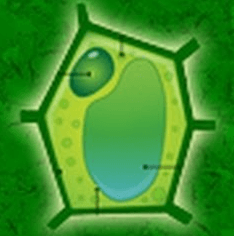
A rigid layer that lies outside the cell's membrane is...
Cytoskeleton
Cilia
Cell Wall
Flagella

Which organelle uses energy from sunlight to make sugar?
Mitochondria
Nucleus
Chloroplasts
Vacuoles

Jello-like material, fills the space between cell organelles, is where many chemical reactions occur.
Cytoplasm
Chlorophyll
Chloroplast
Cell Membrane

What type of cell is shown?
Prokaryotic (Bacteria)
Eukaryotic (Plant or Animal)

Break down molecules and dead organelles, works like a “garbage disposal”
Mitochondria
Vacuole
Lysosome
Ribosome

“Powerhouse” of the cell, breaks food down into energy for the cell.
Vacuole
Chloroplast
Nucleus
Mitochondria
Which organelle is a gelatinous substance that helps fill out the cell
Chloroplast
Lysosomes
Mitochondria
Cytoplasm
Which statement is part of the cell theory?
All cells come from existing cells
All cells are prokaryotic or eukaryotic
All cells can make a tissue
All cells grow and develop


Where are proteins made?
Golgi body
Mitochondrion
Chromosomes
Ribosomes

I make proteins for the cell. What am I?
ribosome
mitochondria
chloroplast
lysosome

Structures that transport and ship proteins like UPS.
Ribosomes
Lysosomes
Organelles
Golgi Bodies
What organelle is called the "powerhouse" of a cell?
Endoplasmic Reticulum
Nucleus
Mitochondria
Nucleolus
Which cell part is a specialized part of the cell with a specific job?
Lysosome
Organelle
Chloroplast
Cytoplasm
Which statement is part of the cell theory?
All cells come from existing cells
All cells are prokaryotic or eukaryotic
All cells can make a tissue
All cells grow and develop
Which statement is part of the cell theory?
All cells can reproduce
All organisms are either unicellular or multicellular
All organisms are made of 1 or more cells
All cells grow and develop
Tiny cell parts (little organs)
Cytoplasm
Vacuoles
Lysosome
Organelles

Passageways in the cell
Golgi Bodies
Cytoplasm
Endoplasmic Reticulum
Lysosome
Contains a cell wall, chloroplasts, and one large vacuole.
Animal Cell
Plant Cell
Bacteria Cell

What kind of cell is this?
plant cell
animal cell
bacteria cell

Which organelle(s) are unique to plant cells?
cell wall
cytoplasm
chloroplast
ribosomes

What is the jelly-like substance found around the organelles?
strawberry jelly
grape jelly
chlorophyll
cytoplasm
Maintenance of a constant, stable internal state, despite changing external environment; this is one characteristic of living things (synonym to equilibrium).
What was Schleiden convinced of?
All plants are made of cells
All animals are made of cells
All cells are prokaryotic
None of the above
Who discovered and named cells while looking at cork?
Captain Hook
Robert Hooke
Matthias Schleiden
Rudolf Virchow
Who discovered that all cells come from other living cells and whose research led to the last major principle of cell theory?
Matthias Schleiden
Theodore Schwann
Robert Hooke
Rudolf Virchow

Robert Hooke, Anton van Leeuwenhoek, Theodor Schwann, Rudolf Virchow, and Matthias Schleiden were all responsible for what theory?
The Theory of Gravity
The Theory of Relativity
The Cell Theory
The Theory of Continental Drift

Are YOU unicellular or multicellular?
Unicellular
(single celled)
Multicellular
(many celled)


Maintaining a stable internal environment is called
homeostasis
equilibrium
balance
evenness
When you step out into the cold, your body shivers in order to keep its temperature at 98.6°F. Which characteristic of life does this represent?
All living things use energy
All living things contain cells
All living things maintain homeostasis
All living things grow
A baby song bird hatches from its egg with both parent songbirds watching. Which characteristic of life does this represent?
All living things reproduce
All living things maintain homeostasis
All living things use energy
All living things grow
Over three years, Tim's height has increased from 5'4" to 5'11". Which characteristic of life does this represent?
All living things contain cells
All living things maintain homeostasis
All living things use energy
All living things grow
Please label the cell pictured.
nucleus
cell membrane
organelles
Which structure is a Golgi body?

The Cell Theory:
1. All living organisms are composed of one or more (a) . (Unicellular or Multicellular)
2. All cells arise from (b) cells. (Not from Spontaneous Generation)
3. Cells are the structural and functional unit of (c) . (Nothing living smaller than a Cell)
Cell Membrane
regulates what goes into and out of the cell
Cell Wall
gives structure to plant cells
Chloroplast
site of photosynthesis in plant cells
Mitochondrion
converts energy from food into energy a cell can use
Nucleus
contains genetic material and controls the use of genes; found in eukaryotic cells
Using complete sentences, explain how the organelles of the cell can represent the three parts of the Holy Trinity and/or the body of Christ.

