
 Worksheets
Unit 4 Assessment
Total questions: 15
Worksheet time: 8mins
Washington's Farewell Address in 1796 advised the United States to continue to look for commercial relationships with other nations but to have as little political connections with other nations as possible and to avoid "foreign entanglements."
With the purpose of staying out of other countries' affairs, which foreign policy did Washington recommend the US try to follow? (2 points)
Engagement in other countries' political affairs
Isolationism in other countries' political affairs
Realism and Engagement
Realism and Multilateralism
Which foreign policy doctrine did the United States promote since the early 1800s in which we discouraged European countries from colonizing the American continents?
Domino Theory of the Cold War
Monroe Doctrine of the early 1800s
Truman Doctrine of the post WWII timeframe
Manifest Destiny of the push to spread America to the west
While dealing with Peacekeeping in Bosnia, the US coordinated its foreign policy and worked through the North Atlantic Treaty Organization (NATO). Which type of foreign policy is this?
Engagement and Multilateralism
Isolationism and Unilateralism
Enagagement and Unilateralism
Isolationism and Multilateralism
In 1846, U.S. President James Polk was intent on achieving "Manifest Destiny" by extending American territory across the Southwest from Texas to California.
Based on the view that America should dominate this area politically, economically, and socially, Polk would probably support this type of foreign policy:
Engagement and unilateralism
Isolationism and unilateralism
Engagement and multilateralism
Isolationism and multilateralism
The shift in United States foreign policy towards an imperialistic one led to the acquisition of overseas possessions in the late 1800s and early 1900s. Which of the following statements supports this shift towards Imperialism? (2 points)
The United States realized the competition among nations for resources and markets was growing and the U.S. could not be left behind.
The United States began to understand the need to strengthen its relationship with Spain and share overseas markets and territories.
The United States wanted to become the main world power in order to conquer and colonize foreign nations on every continent.
The United States realized the Doctrine of Manifest Destiny was no longer valid and must be replaced by the Platt Amendment.
United States Navy Admiral Alfred T. Mahan detailed his view on how to defend the nation and to support imperialism in his 1897 book, "The Interest of America in Sea Power."
Which of the following answers best fits his main argument? (2 points)
With the outward expansion of the United States, the attention to building a stronger navy was important to be able to defend its new territories.
God's favor gave the United States the "right" to expand and impress its beliefs upon all of mankind.
It was the United States' responsibility as a superior race to uplift, civilize, and Christianize native peoples.
The United States would be able to save countries (like the Philippines) by governing them.

"Destruction of the War Ship Maine Was the Work of an Enemy"; "Assistant Secretary Roosevelt Convinced the Explosion of the War Ship Was Not an Accident"; "Who Destroyed the Maine?"; "Naval Officers Think the Maine Was Destroyed by a Spanish Mine."
These New York Journal headline quotes arguably present a sensationalized picture of events to its readers. Which of the following terms best describes this style of exaggerated writing by the newspaper?
Yellow Journalism
Muckraking
Investigative Reporting
Propaganda
The United States' victory in the Spanish-American War established America as a world power.
What was one significant effect of the victory over Spain?
The victory and treaty allowed the United States to abandon the core principles of the Monroe Doctrine.
The victory enabled the United States to create many foreign aid programs to assist needy in the Pacific and Caribbean regions.
The victory encouraged the writing of the Monroe Doctrine which laid out the rules to enforce the Roosevelt Corollary.
The victory and treaty gained the United States former overseas Spanish colonies in Asia, the Pacific, and the Caribbean.
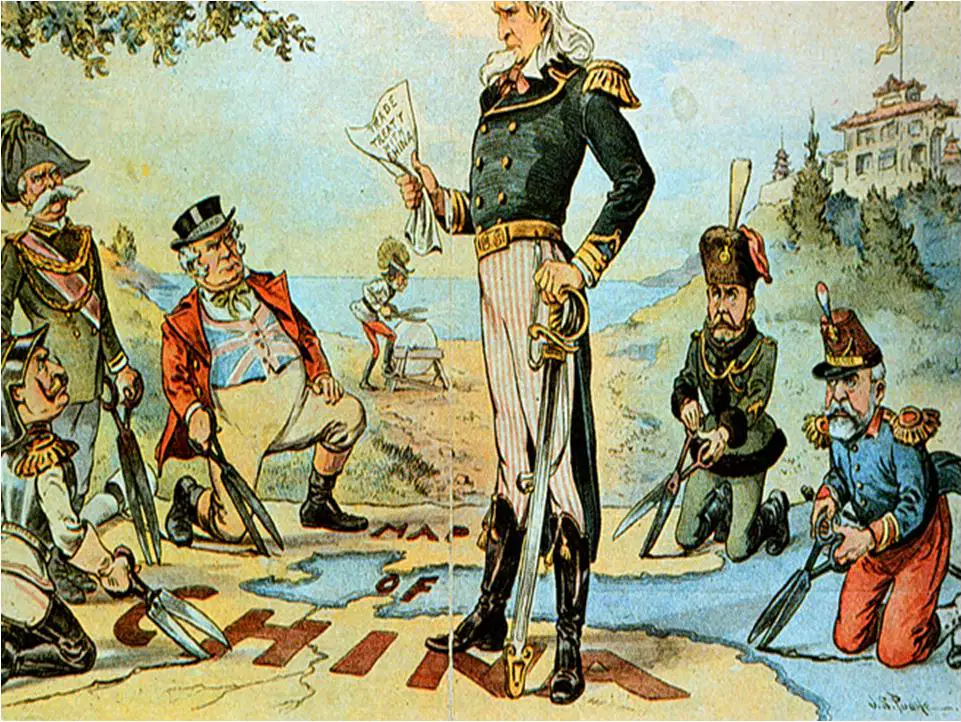
Analyze this political cartoon and identify the United States foreign policy and its purpose characterized in the drawing.
The Open Door Policy; this policy aimed to help expand trade between the United States and China.
The Treaty of Paris; this treaty was created to help create spheres of influence in Europe for the sole purpose of trading.
The Roosevelt Corollary; the purpose of this policy was to protect American business interests in China.
The Platt Amendment; this amendment required the new Chinese constitution to include for the United States to control parts of China.
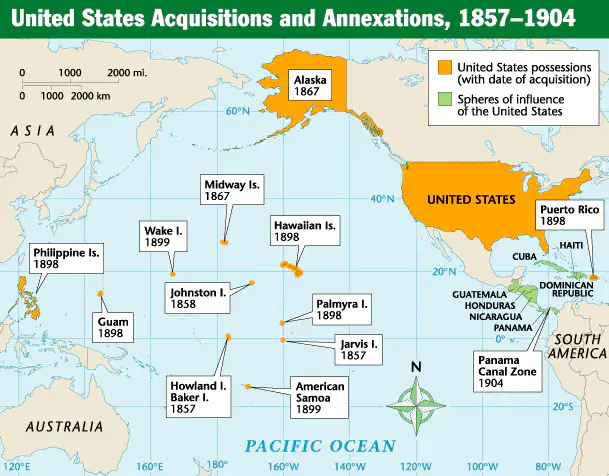
When the United States gained control of Puerto Rico in the Caribbean and the Philippines in the Pacific, it realized the need for a short cut between the two bodies of water. President Roosevelt tried to negotiate a treaty with Colombian officials but was unsuccessful. The aim of this proposed treaty was for ____.
the signing of the Platt Amendment for the new Cuban constitution.
a cease fire between the Panamanians and Colombians.
the annexation of both the Hawaiian Islands and the Philippines.
the leasing of land that would be used to build the Panama Canal.

Analyze the political cartoon titled "Big Stick" in the Caribbean Sea. Which of the following best fits as a subject for this political cartoon? (2 points)
The Roosevelt Corollary as symbolized by the Big Stick extended the Monroe Doctrine to include a policy of protecting and taking action when necessary in the Caribbean Islands.
The Big Stick Diplomacy was also called Dollar Diplomacy which refused to recognize Caribbean governments that were not democratic.
The Missionary Diplomacy policy as symbolized by the Big Stick encouraged American business investment to help the Caribbean economy.
Big Stick Diplomacy promoted the Chinese Open Door Policy of trade relations within the Caribbean for Cubans.
Following up on Taft's "Dollar Diplomacy," President Wilson promoted "Moral Diplomacy" or "Missionary Diplomacy." The objective of this foreign policy focused on (2 points):
the United States' responsibility to only work with Christian countries throughout all of Latin America.
the United States' obligation to invest in the economies of Latin America.
the United States' role in recognizing and cooperating with democratic nations while refusing to recognize or work with authoritarian or oppressive governments.
the duty of the United States to help governments succeed through collective partnerships with all Latin American countries.
When America fought and won the war with Spain in 1898, the U.S. government promised to protect Cuban independence. The Platt Amendment of 1903 (2 points):
established the right for the United States to intervene in Cuban affairs to ensure Cuban independence.
authorized the United States to vote in Cuban elections and form the Cuban government.
ratified the treaty between Cuba and the United States for the purpose of constructing the Panama Canal.
provided United States citizenship rights to the Cuban people.
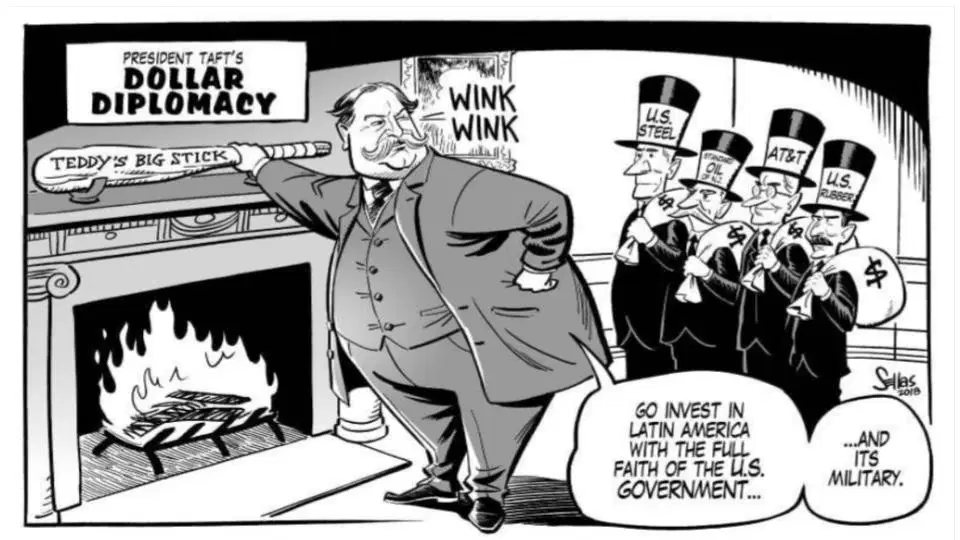
President William Howard Taft used the idea of "Dollar Diplomacy" in Latin America. An example of this policy was used with Nicaragua in encouraging American economic investments with the failed aim to stabilize the government.
The purpose of Dollar Diplomacy in Latin America was to
copy the success of the Open Door Policy in China.
encourage European business investment.
have friendly relations with only governments that were democratic.
encourage American business investment and promote stability.
Filipinos were promised their freedom from the Spanish if they helped the United States in the Spanish-American War. After the Spanish were defeated and the Filipinos felt the Americans didn't fulfill the promise to them, how did they respond?
Filipino rebels, led by Emilio Aguinaldo, fought against the Americans but were defeated after 3 years of war.
Filipinos and Americans negotiated a treaty and the Philippines became a free country.
Filipinos fought the Americans and won their independence within a year.
Filipinos fought with Americans at first, but surrendered quickly with few casualties.

