
 Worksheets
7th KAP Math Transformations Review
Total questions: 100
Worksheet time: 4hrs 15mins
(x, y) ----> (x + 2, y - 3)

Which translation will move the blue shape to the green shape?
3 Left
3 Down
3 Right
3 Up
2 Right
3 Up
2 Left
3 Down
(x, y) -----> (x, y +4)
When translating left or right on a coordinate plane, what coordinate is affected?
x-coordinate
y-coordinate
When translating up or down on a coordinate plane, what coordinate is affected?
x-coordinate
y-coordinate
Slide 3 up and 2 right

Which triangle is a translation of triangle X?
triangle B
triangle A
triangle D
triangle C


Which graph shows a translation?


What is the translation of the point (3, 5) by 2 units to the right and 3 units down?
(5, 2)
(3, 2)
(5, 8)
(1, 8)
What are the coordinates of the point obtained by translating (1, -3) 4 units to the left and 2 units up?
(-7, -1)
(5, -1)
(1, -5)
(-3, -1)
What is the translation of the point (6, -1) by 3 units to the left and 2 units up?
(3, -3)
(-3, 1)
(9, -3)
(3, 3)
What are the coordinates of the point obtained by translating (−3, 2) 5 units to the right and 1 unit down?
(-1, 3)
(7, 1)
(2, -1)
(2, 1)
What is the translation of the point (−1, 6) by 4 units to the right and 3 units down?
(3, 3)
(−5, 0)
(0, 3)
(7, 9)


Describe the transformation that has occured.
Translation of 4 units to the left
Reflection over the y-axis
Reflection over the x-axis
Translation of 4 units to the right

What shape is the result of a reflection across the x-axis from shape E?
A
C
B
D

What is the reflection of F (3, 4) over the x-axis?
F' (-3, -4)
F' (3, -4)
F' (-3, 4)
F' (4, 3)

What is the reflection of R (-1, 6) over the y-axis?
R'(1, 6)
R'(6, 1)
R' (-1, 6)
R' (-6, 1)
What is a key word to describe a reflection of a point?
look-a-like image
same image
mirror image
twin image
Reflect the ordered pair (-2, 5) over the x-axis. What are the coordinates for the reflection.
A. (2, 5)
B. (-2, -5)
C. (-2, 5)
D. (5, -2)
Reflect the ordered pair (5, -2) over the y-axis. What are the coordinates for the reflection.
A. (5, 2)
B. (-5, -2)
C. (-5, 2)
D. (-2, 5)

Point A has the coordinates (-5, 1).
Point B has the coordinates (-9, 3).
Point C has the coordinates (-8, 10).
What would the coordinates of B' be if it was reflected across the x-axis?
(a)

Point A has the coordinates (4, -5).
Point B has the coordinates (6, -3).
Point C has the coordinates (10, -6).
Point D has the coordinates (5, -10).
What would the coordinates of B'' be if it was reflected across the x-axis and then the y-axis?
(a)
Point A has the coordinates (4, -5).
Point B has the coordinates (6, -3).
Point C has the coordinates (10, -6).
Point D has the coordinates (5, -10).
What would the coordinates of C' be if it was reflected across the y-axis?
(a)

Point A has the coordinates (3, 4).
Point B has the coordinates (8, 2).
Point C has the coordinates (10, -10).
What would the coordinates of C'' be if it was reflected across the x-axis and then the y-axis?
(a)
Point A has the coordinates (3, 4).
Point B has the coordinates (8, 2).
Point C has the coordinates (10, -10).
What would the coordinates of B' be if it was reflected across the y-axis?
(a)
Point A has the coordinates (3, 4).
Point B has the coordinates (8, 2).
Point C has the coordinates (10, -10).
What would the coordinates of A' be if it was reflected across the x-axis?
(a)
Plot the point (3, 4) on a coordinate plane. Then, dilate the point by a scale factor of 2. What are the new coordinates of the dilated point?
(5, 6)
(1, 2)
(6, 8)
(9, 12)
On a coordinate plane, point A is located at (2, 5). Point B is the image of point A after a dilation with a scale factor of 3. What are the coordinates of point B?
(8, 20)
(5, 10)
(6, 15)
(3, 8)
If point P(4, 6) is dilated by a scale factor of 0.5, what are the coordinates of the dilated point?
(3, 5)
(6, 4)
(2, 3)
(5, 7)
Identify the center of dilation and the scale factor for the dilation that maps point Q(2, 3) to Q'(6, 9) on a coordinate plane.
(4, 6), 1.5
(2, 3), 2
(0, 0), 3
(1, 1), 4
A triangle with vertices at (1, 2), (3, 4), and (5, 6) is dilated with a scale factor of 2. What are the coordinates of the vertices of the dilated triangle?
(0, 0), (2, 2), (4, 4)
(3, 6), (5, 8), (7, 10)
(4, 8), (6, 10), (8, 12)
(2, 4), (6, 8), (10, 12)
Point R(7, 8) is dilated by a scale factor of 0.75. What are the coordinates of the dilated point?
(8, 7.5)
(5.25, 6)
(6, 5.25)
(9, 9)
On a coordinate plane, point S is located at (3, 3). After a dilation with a scale factor of 4, what are the coordinates of the image point S'?
(9, 9)
(6, 6)
(12, 12)
(15, 15)
Identify the center of dilation and the scale factor for the dilation that maps point T(2, 4) to T'(6, 12) on a coordinate plane.
(0, 0), 2
(4, 2), 3
(0, 0), 3
(2, 4), 2
If point U(5, 7) is dilated by a scale factor of 1.5, what are the coordinates of the dilated point?
(7.5, 10.5)
(3, 5)
(6, 8)
(4.5, 6.5)
Plot the point V(6, 9) on a coordinate plane. Then, dilate the point by a scale factor of 0.5. What are the new coordinates of the dilated point?
(5, 8)
(7, 10)
(3, 4.5)
(4, 7)
A(3,3) B(6,6) C(9,3)

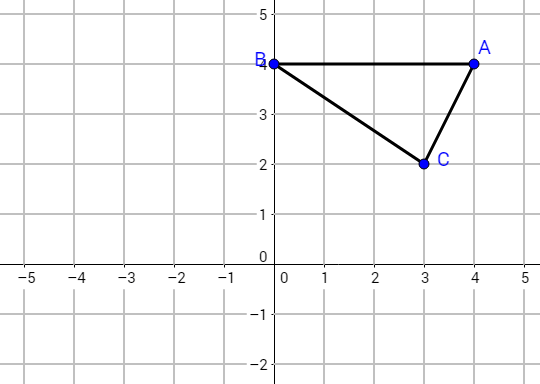

When A(3, 6) is under a dilation of 2 what are the coordinates of A'?
(3, 6)
(1.5, 3)
(6, 12)
(12, 6)

A rectangle has a base of 10 mm and a height of 6 mm, and we double the height, what is the new perimeter and area?
Perimeter = 22 mm and Area = 120 mm
Perimeter = 44 mm and Area = 120 mm
Perimeter = 32 mm and Area = 240 mm
Perimeter = 32 mm and Area = 240 mm

A triangle has a perimeter of 16 cm and an area of 12 cm2. If the dimensions are doubled what is the new perimeter and area?
P =32 cm and A = 24 cm2
P = 32 cm and A = 48 cm2
P = 24 cm and A = 24 cm2
P = 24 cm and 48 cm2

A pentagon has an area of 25 ft2, the sides are tripled what is the new area?
A = 75 ft2
100 ft2
200 ft2
225 ft 2

When the dimensions of a figure are changed by a scale factor of 3, what happens to the perimeter?
The perimeter will be multiplied by 3
The perimeter will be 3 more than the preimage
The perimeter will be multiplied by 9
There is no way to know, we don't have the measurements

The measurements of a hexagon are changed by a scale factor of 4, what will happen to the area?
The area will be multiplied by a factor of 4
The area will be multiplied by a factor of 8
The area will be multiplied by a factor of 16
We cannot determine the new area


Which function was used to produce the image?
f(x, y) = (1/7x, 1/7y)
f(x, y) = (7x, 7y)
f(x, y) = (4x, 4y)
f(x, y) = (8x, 8y)

What is the scale factor?
k = 2
k = 1/2
k = 4
k = 1/4
A(3,3) B(6,6) C(9,3)
If an image is dilated by a scale factor below, the dilation is a...
k = 310Reduction
Enlargement
When the scale factor of a dilation is less than one, the dilation is a...
Reduction
Enlargement
A dilation produces a similar figure
True
False


If you were to rotate ABCD 180° about the origin, what would the coordinates of C' be?
(1, -3)
(-1, 3)
(-1, -3)

If you were to rotate ABCD 270 degree clockwise about the origin, what would the coordinate of B' be?
(6,5)
(-5, 5)
(5, 65
(-5,-5)
Rotate the point (-3,-4) around the origin 90 degrees clockwise. State the image of the point.
Rotate the point (-3,-4) around the origin 360 degrees clockwise. State the image of the point.
(-3,-4)
Rotate the point (3, -5) around the origin 90 degrees counterclockwise. State the image of the point.
(5, 3)
(-5, 3)
(5,-3)
(-3,-5)
Rotate the point (-2, 1) around the origin 90 degrees counterclockwise. State the image of the point.
(-1, 2)
(-1, -2)
(2, -1)
(-2, 1)
If (4,-2) → (4,-2) represents a counterclockwise rotation of the point on a coordinate plane, how many degrees is the rotation?
90
180
270
360
If (3,2)→(-3,-2) represents a counterclockwise rotation of the point on a coordinate plane, how many degrees is the rotation?
90
180
270
360

Triangle A is rotated 90° clockwise with the origin as the center of rotation to create a new figure. Which triangle shows the new location?
A
B
C
D


Rotations, like translations and reflections, produce congruent figures.
true
false

Which quadrant is Point U located?
quadrant 1
quadrant 2
quadrant 3
quadrant 4

If this figure is rotated 180 degrees, which quadrant will it end up in?
quadrant 1
quadrant 2
quadrant 3
quadrant 4
A spinning merry go round in a park is an example of a _______________.
translation
reflection
rotation
dilation
A car driving down a straight road is an example of a _________.
rotation
reflection
translation
dilation
Which algebraic representation represents the transformation when a figure is rotated 90° clockwise?
(x, y) --> (-x, -y)
(x, y) --> (y, -x)
(x, y) --> (-y, x)
(x, y) --> (x, y)

Select the Algebraic representation that matches the image


Select the only two algebraic representations that can work for a reflection


Reflect across x and (a) stays the same.
Reflect across y and (a) stays the same

Match the algebraic representation to the image. Remember the saying: Reflect across ___ and ___ stays the same.

Match the algebraic representation to the image. Remember the saying: Reflect across ___ and ___ stays the same.
In a translation the word RIGHT means:
x+
x-
y+
y-
In a translation the word Down means:
x+
x-
y+
y-
In a translation the word UP means:
x+
x-
y+
y-
In a translation the word LEFT means:
x+
x-
y+
y-

