
 Worksheets
Segment 2 Test
Total questions: 73
Worksheet time: 1hrs 21mins
1.
What are the reactants of cellular respiration in plants?
carbon dioxide and water
glucose and carbon dioxide
the reactants of the electron transport chain
oxygen and glucose
Which of the following is a reactant to photosynthesis?
Oxygen
Carbohydrates
Glucose
Water
Select all that are products of Photosynthesis.
Water
Carbon Dioxide
Oxygen
Sunlight (Light Energy)
Glucose (Sugar/food)

Exit: Carbon dioxide
Exit: Glucose
Exit: Oxygen
Exit: Water vapor
Which of the following is the correct equation for PHOTOSYNTHESIS?
light + carbon dioxide + water --> glucose + oxygen
carbon dioxide + sugar + water --> oxygen + light
oxygen + light + water --> carbon dioxide + sugar
carbon dioxide + oxygen + water --> Light+ Sugar
What two energy molecules are made by the light reaction? Select both answers.
NADPH
glucose
ATP
oxygen gas

What is this reaction showing? (select 2 correct)
production of carbon dioxide
production of oxygen gas
production of sugar
production of water
ATP is also known as
aldehyde triphosphate
arginine titraphosphate
adenine tetra phosphate
adenosine triphosphate

What does the number 1 represent?
water
sunlight
carbon dioxide
oxygen
Which biomolecule is a source of quick energy for cells?
carbohydrates
lipids
proteins
nucleic acids
Which biomolecule plays a role in muscle development and repair?
carbohydrates
lipids
proteins
nucleic acids
A mutation in DNA would initially start with which biomolecules?
carbohydrates
lipids
proteins
nucleic acids
Which of these is NOT a lipid
fats
oils
amino acids
waxes
Glucose, Lactose, and Sucrose all end in -ose. This means they are sugars...which group of biomolecules do they belong to?
carbohydrates
lipids
proteins
nucleic acids
Amino Acids are the monomers of __________.
Nucleic Acids
Proteins
Carbohydrates
Lipids
Carbohydrates are primarily made out of...
Carbon
Hydrogen
Oxygen
Nitrogen
Phosphorus
Proteins are primarily made out of... (and sometimes Sulfur)
Carbon
Hydrogen
Oxygen
Nitrogen
Phosphorus
Nucleic acids are primarily made out of...
Carbon
Hydrogen
Oxygen
Nitrogen
Phosphorus
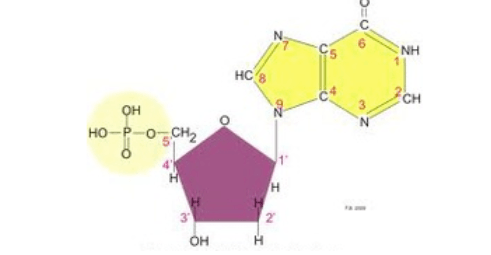
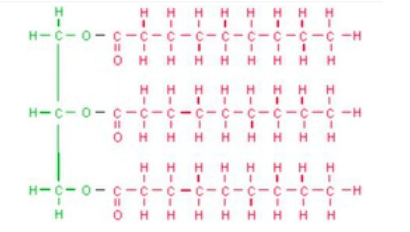
Which are examples of proteins?
glucose, pasta, bread
fats, oils, waxes
meats, enzyme, lactase, eggs
DNA, RNA
What is the equation for aerobic cellular respiration?

Cellular respiration (a) energy.
In what molecule is the energy carried in cells?
Glucose
Oxygen
ATP
Carbon Dioxide
What materials GO INTO cellular respiration?
Glucose
ATP
Oxygen
Carbon Dioxide
Water
During (a) cellular respiration, 36-38 (b) are generated from one glucose molecule. During (c) cellular respiration, 2 ATP molecules are generated from a single (d) molecule.
What are the TWO inputs of photosynthesis?
ATP
carbon dioxide
glucose
oxygen gas
water
What are the TWO outputs of photosynthesis?
ATP
carbon dioxide
glucose
oxygen gas
water
What are the TWO inputs of cellular respiration?
ATP
carbon dioxide
glucose
oxygen gas
water
What are the THREE outputs of cellular respiration?
ATP
carbon dioxide
glucose
oxygen gas
water
In which way are photosynthesis and cellular respiration different?
Cellular respiration stores ATP, while photosynthesis releases ATP.
Cellular respiration produces oxygen, while photosynthesis uses oxygen.
Photosynthesis releases energy, while cellular respiration stores energy.
Photosynthesis uses carbon dioxide, while cellular respiration produces carbon dioxide.

Cellular Respiration's goal is to (a)

In the energy pyramid here, how much of the energy in each level gets transferred to the next level for the organisms to use for energy? (a)
(a) + oxygen ⇒ water + (b) + (c)
The (a) are responsible for converting glucose (food) into (b) for the cell.
Cellular respiration is the process of converting sugar into energy (ATP) for the cell. Where does cellular respiration take place? (a)
The chemical formula for cellular respiration: (a) + (b) → (c) + (d) + (e)
What are the two main products of anaerobic lactic acid fermentation?
ethanol and carbon dioxide
lactic acid and ATP
glucose and oxygen
pyruvate and water
A carbon reservoir that stores more carbon than it releases is a ______.
carbon sink
carbon pocket
the atmosphere
The following are examples of sources of CO2 into the atmosphere EXCEPT
humans
respiration
overheated molecules
methane from cows
deforestation
CO2 moves directly between atmosphere and the ocean by dissolving into and out of ocean water at the surface is known as ...
CO2 movement
burial
direct exchange
direct point source
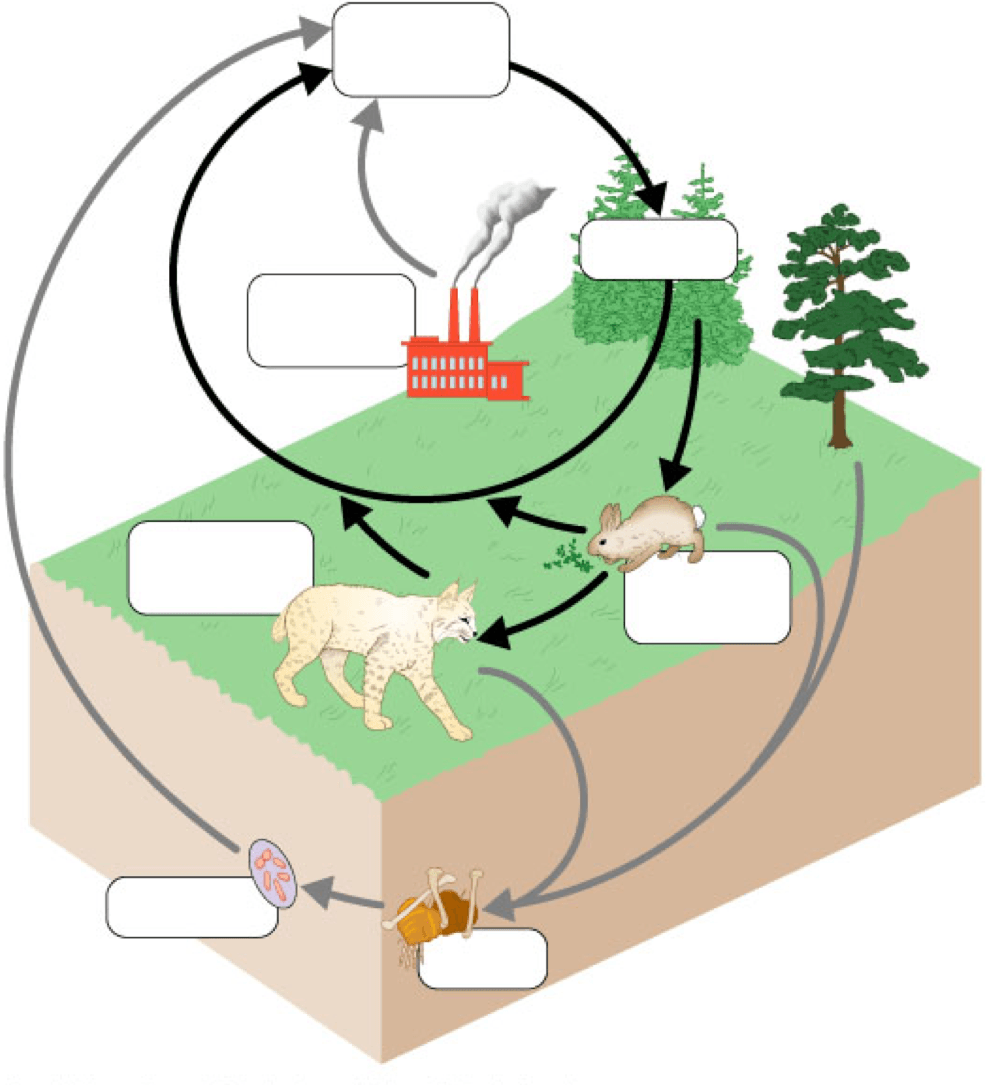
Which is a true statement?
Humans depend on oxygen, plants depend on carbon dioxide
Plants produce carbon dioxide
Humans depend on carbon dioxide, plants depend on oxygen
Humans don't depend on plants for the air they need
How do animals get carbon?
By eating plants and or other animals.
They absorb it from the atmosphere.
From the ground
They do not get carbon from anywhere.
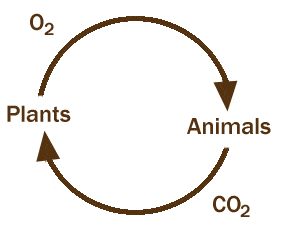
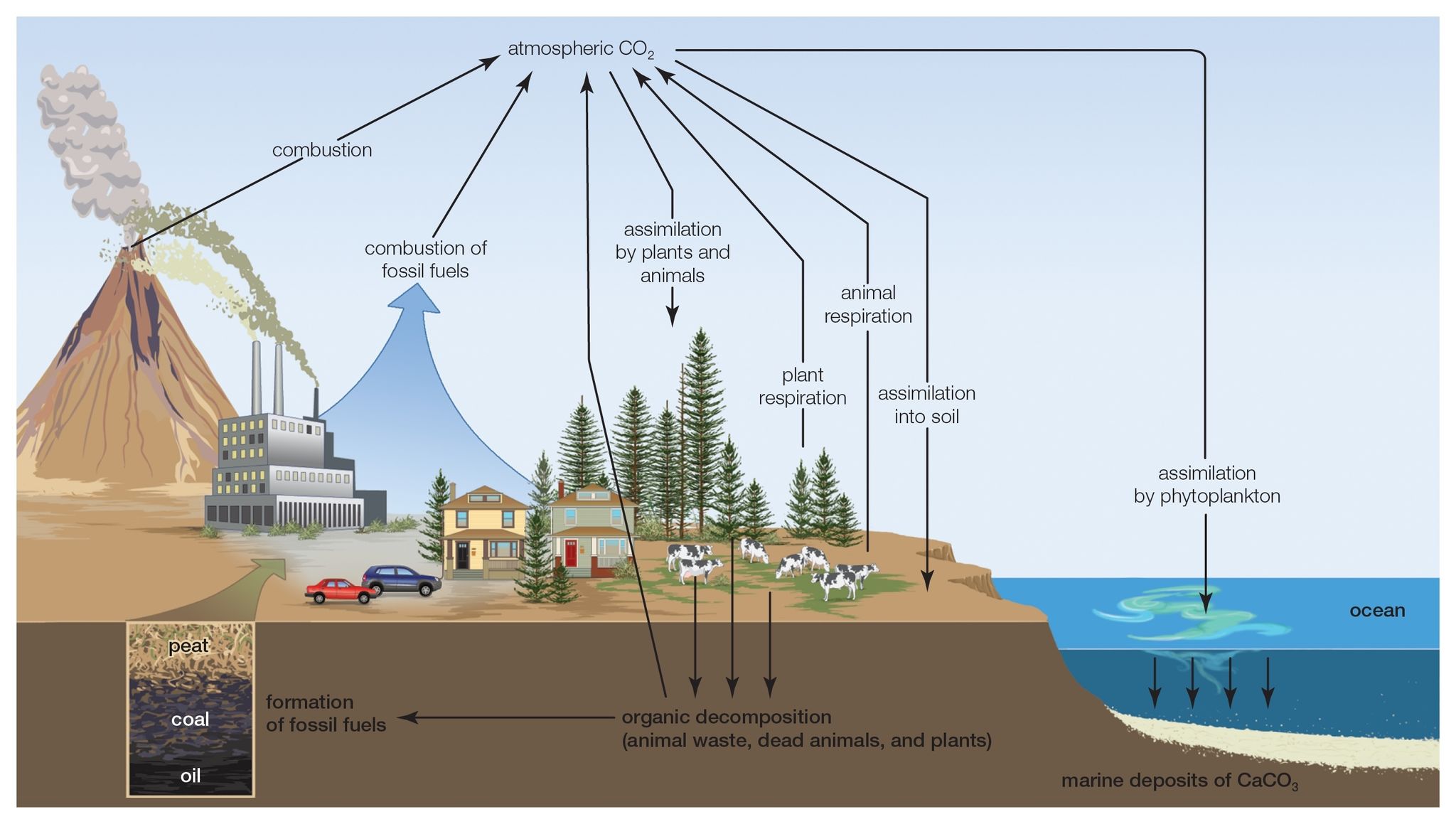
4) Which part of the carbon cycle involves animals breathing in oxygen and out carbon dioxide?
Photosynthesis
The oceans
Respiration
Decay
Combustion
10) How has man influenced the carbon cycle and increased the amount of carbon in the atmosphere?
Burning coal
Cutting down trees
Burning oil
All of the above
None of the Above
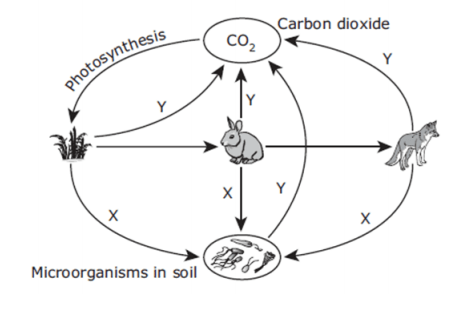
Y : Predation
Y : Decomposition
Y : Nitrogen Fixation
Y : Respiration
How do humans affect the carbon cycle?
Inhaling oxygen
Wearing sunscreen
Using pencils to write
Exhaling carbon dioxide
The (a) is where photosynthesis happens
Cellular respiration is the process of converting sugar into energy (ATP) for the cell. Where does cellular respiration take place? (a)
Which of the following best describes the flow of energy in an ecosystem?
It flows from producers to consumers to decomposers.
It cycles between the sun, plants, and animals.
It is primarily stored in the form of chemical energy in plants.
It flows from decomposers to consumers to producers.

What is this?
precipitation
evaporation
condensation

What is this?
precipitation
evaporation
condensation
Where is most of Earth's water?
in oceans and glaciers
underground
in clouds
__________________ is the process by which moisture is carried through plants from roots to small pores on the underside of leaves, where it changes to vapor and is released to the atmosphere. It is essentially evaporation of water from plant leaves.
Transpiration
Percolation
Infiltration
Plant Uptake

