
Font size
 Worksheets
The Road to Revolution
Total questions: 11
Worksheet time: 6mins
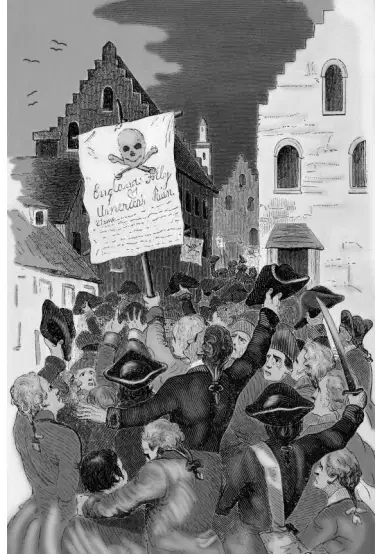
Why were the people shown in the image rioting?
They opposed a tax on paper products.
They resented the policy of salutary neglect.
They wanted to import sugar and other goods.
They disliked their government representatives.

Why did Parliament enforce the policy shown in the map?
to preserve forests in the Appalachian Mountains
to respect the boundaries of Spanish territory
to prevent conflict with Native Americans
to discourage trade with French trappers
“The very act of taxing, exercised over those who are not represented, appears to me to be depriving them of one of their most essential rights, as freemen; and if continued, seems to be in effect an entire disfranchisement of every civil right.”
Which statement would James Otis agree with?
Colonists should be able to impose laws on the British.
King George III is unfit to rule over the British Empire and should be deposed.
Taxation without representation goes against the rights of Englishmen.
The colonists should pay their fair share of French and Indian War debts.
What was the purpose of colonial militias?
to organize a permanent standing army
to protect trade from British interference
to protect local communities from British attack
to quickly communicate information between cities
What were the effects of the Boston Tea Party?
The colonists were required to pay a new tax on tea.
Colonists taunted and threw snowballs at British soldiers.
The Sons of Liberty organized the Committee of Correspondence.
Parliament passed the Intolerable Acts.
Delegates met at the First Continental Congress.
Why is Crispus Attucks important to U.S. history?
He organized numerous boycotts of British products.
He is believed to be the original organizer of the minutemen.
He distributed pamphlets that spoke out against British taxation.
He is considered the first person to die for American independence.
Why did the colonists oppose the Townshend Acts?
They placed new taxes on sugar.
They denied the colonists’ right to a trial by jury.
They made smuggling tea from the Dutch illegal.
They forced the colonists to house soldiers in their homes.
Let us not deceive ourselves, sir. These are the implements of war and subjugation [oppression]; the last arguments to which kings resort. I ask gentlemen, sir, what means this martial array, if its purpose be not to force us to submission? Can gentlemen assign any other possible motive for it? Has Great Britain any enemy, in this quarter of the world, to call for all this accumulation of navies and armies? No, sir, she has none. They are meant for us: they can be meant for no other. They are sent over to bind and rivet upon us those chains which the British ministry have been so long forging. And what have we to oppose to them? Shall we try argument? Sir, we have been trying that for the last ten years. Have we anything new to offer upon the subject? Nothing. We have held the subject up in every light of which it is capable; but it has been all in vain. Shall we resort to entreaty and humble supplication [pleading]? What terms shall we find which have not been already exhausted? . . . Our petitions have been slighted; our remonstrances [protests] have produced additional violence and insult; our supplications have been disregarded; and we have been spurned, with contempt, from the foot of the throne! In vain, after these things, may we indulge the fond hope of peace and reconciliation. There is no longer any room for hope. If we wish to be free—if we mean to preserve inviolate those inestimable privileges for which we have been so long contending . . . we must fight!
What does Patrick Henry suggest when he asks, “Has Great Britain any enemy, in this quarter of the world, to call for all this accumulation of navies and armies?”
The British are preparing to pass more taxes.
The troops are there to oppress the colonists.
The British are preparing for another war with France.
The troops are there to support colonial governments.
5th. That the only representatives of the people of these colonies, are persons chosen therein, by themselves; and that no taxes ever have been, or can be constitutionally imposed on them, but by their respective legislatures. . . .
8th. That the late act of Parliament, entitled, An act for granting and applying certain stamp duties, and other duties in the British colonies and plantations in America, etc., by imposing taxes on the inhabitants of these colonies, and the said act, and several other acts, by extending the jurisdiction of the courts of admiralty beyond its ancient limits, have a manifest tendency to subvert the rights and liberties of the colonists.
According to the excerpt, why do the colonists oppose the Stamp Act?
It makes paper goods too expensive.
It was imposed without their consent.
It disrupts trade between the colonies.
It only raises a small amount of revenue.
What was the main purpose of John Dickinson’s Letters from a Farmer in Pennsylvania?
to urge colonists to resist British taxation
to argue against the rights of Englishmen
to discourage colonists from boycotting British goods
) to shape public opinion in favor of the Loyalist cause
How did the The Sons of Liberty increase the likelihood of war between Great Britain and the American colonies?
Because they organized protests, petitions, and boycotts against British policies and taxes;
They refused to organized protests, petitions, and boycotts against British policies and taxes;
The Sons of Liberty organized the Committee of Correspondence to quickly share information between colonies following the Boston Massacre.
Because the Sons of Liberty played a role in organizing the Boston Tea Party.
Because the Son of Liberty had killed a British soldier.

