
 Worksheets
Computational thinking - General review of the course
Total questions: 10
Worksheet time: 11mins
Which is the definition for Computational Thinking?
A problem-solving thought process in which a problem is defined and structured, in order to arrive at an effective solution in a finite time with a specific sequence of steps
The systematic way a computer operates by executing lines of code.
The method for writing and running programs to accomplish specific tasks.
The process of coding and programming in a particular computational language, such as Python.
Match the computational thinking pillar with its definition:
The pillar that fragments a complex problem into smaller, simpler problems.
Decomposition
The pillar that identifies similarities or trends within problems to simplify the approach and establish standard solutions.
Pattern Recognition
The pillar where unimportant details are filtered or ignored, focusing on the key information or the ESSENCE of the problem.
Abstraction
The pillar where a set of specific instructions are defined to solve a specific problem.
Algorithm design
Which of the following is not one of the six characteristics of a good algorithm?
General and Precise:
The algorithm should be applicable to a broad set of problems while providing specific instructions to achieve the desired outcome.
Sequential and Ordered:
The steps of the algorithm must be organized one at a time in a specific order, ensuring that each step logically follows the previous one.
Defined and Finite:
An algorithm should have a clear starting point and a goal, with a limited number of steps that can be completed in a finite amount of time.
Ambiguous and Flexible:
The algorithm should allow for various interpretations and adjustments, adapting to different situations without strict guidelines
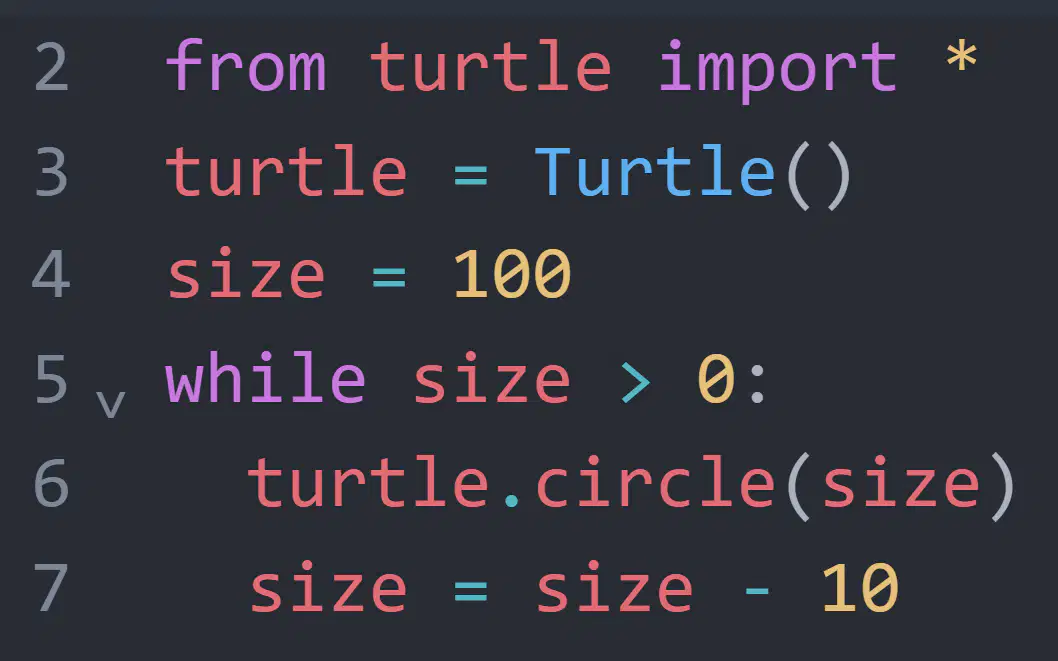
What is happening on this program?
The code creates a turtle and draws one large circle with a radius of 100 units.
The code creates a turtle that draws a series of circles with a decreasing radius, starting from 100 units and reducing the size by 10 units until the radius reaches cero.
The code creates a turtle and defines a size function that draws a circle with a radius of 100 units, then the program uses a loop to draw 10 different circles.
The code creates a turtle and defines a size function that draws a circle with a radius of 100 units.
Match the columns:
Raw unprocessed facts and figures that are collected for future analysis or reference.
DATA
Processed and organized data with a meaning. It is useful for decision-making.
INFORMATION
A “package” that contains data. A named memory location whose content can change throughout the program's execution.
VARIABLE
Which of the following best describes the difference between a FOR loop and a WHILE loop in programming?
A WHILE loop requires an index or counter variable, but a FOR loop does not.
A for LOOP is used when the number of needed iterations is known. A WHILE loop is used when the number of iterations is unknown or depends on a certain condition.
Both FOR and WHILE loops are used only when the exact number of iterations is known in advance.
A FOR loop runs until a condition is false, a WHILE loop runs a set number of times.
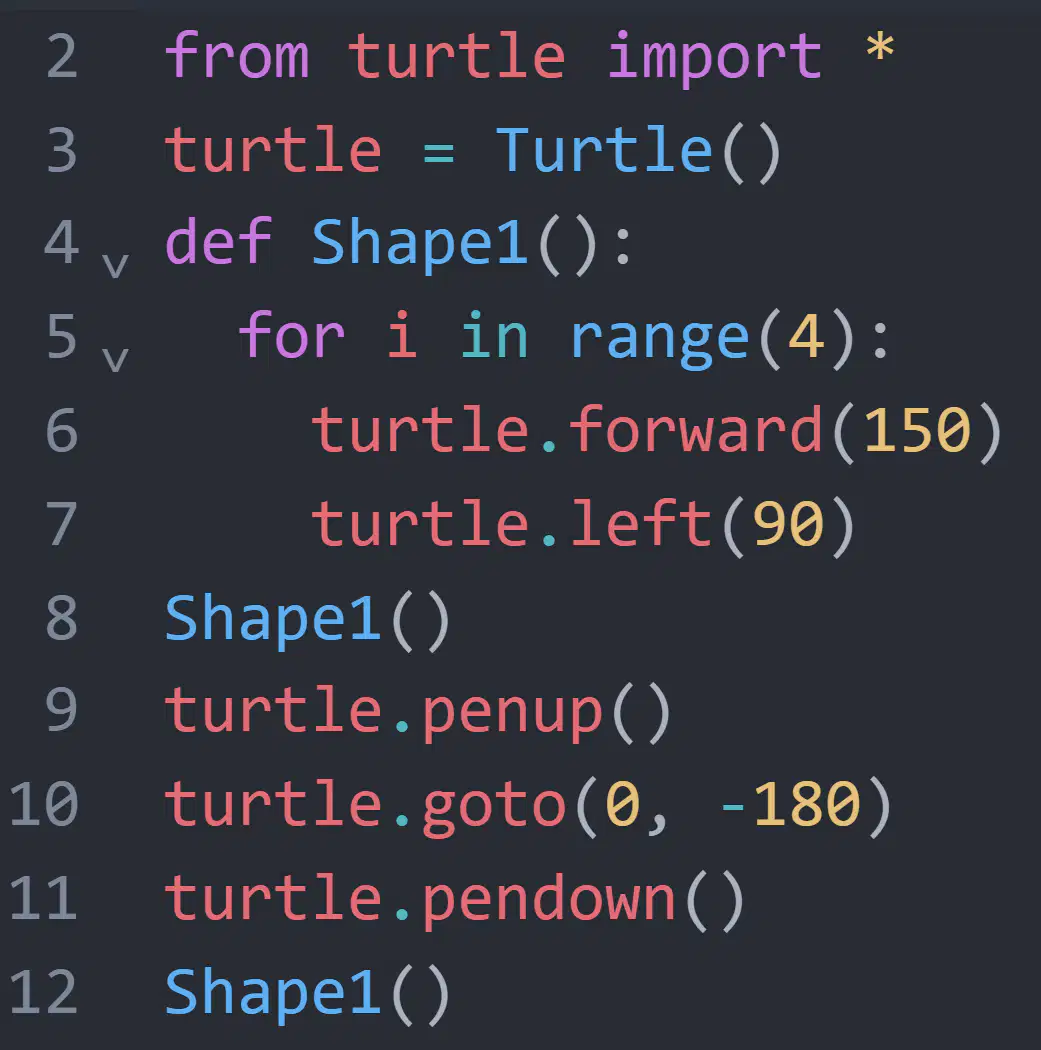
What will be the result of this program?
Two equal squares will be drawn, one on top of the other.
Two rectangles of different sizes will be drawn on the same place.
One square will be drawn.
Nothing will be drawn.
Match the concept to its definition
Allows the computer to make decisions based on a Boolean condition. Depending on whether a condition is TRUE or FALSE, one or another set of instructions is executed (IF, ELSE, ELIF cases).
Decision structure
Compares two values and returns a Boolean result (TRUE or FALSE). == , !=, >, < , >=, <=.
Relational Operation
Combines two or more Boolean conditions and returns a single Boolean value. It is useful for avoiding nested conditions. AND, OR and NOT.
Logical operation
Performs a mathematical calculation involving numbers, using basic operators such as addition (+), subtraction (−), multiplication (×), division (÷).
Arithmetic operation
Match the labels in their correct place
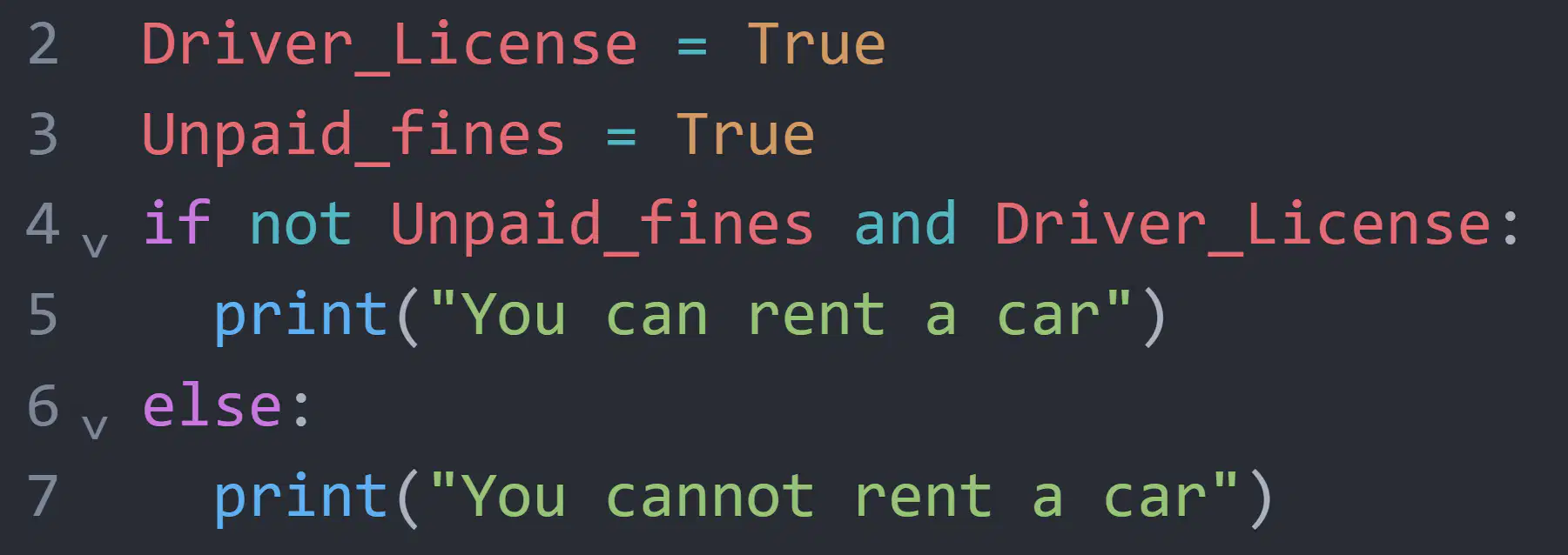
To rent a car, you must NOT have any unpaid fines, AND you must have a valid driver’s license.
Following this code, will I be able to rent a car?
YES
NO

