
 Worksheets
Layers of the Earth Quiz
Total questions: 28
Worksheet time: 14mins
Inside the Earth has four major layers. Which layer causes movement in the continents?
Crust
Mantle
Outer Core
Inner Core
Which layer of the Earth is made up of tectonic plates?
Inner Core
Outer Core
Asthenosphere
Lithosphere
Name the layers correctly.
1 – mantle, 2 – inner core, 3 – outer core, 4 – crust
1 – crust, 2 – mantle, 3 – inner core, 4 – outer core
1 – crust, 2 – mantle, 3 - outer core, 4 – inner core
1 – crust, 2 – inner core, 3 – mantle, 4 – outer core
In which layer would you find convection currents?
Mantle
Crust
Inner core
Outer core
As we go deeper into the Earth, which of the following is true?
Pressure goes up and temperature goes down
Pressure goes down and temperature goes up
Both pressure and temperature go up
Both pressure and temperature go down
Alfred Wegener proposed that all continents were once joined together to form a supercontinent known as what?
Laurasia
Eurasia
Pangea
Pancreas
Tectonic plates are pieces of the _______ that move on the asthenosphere.
Lithosphere
Atmosphere
Hydrosphere
Biosphere
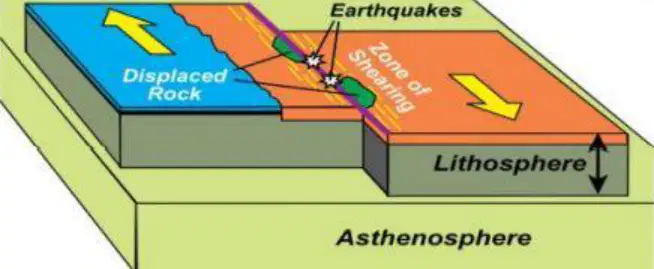
Identify the type of plate movement.
Divergent boundary
Convergent boundary
Transform boundary
None of the above
A plate boundary is a place where two tectonic plates meet. Which statement below shows the correct definition of a tectonic plate boundary?
At a divergent boundary, plates separate.
At a transform boundary, plates move apart.
At a convergent boundary, plates slide past each other.
At a divergent boundary, one plate sinks under the other.
Which statement best supports the theory of continental drift?
Basaltic rock is found to be younger at increasing distances from a mid-ocean ridge.
Marine fossils are often found in deep-well drill cores.
The present continents appear to fit together as pieces of a larger landmass.
Areas of shallow-water seas tend to accumulate sediment, which gradually sinks.
Alfred Wegener’s theory of continental drift was not well accepted because he could not explain the force that moved continents. Current theories explain this movement with:
Subduction zones at continental margins
Hot spots forming under continents
Magnetic reversals of the north and south poles
Convection currents in the mantle
What landforms are created by the movement of tectonic plates?
Mountains
Volcanoes
Earthquakes
Both A and B
Subduction can occur __________.
When a continental plate and oceanic plate converge
When two continental plates diverge
When two oceanic plates slide past each other
When a continental plate and oceanic plate diverge
Fossils can tell scientists:
The environment millions of years ago
How plants and animals have changed over time
How the Earth has changed over time
All of the above
What is fossilized evidence that shows animal activity in sedimentary rock called?
Pangea
Uniformitarianism
______ describes the large-scale movement of the Earth’s lithosphere.
Plate tectonics
Volcanism
Erosion
Sedimentation
The spread of molten rock that comes up through the cracks of tectonic plates and forms new oceanic crust is called _____________.
Sea-floor spreading
Subduction
Continental drift
Plate tectonics
_______ is the geological process of the past that can be seen in the geological processes occurring today.
Uniformitarianism
Catastrophism
Gradualism
Neptunism
_______ describes the weather conditions over a long period of time.
Climate
Weather
Temperature
Humidity
Pangea is Greek for, “_______.”
Large Continent
All the Earth
Drifting World
Broken Land
Which of the following statements are TRUE about Earth’s layers?
The crust is the thickest layer, and the mantle is the thinnest.
Earth’s core is entirely liquid.
The crust is solid but capable of flow.
The mantle is the thickest layer, and the crust is the thinnest.
Which of the following is NOT created by convergent boundaries?
Mountains
Volcanoes
Rift valleys
Earthquakes
This layer of the Earth is made up of crust and the upper part of the mantle.
Outer core
Inner core
Lithosphere
Mesosphere
Which of the following is NOT evidence that supports Pangea?
Fossils
Rocks and mountains
What type of rock are fossils most likely found in?
Metamorphic
Sedimentary
Igneous
None of the above
Tree rings can tell scientists _.
What the weather conditions were like
How old the tree is
Both a and b
None of the above
What layer of the Earth is solid because of the pressure from other layers?
Crust
Mantle
Inner core
Outer core
What causes convection currents in the mantle?
Wind
Solar radiation
Density differences
Earth’s rotation

