
NEW
Font size
 Worksheets
Unit 3: Cell Transport
Total questions: 21
Worksheet time: 13mins
What type of molecule diffuses across a selectively permeable membrane during the process of osmosis?
Carbon dioxide
Glucose
Oxygen
Water
What will be the most likely effect of placing a freshwater protozoan in a highly concentrated saltwater solution?
The protozoan will burst.
The protozoan will swell.
The protozoan will shrink.
The protozoan will be unaffected.
Which statement about active transport is most accurate?
Active transport utilizes energy from ATP molecules.
Active transport is essential to move water into and out of a cell.
Active transport is the only way to move ions into and out of a cell.
Active transport is required to move ions into and out of a cell.

Cells use a variety of methods to move essential materials across biological membranes. What process helps to move the molecules shown in the diagram across the membrane?
Active transport
Facilitated diffusion
Osmosis
Simple diffusion
A cell has a 95% concentration of water inside its membrane. It is placed in an environmental solution that has an 85% concentration of water. In which direction and by what process will water molecules move across the cell membrane?
Water will move out of the cell, along the concentration gradient, by osmosis.
Water will move into the cell, along the concentration gradient, by osmosis.
Water will move out of the cell, against the concentration gradient, by osmosis.
Water will move into the cell, against the concentration gradient, by osmosis.

A student creates a model to show how red blood cells react when placed in solutions with differing solute concentrations. Based on the size of the arrows, into what type of solution is each red blood cell placed?
X: hypertonic; Y: isotonic; Z: hypotonic
X: hypotonic; Y: hypertonic; Z: isotonic
X: isotonic; Y: hypertonic; Z: hypotonic
X: isotonic; Y: hypotonic; Z: hypertonic

The diagram shows two types of blood cells, normal blood cells and blood cells after they have been placed in an unknown solution. Into what type of solution were the cells placed?
Hypotonic
Hypertonic
Isotonic
Osmotic
Under what conditions are solute molecules transported across the cell membrane from the inside to the outside of an animal cell without the utilization of energy?
when the solute produced by the cell is required for essential functions
when the solute produced by the cell is a component of the cell membrane
when the concentration of solute is higher inside the cell than outside the cell
when the concentration of solute is higher outside the cell than inside the cell
A student places a cell with an initial 5% salt concentration into a solution with a 50% salt concentration. What is most likely to happen and why?
Water will move out of the cell because there is more salt outside the cell than inside
Water will move out of the cell because there is more water inside the cell than outside.
Water will enter the cell because there is more water inside the cell than outside.
Water will enter the cell because there is more water outside the cell than inside.
In which situation would water enter a cell through osmosis?
The cell is 20% water, and the cell's environment is 80% water.
The cell is 50% water, and the cell's environment is 50% water.
The cell is 60% water, and the cell's environment is 40% water.
The cell is 80% water, and the cell's environment is 20% water.

Examine the diagram that shows a container divided into sections by a semipermeable membrane. What will happen to the container over time?
Diffusion will not take place so the concentration of water and sugar will stay the same.
The water will diffuse from section 2 into section 1 until the concentration of water is balanced.
The water will diffuse from section 1 into section 2 until the concentration of water is balanced.
The sugar will diffuse from section 2 into section 1 until the concentration of sugar is balanced.
What would happen if the concentration gradient were eliminated between a cell and its environment?
Active transport would begin.
Molecules would stop moving.
The rate of diffusion would increase between the cell and its environment.
The cell would be in equilibrium with its environment.

A scientist has cells composed of 10% salt and 90% water. She needs to reduce the amount of water in the cells for an experiment. Examine the table showing 4 different solutions. Into which solution should the scientist place the cells to remove the most water?
W
X
Y
Z
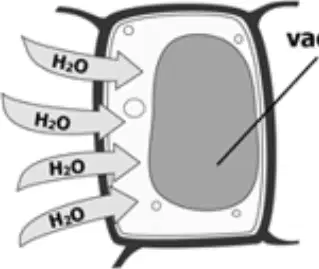
Examine the diagram of the cell. What must be true about the relative solute concentrations for this cell?
Solute concentrations are greater inside the cell than outside the cell.
Solute concentrations are greater outside the cell than inside the cell.
Solute concentrations are equal on both sides of the cell wall.
There are no solutes inside the cell.
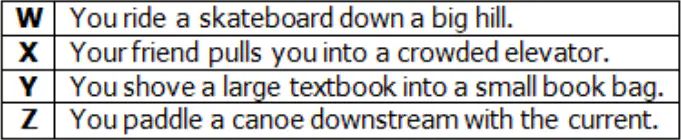
The table shows four different activities. Which two activities most accurately compare to the concept of active transport?
X and Z
X and Y
W and Y
W and Z

Analyze the graph showing the size of various molecules. Which molecule most likely requires active transport to move across the plasma membrane?
molecule W
molecule X
molecule Y
molecule Z
Which example represents a process that requires ATP for energy?
diffusion of hydrogen ions back into the mitochondrial matrix
facilitated diffusion of glucose into a cell with the concentration gradient
osmosis of water from the soil into the roots of soybean plants
transport of sodium ions out of the cell against the concentration gradient.
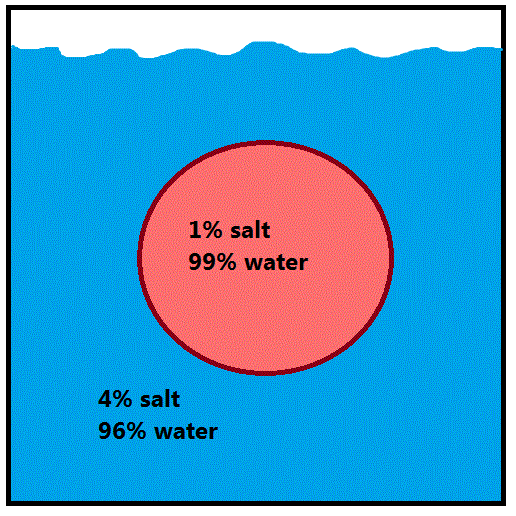
Where will the water go?
Into the cell
Out of the cell
Equally in & out - it's isotonic
There is no water

Which CELL contains MORE particles than are found in the surrounding solution?
Left
Center
Right

In the diagram shown the purple dots represent solutes. Which way would the water move through the semi permeable membrane?
From the A side to the B-side
From the B side to the A side
Water would move at equal rates, to and from both sides

In the cell pictured, which way would water move?
Into the cell, causing the cell to swell
Out of the cell, causing the cell to shrink
In and out of the cell equally, keeping the shape the same

