
 Worksheets
chemistry grade 11
Total questions: 18
Worksheet time: 10mins
These particles are found in the nucleus of the atom.
protons only
protons and electrons
electrons only
protons and neutrons
Discovered the neutron. He concluded the nucleus also contains a particle that has equal mass to the proton. But unlike the proton, its electrically neutral.
Chadwick
L. De Brogile
Schrodinger
Bohr

Whose model suggested that negative particles were mixed in with positively charged material - like seeds in a watermelon?
J.J. Thomson
Ernest Rutherford
Niels Bohr
Albert Einstein
What did the Dalton model of the atom describe it as?
An indivisible sphere
A cluster of electrons
A mini solar system
A cube-shaped structure
What is the relative electrical charge of an electron?
+1
0
-1
+2
According to the plum pudding model, what is the atom composed of?
A ball of positive charge with negative electrons embedded in it
Only neutrons and protons
Alternating layers of protons and electrons
A central nucleus surrounded by orbiting electrons
Who discovered that the atom had an small, dense, positively charged center?
Ernest Rutherford
J.J Thomson
Robert Millikan
John Dalton
Made Daltons model invalid. Protons occupy a dense central region called the nucleus. Electrons orbit the nucleus much like planets orbiting the sun.
Dalton
Thomas
Rutherford
Bohr
Discovered the electron using the cathode-ray tube. It is known as the plum pudding "chocolate chip cookie model"
Dalton
Thomas
Rutherford
Bohr
Known for his Atomic Theory. This theory states that all matter is composed of extremely small particles.
Dalton
Thomas
Rutherford
Bohr
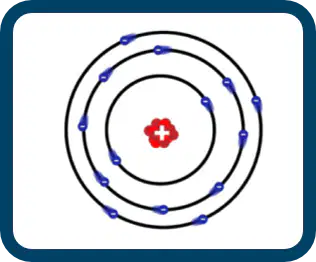
Bohr's model of an atom is also called as _____.
Nuclear Model
Plum pudding model
Solid sphere model
Planetary Model
What happens to the charge of an atom when it loses an electron?
It remains neutral.
It becomes positive.
It becomes negative.
It remains the same.
A probable location of an electron around the nucleus in a quantum mechanical model is called a(n)_____.
atomic orbital
atomic cloud
orbital cloud
none of these

In the Bohr model, how do electrons travel?
Electrons move in and out of the nucleus
Electrons do not move
Electrons move in circular orbits around the nucleus
Electrons move in a straight line
1. What element is represented in this Bohr Model?
Carbon
Hydrogen
Aluminum
Lithium
What is the spectrum region for Balmer series?
Visible
Ultraviolet
Infrared
X-rays
What is n defined as in the Bohr's atomic model?
a letter
Principal quantum number
Principal quantum variable
a quantitiy
Positively charged subatomic particles located in the nucleus of an atom
protons
neutrons
electrons
ions

