
Font size
 Worksheets
WEEK 14 BIRTH OF DEMOCRACY PLAY GREECE -FAST AND CURIOUS
Total questions: 26
Worksheet time: 14mins
main character or one of the main characters in a play
protagonist
antagonist
narrator
conflict
the opponent or enemy of the main character
antagonist
protagonist
conflict
characterization
a struggle between forces
character
antagonist
protagonist
conflict
narrator
main character
speaker who presents important info, but has no role
means through which the character is described
opponent or enemy
a government run by the people
Aeropagus
Pericles
democracy
aristocrat
highest hill in Athens- site of ancient temples and government buildings
city-state
aristocrat
Aeropagus
Acropolis
member of the upper class
Assembly
aristocrat
city-state
ostracize
an independent state (country) consisting of one city and the area around it
nation-state
city-state
state
country
to send into exile (Athenians could vote to exile someone for 10 years by writing the person's name on a piece of pottery called ostraca) This is similar to impeachment and censorship- it removes the person's influence on the society and government.
ostracize
aristocrat
Acropolis
Parthenon
helped give common people more power
Pericles
Ephialtes
Aristocrat
reform
to make better; improve
reform
politics
democracy
represent
to act or speak for in government
represent
common
aristocrat
democracy
the mass of ordinary people, especially those without a title of nobility or royalty
common
aristocrats
Aeropagus
reform
a person considered to be in the highest class
aristocrat
common
Pericles
people
the society of Athens
Athenian
Athensish
common
idk
able to vote
citizens
women
slaves
foreign residents
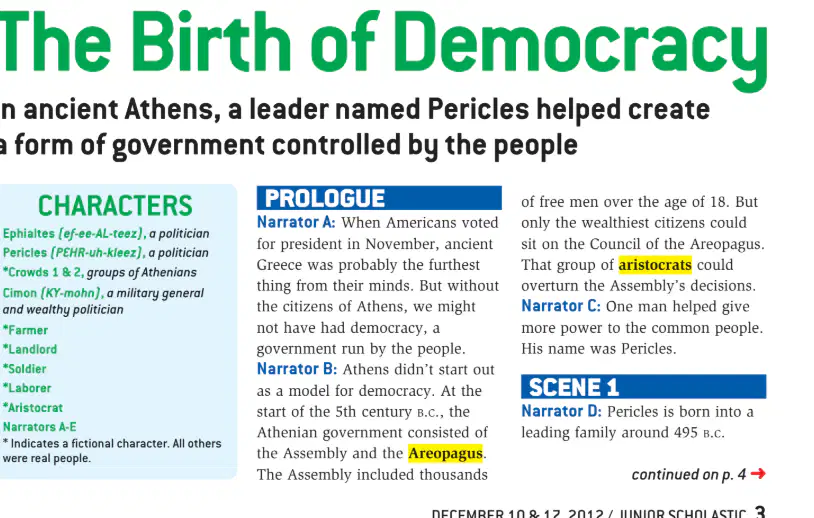
According to the text on page 3 of "The Birth of Democracy," who could be in the Council of Areopagus? The Council could overturn any decision by the Assembly- which meant it had zero power.
free men over 18
aristocrats- high class
farmers
soldiers
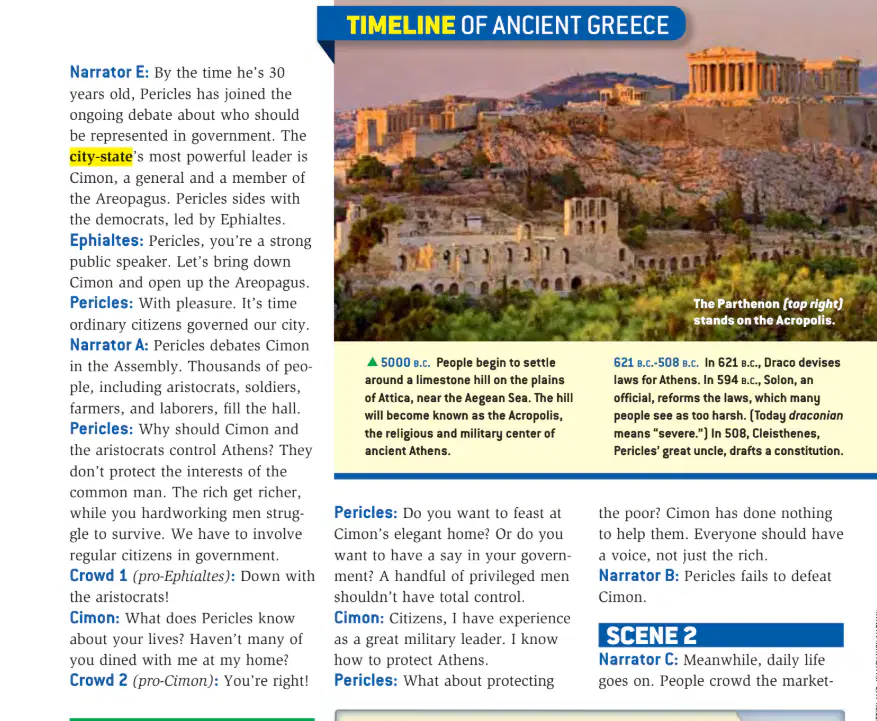
On page 4, scene 1, the conflict is between an aristocrat, Pericles, (who sides with the democrats of the Assembly and their leader Ephialtes) against
Cimon and the aristocrats who control the Council of Aeropagus
Pericles and the Assembly with the leader Ephialtes
Cimon and regular citizens
Pericles and the rich

Page 4 Scene 1: The conflict is about who should have a voice and power in the government. Remember the common people in the Assembly were weak, because the aristocrats in the Council of Aeropagus could over rule anything they had decided. Which man wanted regular citizens (commoners) to be able to have power in the government. (choose two)
Cimon
Ephialtes
Pericles
Aeropagus
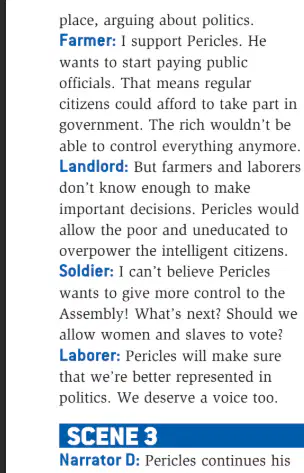
According to the text in scene 2, why does Pericles want to start paying officials (government workers)? (choose three)
common people could be part of government
if there is no pay, only rich people can be part of government
if only rich people are part of government, only rich people have power over the decisions of the government
common people did not want to be part of the government
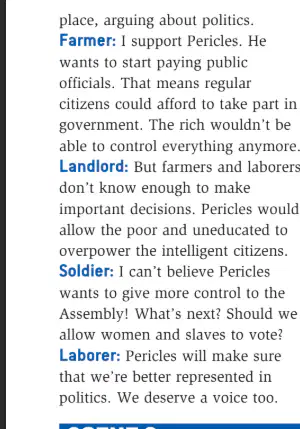
According to this text on page 5 in Scene 2,I can infer that slaves and women could NOT vote at that time because- choose 2
it says, "I can't believe Pericles wants to give more control... Should we allow women and slaves to vote?"
Women and slaves could vote. The text says, "What's next? Should we allow women and slaves to vote?"
If they could already vote, there is no need to say, "What's next?"
Politics is just for men, as it was in ancient times.
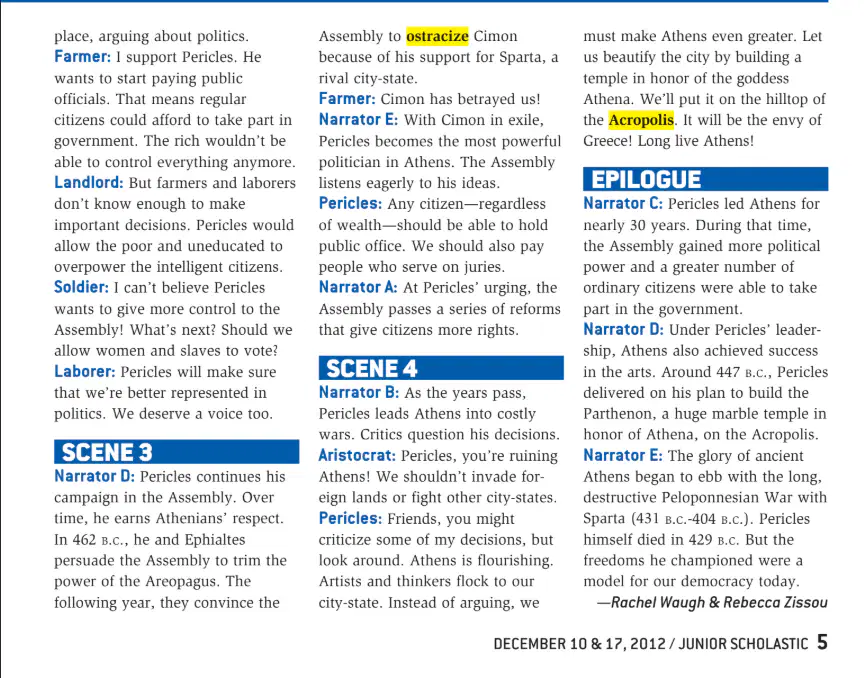
According to Scene 3, PERICLES (who is an aristocrat and has been trying to get more power for the democrats -Assembly) becomes the MOST POWERFUL politician in Athens because
He convinced the Assembly to OSTRACIZE Cimon.
he made a series of reforms
he gave common citizens more rights
he was in favor of democracy and allowing women and slaves to vote
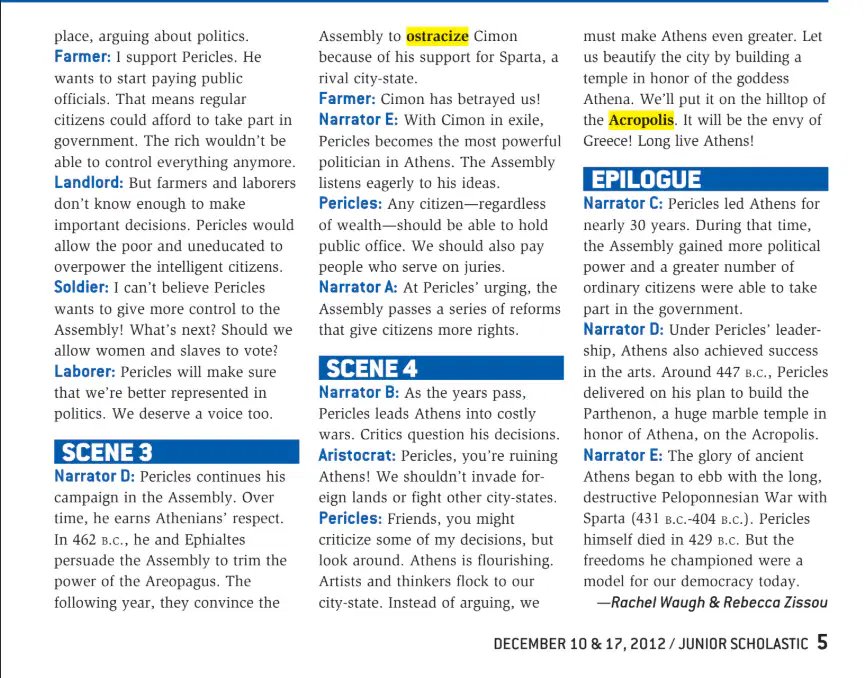
In scene 4 and the epilogue, Instead of Making Athens Great, ____wanted to build a temple (PARTHENON) to the city's goddess, Athena.
Pericles
Comon
Cimon
Ephialtes
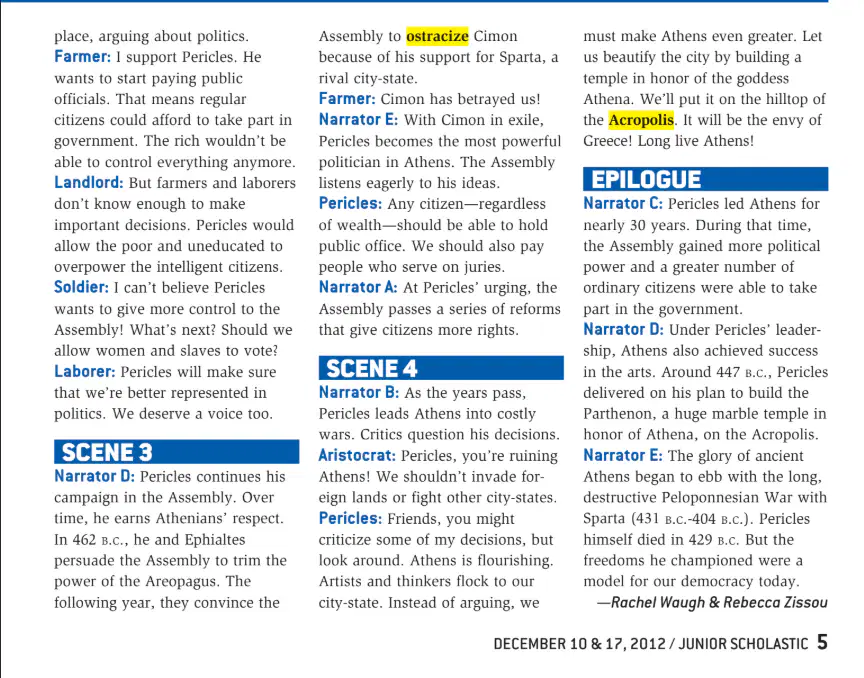
In Scene 4 and the Epilogue, which aristocrat (who sided with the democrats and had used politics to become the most powerful politician in Athens,) invaded other lands in costly wars called the Peloponnesian Wars. note- because of the war, Athens fell and surrendered to Sparta.
Socrates
Parthenon
Peloponnesian
Pericles

Match the following types of governments
People elect their local legislator, and the legislature elects the leader
Parliamentary Democracy
People elected their leaders
Representative Democracy
Where people get to vote on everything
Direct Democracy
One person runs government and is above the law
Dictatorship
No leader, no government
Anarchy
Monarchy
A system of government where power belongs to a ruling family
Democracy
A system of government where power comes from the people.
Totalitarianism
A system of government where the rulers have total unchecked control of the nation.
Theocracy
A form of government based on religious law.
Republic
Form of democracy where citizens elect representatives to vote on their behalf

