
 Worksheets
Chemistry Retake/Make Up
Total questions: 25
Worksheet time: 16mins
In a lava lamp, how does heat transfer occur?
Fast-moving particles get larger
Slow-moving particles get smaller
Fast-moving particles transfer energy to slower-moving particles
Slow-moving particles transfer energy to faster-moving particles
The molecules in the liquid inside a lava lamp are closer together than they are in the solid wax.
True
False
If you placed a hot lava lamp in cold water, the temperature of the lava lamp will __________________________ while the temperature of the water will __________________________.
decrease, increase
increase, decrease
remain the same, remain the same
increase, increase
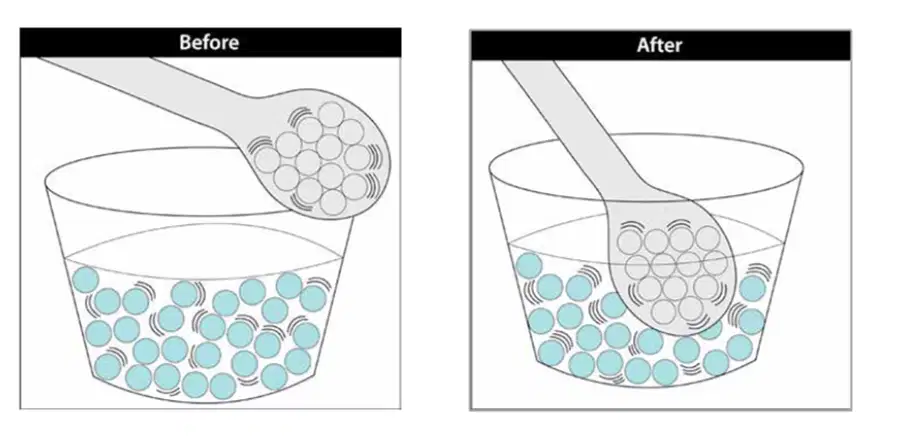
What happens to the motion of molecules when a room temperature metal spoon is placed in a lava lamp that is turned on?
The molecules in the spoon start moving faster.
The molecules in the lava lamp start moving slower.
The molecules in both the spoon and the lava lamp remain unchanged.
The molecules in the spoon start moving slower.
Is this a description of lava lamp operation during cooling or heating? When the wax blobs in a lava lamp slow down so much that their attractions overcome their speed, they join together forming larger blobs.
cooling
heating
solidifying
melting
boiling
During a hot summer day, Charlotte noticed that
particles in her ice cream have less energy
particles in her ice cream move faster causing it to melt
her balloon contracts
When you bring two drops of water near each other and allow them to touch, they combine immediately and become one drop. This is mainly because:
Water molecules are made of atoms
Water molecules are attracted to each other
Water molecules are magnetic
Water is a liquid

In which state of matter are molecules moving the slowest?
solid
liquid
gas
all of the above
In which state of matter are molecules moving the slowest?
solid
liquid
gas
all of the above

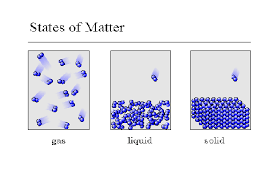
In which state of matter are the particles least able to move?
A
B
C
When a solid changes straight to a gas.
condensation
sublimation
deposition
freezing
When a gas turns straight to solid.
sublimation
melting
deposition
evaporation
Charlotte and Anika are conducting an experiment to see how food coloring spreads in different temperatures of water. They observe that food coloring spreads out faster in hot water than in cold water. This is mainly because:
The water molecules in hot water move more quickly
The molecules in hot water are larger
The food coloring molecules are small
Hot water is less dense
Zoe is conducting an experiment with water. She wants to know: What is the relationship between temperature and the movement of molecules in water?
Higher temperature, slower movement.
Higher temperature, faster movement.
Lower temperature, faster movement.
Temperature does not affect movement.

When a gas changes into a liquid, it is called ________________.
evaporation
condensation
melting
freezing
What are the four major phase changes?
Freezing, Melting, Condensation, Evaporation
Melting, Condensation, Evaporation, Heat
Freezing, Melting, Condensation, Cooling
Condensation, Evaporation, Freezing, Heating
Anything that has mass and takes up space
Mass
Volume
Matter
Temperature
What has a fixed volume and fixed shape
Solid
Liquid
Gas
What has no fixed volume and no fixed shape
Solid
Liquid
Gas
Rank the States of Matter based on most compact particles to most spread out
liquid-gas-solid
gas-liquid-solid
solid-liquid-gas
liquid-solid-gas
If temperature increases, what happens to pressure?
It increases as well
It will not change
It will decrease
It isn't dependant on temperature
Rank the States of Matter from slowest particle speed to fastest
solid-liquid-gas
liquid-gas-solid
gas-liquid-solid
solid-gas-liquid

In heat transfer, heat always flows from the _______________ object to the _______________ object.
hotter / colder
colder / hotter
hotter / hotter
colder / colder

Which of the following statements is true regarding heat energy?
The quicker a molecule moves, the colder it is.
The slower a molecule moves, the warmer it is.
The quicker a molecule moves, the warmer it is.
The faster you dance, the quicker you get tired.

