wayground logo

Free Printable Worksheets

NEW

Font size

S
M
L
XL
Worksheets

Biology Year 6 Review

Total questions: 25

Worksheet time: 34mins

Name
Class
Date
1.

Which scientist visited the Galapagos Islands and came up with the theory of natural selection?

a)

Theodor Schwann

b)

Gregor Mendel

c)

Charles Darwin

d)

Rudolf Virchow

2.

Gigantopithecus were very large primates that lived 500,000 years ago. Since none of these mammals are still today, they are said to be....

a)

Extinct

b)

Threatened

c)

Endangered

d)

Declining

3.

A physical or behavioral trait that helps an organism survive and reproduce in its environment is called a what?

a)

An adaptation

b)

A response to a stimulus

c)

A mutation

d)

Evolution

4.

What most likely caused the finches on the Galapagos Islands to have beaks that were different from the finches on the mainland?

a)

There were different types of predators on the island.

b)

There were different types of food available on the island.

c)

The finches had no water to drink.

d)

The finches on the mainland could not fly high enough.

5.
What is another name for natural selection?
a)
survival of the smartest
b)
survival of the fastest
c)
survival of the biggest
d)
survival of the fittest
6.
Change over time is
a)
evolution
b)
generation
c)
growth
d)
biogenesis
7.

Which trait did Darwin pay most attention to about the finches in the galapagos islands?

a)

Their Feathers

b)

Their Horns

c)

Their Size

d)

Their Beak Shape

8.
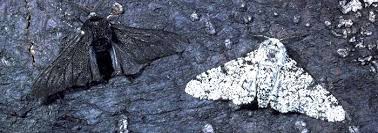
Predict which moth would increase in population
a)
light 
b)
dark
9.

Which two animals are closer relatives?

a)

Dolphin and Wolf

b)

Wolf and Shark

c)

Shark and Dolphin

10.
The white feathers of a snowy owl allow it to blend in with its environment during the winter months (snow). This is an example of ________________
a)
Species
b)
Environmental Change
c)
Adaptation
d)
Variation
11.

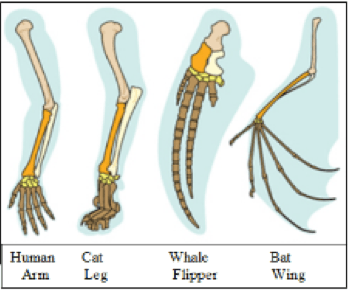
The bones in the figure above are-

a)

Evidence of a common ancestor

b)

Evidence that animals can walk

c)

Evidence that fossils are old

d)

Evidence of nothing

12.
For evolution to happen, this has to occur first:
a)
an organism finds a new mate
b)
and organism's DNA changes
c)
The environment in which a species lives changes
d)
the population increases
13.
What type of beak would help a bird pick insects off a plant?
a)
a large thick beak
b)
a long thin beak
c)
a small short beak
d)
a large hooked beak
14.
The relationship between ALL the organisms in a community showing who eats whom is called a ___________________________.
a)
Food Web
b)
Food Chain
c)
Abiotic Factors
d)
Biotic Factors
15.
An animal that only eats other animals is a _______________.
a)
carnivore
b)
omnivore
c)
herbivore
d)
decomposer
16.
An organism that lives by breaking down dead organic matter into simpler parts is a _______________________.
a)
scavenger
b)
consumer
c)
decomposer
d)
carnivore
17.
In the food web shown, the snail would be considered...
a)
primary consumer
b)
secondary consumer
c)
tertiary consumer
d)
producer
18.
Which organism do the owl and the weasel compete for in the food web?
a)
Hawk
b)
Spider
c)
Grasshopper
d)
Shrew
19.

Arrows in a food web represent...

a)

eating

b)

sunlight

c)

energy

d)

matter

20.

Which of the following organisms is a primary consumer?

a)

grass

b)

rabbit

c)

fox

d)

snake

21.
Which organism has the most energy and which organism has the least amount of energy? Choose the best answer. 
a)
mosquito and grass
b)
mouse and grass
c)
grass and owl
d)
grass and small bird
22.
Which of the following would be the most likely effect, if there were a sudden increase in the cricket population?
a)
There would be a decrease in the small bird population.
b)
There would be a decrease in the grass/flowers population.
c)
There would be a decrease in the mice population.
d)
There would be an increase in the grass/flowers population.
23.

The original source of energy for a food web is...

a)

plants

b)

sun

c)

producers

d)

decomposers

24.

Which list below contains only biotic factors?

a)

Rocks, air, water, sunlight

b)

Air, sunlight, rabbits, grass

c)

Rabbits, grass, hawks, mice

25.

A frog eats a fly. The frog and fly are demonstrating a ________ relationship.

a)

mutualism

b)

competition

c)

predator/prey

d)

parasitism