
 Worksheets
AP Biology Semester 1 Final Review Day 2
Total questions: 20
Worksheet time: 42mins
No membrane-bound organelles
No nucleus
Simple
Small
Bacteria
Archea
Unicellular
Cytoplasm
Ribosomes
DNA
Cell Membrane
Complex
Large
Protist
Plant
Animal
Fungi
Multicellular
Nucleus
Membrane-bound organelles
Which of the following best explains why a cell’s plasma membrane is composed of two layers of phospholipids rather than just a single layer?
Having two oppositely oriented layers of phospholipids allows only the hydrophilic heads to interact with water inside and outside of the cell.
Having two oppositely oriented layers of phospholipids allows the hydrophilic heads to repel water both inside and outside of the cells.
Having two identically oriented layers of phospholipids gives cells more protection from the exterior environment than just a single layer would.
Having two identically oriented layers of phospholipids allows for the production of vacuoles while still maintaining a protective barrier.
According to the endosymbiotic theory, mitochondria and chloroplasts are believed to have evolved through a symbiotic relationship originating when an early ancestor of eukaryotic cells engulfed a prokaryotic cell. Which of the following does NOT represent a piece of evidence to support this theory?
Mitochondria and chloroplasts contain their own DNA
Mitochondria and chloroplasts have their own protein synthesis machinery
Mitochondrial and chloroplast chromosomes are surrounded by a single layer of membrane
Mitochondria and chloroplasts can self-replicate
What evolutionary advantage does compartmentalization of core metabolic processes offer eukaryotes?
Evolution of the mitochondria allowed eukaryotes to perform respiration.
With the evolution of mitochondria in eukaryotes, the Krebs cycle and electron transport chain also evolved.
Evolution of a nucleus in eukaryotes separates the processes of transcription and translation and they can be regulated separately.
A nucleus in bacteria provides separation of respiration from transcription.
Match the following information to the correct transport.
high to low concentrations
low to high concentrations
simple diffusion
osmosis
facilitated diffusion
little to no energy
requires ATP
pumps
endocytosis
exocytosis
pinocytosis
phagocytosis
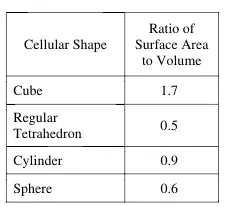
In an experiment, the efficiency of oxygen exchange across the plasma membrane is being assessed in four artificial red blood cells. The table above lists some properties of those artificial cells. Other conditions being equal, reorder the following artificial cells from the most efficient in exchanging oxygen with the environment by diffusion to the least.
Cube
Cylinder
Sphere
Tetrahedron

A student peeled the skins from grapes, exposing cells with membranes that are only permeable to water and small diffusible solutes. The student measured the mass of the peeled grapes. The student then placed each peeled grape into one of five solutions. After 24 hours, the student removed the peeled grapes from the solutions, measured their final mass, and calculated the percent change in mass (Table 1). Which solutions are hypotonic to the bag?
Grape Juice
NaCl
Grape Soda
Tap Water
A student peeled the skins from grapes, exposing cells with membranes that are only permeable to water and small diffusible solutes. The student measured the mass of the peeled grapes. The student then placed each peeled grape into one of five solutions. After 24 hours, the student removed the peeled grapes from the solutions, measured their final mass, and calculated the percent change in mass (Table 1). Based on Table 1, which of the following best explains the difference in water potential between certain solutions and the grapes?
Grape soda and NaCl have a lower water potential because these two solutions caused the grape to lose water.
NaCl and tap water have a lower water potential because these two solutions caused the grape to gain water.
Tap water and grape juice have a lower water potential because these two solutions caused the grape to lose water.
Grape soda and grape juice have a lower water potential because these two solutions caused the grape to gain water.
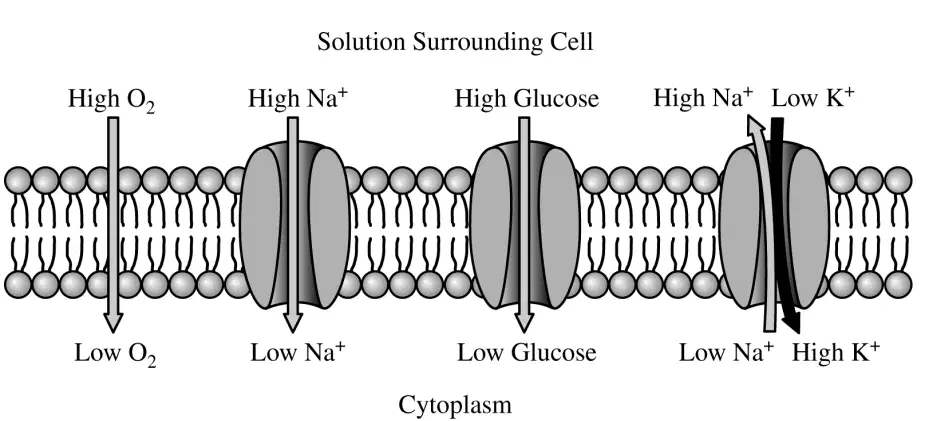
The manner in which several different ions and molecules move through a cell membrane is shown in the diagram above. For each ion or molecule, the relative concentration on each side of the membrane is indicated. Which of the following accurately describes one of the movements taking place?
Glucose is transported into the cell by active transport.
Na+ is transported into the cell by active transport.
The movement of glucose through the membrane requires ATP hydrolysis.(energy)
Na+ transport out of the cell requires ATP hydrolysis (energy)
Which of the following describes the most likely location of cholesterol in an animal cell?
Embedded in the plasma membrane
Dissolved in the cytosol
Suspended in the stroma of the chloroplast
Bound to free ribosomes
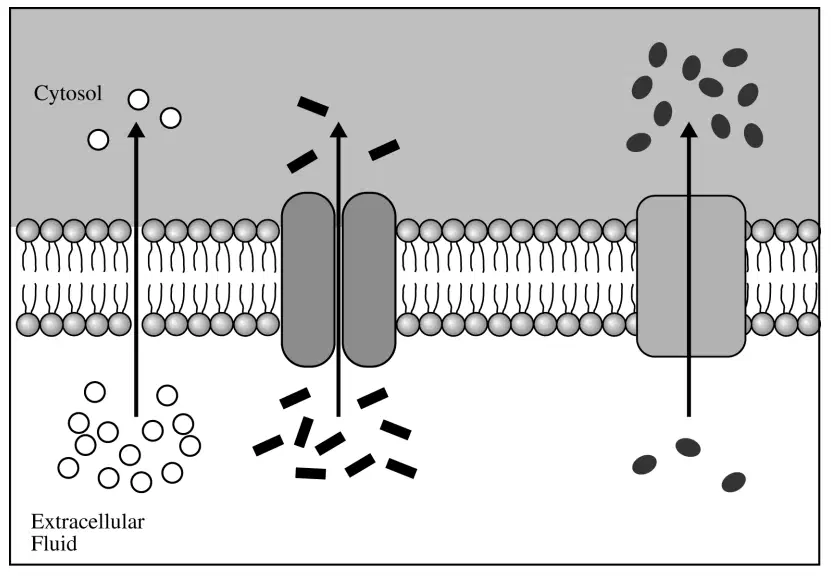
Which of the following scientific questions is most relevant to the model represented in the figure below?
Is ATP required for the transportation of sugars across the outer mitochondrial membrane?
Which molecular substance is actively transported across the plasma membrane?
Do the types of phospholipids in a membrane affect the rate at which molecules enter a cell by passive diffusion?
How does temperature affect the movement of molecules into lysosomes?
Match the following information with the type of osmotic solution
water moves into cell
animals - water will move inside and cell will burst and die
plants - cell is turgid and cell will retains shape
no net movement of water
animals - water moves into and out fo the cell at equal rates, and cell will stay the same
plants - cell is no longer is turgid, and plants will begin to wilt
water moves out of cell
animals - water moves out of cell, and cell gets dehydrated and dies
plants - cells became plasmolyzed and dry up, and plant will most likely die


This organelle comprises of ribosomal RNA and protein and synthesizes protein according to mRNA sequence.
Chloroplasts
Mitochondria
Vacuole
Ribosomes
Calculate SA:V ratio of a sphere (radius = 1.8 units).
Calculate SA:V ratio of a cube (side = 0.84 units).
The molar concentration of a sugar solution in an open beaker has been determined to be 0.3M. Calculate the solute potential at 27 degrees.
NaCl dissociates into 2 particles in water: Na+ and Cl-. If the solution contained 0.1M NaCl, what is the Ψ of the solution if the pressure potential is 2 bars? Temp is 20 degrees Celsius.
If a cell’s ΨP = 9 bars and its ΨS = -3 bars, what is the resulting Ψ?
If a cell’s ΨP = 9.8 bars and its ΨS = -1.3 bars, what is the resulting Ψ?

