wayground logo

Free Printable Worksheets

Font size

S
M
L
XL
Worksheets

24.25 Unit 2 TEST REVIEW

Total questions: 100

Worksheet time: 52mins
Name
Class
Date
1.
__________ properties are any characteristic of matter that CANNOT be observed or measured without changing the identify of the substance.
a)
Chemical
b)
Physical
c)
Structural
d)
Characteristic
2.
__________ properties are any characteristic of matter that CAN be observed or measured without changing the identify of the substance.
a)
Chemical
b)
Physical
c)
Structural
d)
Characteristic
3.
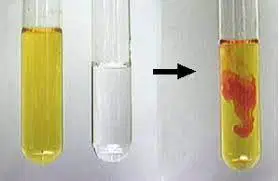
Look at the picture below. What clue or evidence observed in the picture above indicates that a chemical change is probably occurring?
a)
light was released
b)
the color changed
c)
the temperature changed
d)
bubbles were produced
4.
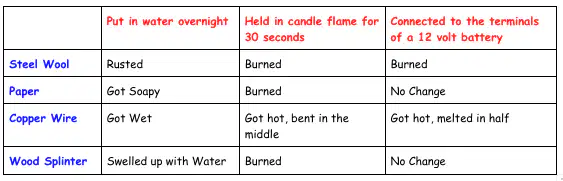
Terry and Jean experimented with several items to see what would happen under different conditions. Below is the data they wrote at the conclusion of the experiment. Which substance changed CHEMICALLY under ALL 3 conditions?
a)
steel wool
b)
wood splinter
c)
paper
d)
copper wire
5.
Which of the following is evidence that a CHEMICAL REACTION is happening? (select ALL that apply) 1 - color change 2 - odor change/formation of gas (bubbles) 3 - colder temperature 4 - precipitate forms
a)
2 and 3 only
b)
1, 2, and 4 only
c)
1, 2, 3, and 4
d)
1 and 4 only
6.
When a candle burns, the ___________________ is evidence of a physical change, while the ___________________ is evidence of a chemical change.
a)
light given off, wax melting
b)
light given off, smoke produced
c)
wax melting, wick getting shorter
d)
wax melting, light given off
7.
What two types of matter are considered chemically pure substances?
a)
elements and compounds
b)
solutions and mixtures
c)
solutions and compounds
d)
elements and mixtures
8.
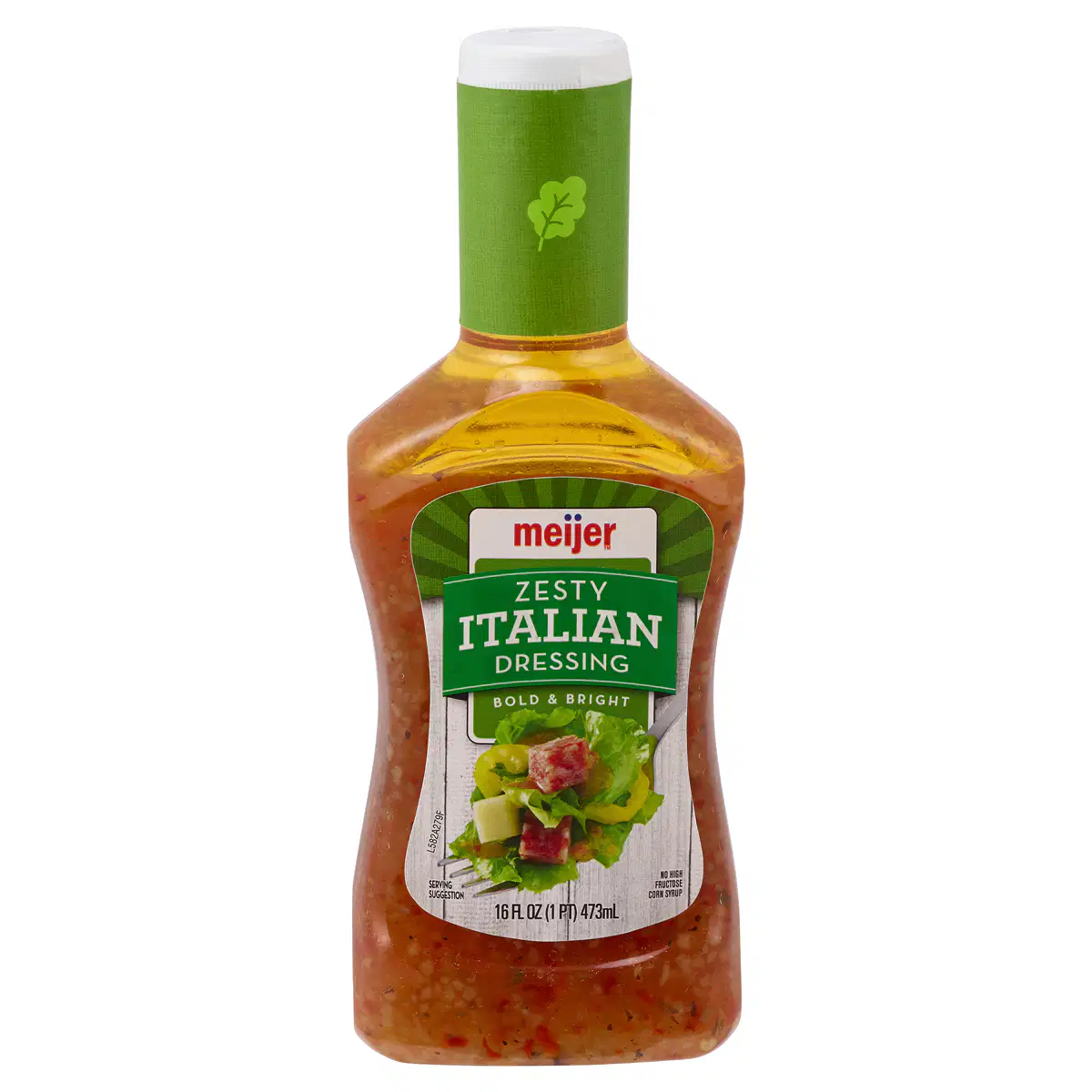
Is this mixture homogeneous or heterogeneous?
a)
Homogeneous
b)
Heterogeneous
9.
Which arrangement correctly orders mixtures in terms of INCREASING particle size? (INCREASING: Smallest Particle Size to Largest Particle Size)
a)
colloid, suspension, solution
b)
suspension, colloid, solution
c)
solution, colloid, suspension
d)
solution, suspension, colloid
10.
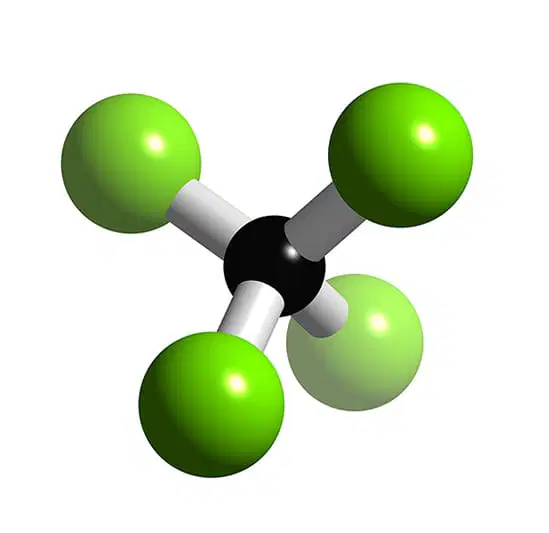
How would Carbon Tetrachloride (CCl4) be classified? This is one carbon chemically bonded to four chlorine atoms.
a)
element
b)
compound
c)
atom
d)
mixture
11.
How would Carbon (C) be classified?
a)
heterogeneous mixture
b)
pure substance
c)
homogeneous mixture
d)
none of them
12.
How would an 18 karat gold ring be classified? (18 karat gold means that the ring is NOT pure gold but 75% gold mixed UNIFORMLY throughout the melting process with other metals to make it strong.)
a)
homogeneous mixture
b)
pure substance
c)
heterogeneous mixture
d)
None of them
13.
Sand is floating in water, but most of the sand is settled at the bottom. Which type of mixture is this?
a)
Suspension
b)
Solution
c)
Solvent
d)
Colloid
14.
Identify the parts of a homogenous mixture as seen in the image below.
a)
A - Solution B - Solvent C - Solute
b)
A - Solvent B - Solute C - Solution
c)
A - Solvent B - Solution C - Solute
d)
A - Solution B - Solute C - Solvent
e)
A - Solute B - Solvent C - Solution
15.
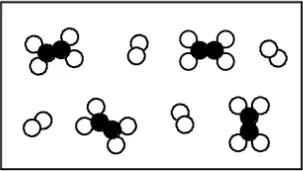
Classify the below image.
a)
mixture of elements and compounds
b)
mixture of compounds
c)
mixture of elements
d)
elements
16.
In this type of mixture, the particles scatter light (Tyndall effect) but do not settle out upon standing (standing meaning "not moving")
a)
Solvent
b)
Solution
c)
Suspension
d)
Colloid
17.
Table salt (NaCl) and sugar (C12H22O11) are dissolved in water. Table salt and sugar are both classified as a(n)
a)
Compound.
b)
Element.
18.
Since table salt and sugar are being dissolved in water, water is considered to be the ____________ as water is the substance doing the dissolving.
a)
solute
b)
solvent
19.

Finding the density of matter is a

a)

Physical Property

b)

Chemical Property

c)

Physical Change

d)

Chemical Change

20.

Tearing a piece of paper in half is a

a)

Physical Property

b)

Chemical Property

c)

Physical Change

d)

Chemical Change

21.

A substance with a warning label being toxic is a

a)

Physical Property

b)

Chemical Property

c)

Physical Change

d)

Chemical Change

22.

Iron burns in air and creates iron oxide (rust) is a

a)

Physical Property

b)

Chemical Property

c)

Physical Change

d)

Chemical Change

23.

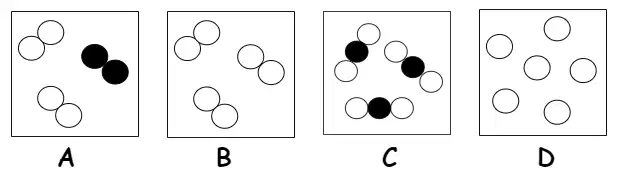
IMAGE A is a

a)

Element

b)

Compound

c)

Diatomic Element

d)

Mixture

24.

IMAGE B is a

a)

Element

b)

Compound

c)

Diatomic Element

d)

Mixture

25.

IMAGE C is a

a)

Element

b)

Compound

c)

Diatomic Element

d)

Mixture

26.

IMAGE D is an

a)

Element

b)

Compound

c)

Diatomic Element

d)

Mixture

27.

Liquid water turning into the gas phase is considered a _______________ change/reaction.

a)

Endothermic

b)

Exothermic

28.

Liquid water changing to a solid is considered a _______________ change/reaction.

a)

Endothermic

b)

Exothermic

29.

A burning log at a campfire is considered a _______________ change/reaction.

a)

Endothermic

b)

Exothermic

30.

Cooking an egg on the stove is considered a _______________ change/reaction.

a)

Endothermic

b)

Exothermic

31.

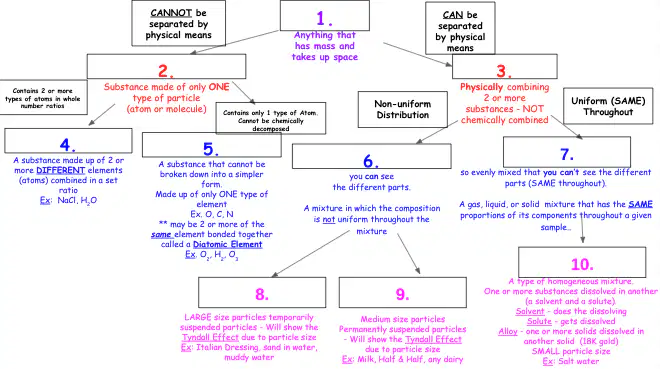
What word belongs in space 1?

a)

Mixture

b)

Pure Substance

c)

Matter

d)

Chemical

32.

What word belongs in space 2?

a)

Mixture

b)

Pure Substance

c)

Matter

d)

Compound

33.

What word belongs in space 3?

a)

Mixture

b)

Pure Substance

c)

Matter

d)

Compound

34.

What word belongs in space 4?

a)

Element

b)

Compound

c)

Homogeneous Mixture

d)

Heterogenous Mixture

35.

What word belongs in space 5?

a)

Element

b)

Compound

c)

Homogeneous Mixture

d)

Heterogenous Mixture

36.

What word belongs in space 6?

a)

Element

b)

Compound

c)

Homogeneous Mixture

d)

Heterogenous Mixture

37.

What word belongs in space 7?

a)

Element

b)

Compound

c)

Homogeneous Mixture

d)

Heterogenous Mixture

38.

What word belongs in space 8?

a)

Colloid

b)

Compound

c)

Solution

d)

Suspension

39.

What word belongs in space 9?

a)

Colloid

b)

Compound

c)

Solution

d)

Suspension

40.

What word belongs in space 10?

a)

Colloid

b)

Compound

c)

Solution

d)

Suspension

41.

A student mixes yellow powder with water. Which observation would prove a CHEMICAL change occurred?

a)

The powder DISSOLVED in the water

b)

The water turned the COLOR yellow

c)

The bag's TEMPERATURE changed

d)

The STATE OF MATTER changed

42.

Which of the following options provides evidence of a CHEMICAL change?

a)

Wood is burned releasing ash and smoke

b)

Rocks separate when soil is sifted

c)

Water turns to ice when you put it in the freezer

d)

Salt dissolves in water

43.

Which of the following examples provides evidence of a PHYSICAL change?

a)

Wood is burned and releases ash and smoke

b)

Iron rusts over time

c)

When mixed, baking soda and vinegar form gas bubbles

d)

A piece of paper changes shape when you rip it up

44.

A white tablet is dropped into water. The water becomes cloudy and bubbles are produced. What type of change has occurred?

a)

Physical change

b)

Chemical change

c)

No change

45.

Which observations prove a chemical change has occurred?

a)

Dissolving and expected color change

b)

Mixing and dissolving

c)

State of matter change and boiling water bubbles

d)

Unexpected color change and temperature change

46.

When mixing milk and vinegar, a white, chunky, solid substance is formed. What has occurred?

a)

Physical change: state of matter

b)

Chemical change: production of a solid (precipitate)

c)

Physical change: freezing

d)

Chemical change: rust

47.
In an exothermic reaction, heat is ...
a)
taken in
b)
given out
48.

In an endothermic reaction, heat is ...

a)

taken in

b)

given out

49.
During an endothermic reaction in a beaker if we are part of the surroundings and touched the beaker, it would feel _______. 
a)
Warm
b)
Cold
50.
If a chemical reaction is EXOTHERMIC, the temperature would....
a)
Stay the same
b)
Increase
c)
Decrease
51.

Can matter be created or destroyed during a chemical reaction?

a)

Yes

b)

No

c)

Sometimes

d)

I don't know

52.

All the matter is made up of

a)

Atoms

b)

Mixtures

c)

Compounds

d)

Reactions

53.

An element is formed by

a)

Atoms of the same kind

b)

Atoms of different kind

c)

compounds and atoms

d)

Compounds and mixtures

54.

IS a substance formed by atoms of a different kind

a)

Element

b)

Compound

c)

Mixtures

d)

Atoms

55.

A substance formed by different compounds and elements is a

a)

Pure substance

b)

Mixture

c)

Element

d)

Compound

56.

What type of matter is shown in this particle diagram?

a)

Element

b)

Compound

c)

Mixture of Elements

d)

Mixture of Compounds

e)

Mixture of Elements and Compounds

57.

What type of matter is shown in this particle diagram?

a)

Diatomic Element

b)

Compound

c)

Mixture of Elements

d)

Mixture of Compounds

e)

Mixture of Elements and Compounds

58.

What type of matter is shown in this particle diagram?

a)

Element

b)

Compound

c)

Mixture of Elements

d)

Mixture of Compounds

e)

Mixture of Elements and Compounds

59.

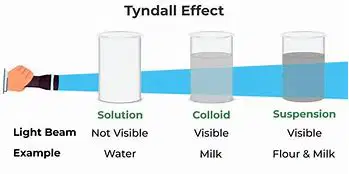
What phenomenon occurs when dispersed particle scatter light?

a)

Side effect

b)

Tyndall Effect

c)

Shaft Effect

d)

No Effect

60.

An example of colloid is ____ .

a)

Sugar and water

b)

Half and Half (Milk)

c)

Salt and water

d)

Water

61.

An example of suspension is ____ .

a)

Sugar and water

b)

Sand and water

c)

Salt and water

d)

Water

62.

It is homogeneous mixture because the substance or the material is soluble or miscible when mixed with water.

a)

Colloid

b)

Suspension

c)

Solution

d)

Ingredients

63.

A ______ is any material that can be dissolved by liquid.

a)

solvent

b)
solute
c)

element

d)

mixture

64.

A _______ is any substance that can dissolve a solute.

a)

solvent

b)

solute

c)

solution

d)

molecule

65.

A ___________ mixture has only one phase that is uniformly distributed throughout the mixture

a)
homogeneous
b)

heterogeneous

c)

compound

d)

element

66.
Salt dissolves in water
a)
physical Change
b)
chemical change
67.
Density: Chemical or Physical Property
a)
Chemical Property
b)
Physical Property
68.

Reacts with acid: Chemical or Physical Property

a)
Chemical Property
b)
Physical Property
69.

Formation of gas/Odor change ... Physical or Chemical Change?

a)

Physical

b)

Chemical

70.

Unexpected Color change ... Physical or Chemical Change?

a)

Physical

b)

Chemical

71.

Increase or decrease in temperature ... Physical or Chemical Change?

a)

Physical

b)

Chemical

72.

How would an 18 karat gold ring be classified? 

a)

homogeneous mixture

b)

pure substance

c)

heterogeneous mixture

d)

None of them

73.

Which of the following shows the Tyndall effect?

a)

Water

b)

Milk

c)

Honey

d)

Oxygen gas

74.
__________ properties are any characteristic of matter that CANNOT be observed or measured without changing the identify of the substance.
a)
Chemical
b)
Physical
c)
Structural
d)
Characteristic
75.
__________ properties are any characteristic of matter that CAN be observed or measured without changing the identify of the substance.
a)
Chemical
b)
Physical
c)
Structural
d)
Characteristic
76.
Look at the picture below. What clue or evidence observed in the picture above indicates that a chemical change is probably occurring?
a)
light was released
b)
the color changed
c)
the temperature changed
d)
bubbles were produced
77.
Terry and Jean experimented with several items to see what would happen under different conditions. Below is the data they wrote at the conclusion of the experiment. Which substance changed CHEMICALLY under ALL 3 conditions?
a)
steel wool
b)
wood splinter
c)
paper
d)
copper wire
78.
Which of the following is evidence that a CHEMICAL REACTION is happening? (select ALL that apply) 1 - color change 2 - odor change/formation of gas (bubbles) 3 - colder temperature 4 - precipitate forms
a)
2 and 3 only
b)
1, 2, and 4 only
c)
1, 2, 3, and 4
d)
1 and 4 only
79.
When a candle burns, the ___________________ is evidence of a physical change, while the ___________________ is evidence of a chemical change.
a)
light given off, wax melting
b)
light given off, smoke produced
c)
wax melting, wick getting shorter
d)
wax melting, light given off
80.
What two types of matter are considered chemically pure substances?
a)
elements and compounds
b)
solutions and mixtures
c)
solutions and compounds
d)
elements and mixtures
81.
Is this mixture homogeneous or heterogeneous?
a)
Homogeneous
b)
Heterogeneous
82.
Which arrangement correctly orders mixtures in terms of INCREASING particle size? (INCREASING: Smallest Particle Size to Largest Particle Size)
a)
colloid, suspension, solution
b)
suspension, colloid, solution
c)
solution, colloid, suspension
d)
solution, suspension, colloid
83.
How would Carbon Tetrachloride (CCl4) be classified? This is one carbon chemically bonded to four chlorine atoms.
a)
element
b)
compound
c)
atom
d)
mixture
84.
How would Carbon (C) be classified?
a)
heterogeneous mixture
b)
pure substance
c)
homogeneous mixture
d)
none of them
85.
How would an 18 karat gold ring be classified? (18 karat gold means that the ring is NOT pure gold but 75% gold mixed UNIFORMLY throughout the melting process with other metals to make it strong.)
a)
homogeneous mixture
b)
pure substance
c)
heterogeneous mixture
d)
None of them
86.
Sand is floating in water, but most of the sand is settled at the bottom. Which type of mixture is this?
a)
Suspension
b)
Solution
c)
Solvent
d)
Colloid
87.
Identify the parts of a homogenous mixture as seen in the image below.
a)
A - Solution B - Solvent C - Solute
b)
A - Solvent B - Solute C - Solution
c)
A - Solvent B - Solution C - Solute
d)
A - Solution B - Solute C - Solvent
e)
A - Solute B - Solvent C - Solution
88.
Classify the below image.
a)
mixture of elements and compounds
b)
mixture of compounds
c)
mixture of elements
d)
elements
89.
In this type of mixture, the particles scatter light (Tyndall effect) but do not settle out upon standing (standing meaning "not moving")
a)
Solvent
b)
Solution
c)
Suspension
d)
Colloid
90.
Table salt (NaCl) and sugar (C12H22O11) are dissolved in water. Table salt and sugar are both classified as a(n)
a)
Compound.
b)
Element.
91.
Since table salt and sugar are being dissolved in water, water is considered to be the ____________ as water is the substance doing the dissolving.
a)
solute
b)
solvent
92.

Finding the density of matter is a

a)

Physical Property

b)

Chemical Property

c)

Physical Change

d)

Chemical Change

93.

Tearing a piece of paper in half is a

a)

Physical Property

b)

Chemical Property

c)

Physical Change

d)

Chemical Change

94.

A substance with a warning label being toxic is a

a)

Physical Property

b)

Chemical Property

c)

Physical Change

d)

Chemical Change

95.

Iron burns in air and creates iron oxide (rust) is a

a)

Physical Property

b)

Chemical Property

c)

Physical Change

d)

Chemical Change

96.

IMAGE A is a

a)

Element

b)

Compound

c)

Diatomic Element

d)

Mixture

97.

IMAGE B is a

a)

Element

b)

Compound

c)

Diatomic Element

d)

Mixture

98.

IMAGE C is a

a)

Element

b)

Compound

c)

Diatomic Element

d)

Mixture

99.

IMAGE D is an

a)

Element

b)

Compound

c)

Diatomic Element

d)

Mixture

100.

Liquid water turning into the gas phase is considered a _______________ change/reaction.

a)

Endothermic

b)

Exothermic