
Font size
 Worksheets
Unit 6 Review
Total questions: 19
Worksheet time: 24mins
Which of the following best explains how Islam influences law in the Muslim world?
Shari’a Law dictates economic practices but mostly leaves politics alone.
Laws encourage traditional practices and reject the use of modern technologies.
Islamic tradition heavily influences the creation and enforcement of laws.
In the justice system, men and women are treated as equals before the law.
The 5 Pillars of Islam (The Essentials)
Shahada (Faith):
Declaration of faith in one God:
Salah (Prayer):
Five daily prayers:
Zakat (Charity):
Giving to those in need:
Sawm (Fasting):
Fasting during Ramadan:
Hajj (Pilgrimage):
Pilgrimage to Mecca:
Question: Arrange the following events in the correct order of their occurrence:
1. (a)
2. (b)
3. (c)
4. (d)
5. (e)
Which book is the Islamic sacred text? Click on the correct image below:
The (a) is the sacred text of (b) .
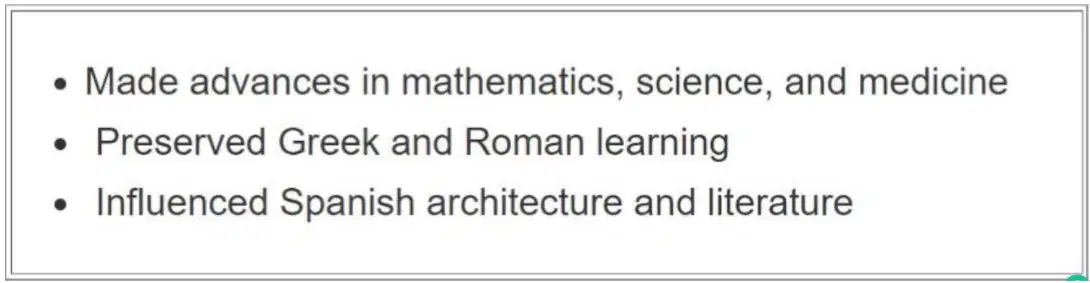
These achievements are most closely associated with the
Golden Age of Islam
Gupta Empire
Tang dynasty
Ottoman Empire

This author most likely agrees that Islam –
was able to expand because of beliefs shared with other pre-existing religions
had a greater economic impact on Europe than it did on Asia and Africa
celebrated Mohammed’s beliefs to encourage the growth of slavery in Africa
was similar to the Roman Catholic Church in its reliance on priests and clergy

What event would come next to complete this timeline?
Expansion of Muslim empire
Development of the five pillars
Birth of the first prophet
Historical origins of Islam
Match the sources that influence Islamic laws and beliefs.
Shariah Law
based on the Qur'an and Sunnah
Quran
Holy book of Islam
Sunnah
Muhammad's example for the way of life
The role of Muslim religious leaders in Africa was to (a)
An example of Islam’s impact on Africa was that it (a)
Which development encouraged Arab traders to exchange goods for slaves in sub-Saharan Africa in the 11th and 12th centuries?
Arabs praised African slaves for their knowledge of herbs and medicines.
Slaves were in great demand for soybean plantations in the Americas.
Mohammed encouraged his followers to acquire large numbers of slaves.
Caravans were going to West Africa to obtain precious minerals.
Which statement belongs in the center of the Venn diagram?
One way in which the African kingdoms of Ghana, Mali, and Songhai were similar was that they (a)
Which of the THREE below was WHY salt is important in West Africa?
Salt was worth its weight in gold in West Africa.
All people require mineral salt in their diets to stay healthy.
Salt has always been valued for flavoring and preserving food.
West Africa was poor in salt.
West Africans used salt as currency.
For centuries, salt was worth its weight in gold in West Africa. All people require mineral salt in their diets to stay healthy, and salt has always been valued for flavoring and preserving food. Salt occurs naturally in some environments and foods. However, this was not the case in the savannah and forests of West Africa. In coastal regions, people could use salt from the ocean, but sea salt didn’t travel well. So, inland people needed a reliable source of the mineral.
West Africans in search of salt turned north. The desolate Sahara held a deep and seemingly endless supply of salt beneath the desert sand. By about 700 CE, Berber traders from North Africa were crossing the Sahara to bring many commodities, including salt, south to the cities of West Africa. They understood West Africa's need for salt and demanded high prices for it. While West Africa was poor in salt, it was rich in gold. So, salt was often traded for gold pound for pound. Gold and salt were so closely linked that some West Africans even used salt as currency.
Which of the following is the main idea of the reading?
The Sahara can be dangerous to cross on foot.
Salt was highly valued in West Africa.
Humans require salt to stay healthy.
Camels are ideal for hauling goods across deserts.
Which of the following supports the main idea of the reading?
All people require mineral salt in their diets to stay healthy, and salt has always been valued for flavoring and preserving food.
West Africa was poor in salt, it was rich in gold.
Salt was often traded for gold pound for pound.
Gold and salt were so closely linked that some West Africans even used salt as currency.
Reread the following sentence from the text: "Gold and salt were so closely linked that some West Africans even used salt as currency."
What idea in the text does this sentence emphasize?
West African people needed a reliable source of the mineral.
West Africa was rich in Gold.
West was poor in salt.
Salt was traded for gold pound for pound.
Which on the following supports the the idea in Part 1.
For centuries, salt was worth its weight in gold in West Africa.
est Africans in search of salt turned north.
Berber traders from North Africa were crossing the Sahara to bring many commodities, including salt, south to the cities
of West Africa.
West Africa was poor in salt, it was rich in gold.
Which of the following sentences is a fact rather than a opinion.
The Sahara has harsh conditions, so people should not travel there.
West Africa valued salt because it lacked a reliable source for the mineral.
It is surprising that something as common as salt was so valuable.
West Africa valued gold because it lacked a reliable source for the mineral.
Which religion spread throughout the African region through Arab traders?
Monotheism
Muslim
Islam
Christianity

