
 Worksheets
Unit 2 Metabolism Review
Total questions: 20
Worksheet time: 10mins
An athlete thinks that she can exercise as long as she eats different types of food because her body just needs different types of food molecules to work correctly. Is the athlete correct?
Yes, her cells only work when they have molecules from different types of food.
No, her muscles do not need molecules from food because cells make all the molecules they need.
No, all cells need molecules from food and molecules from the air to work properly.
No, only her stomach cells need food molecules to work correctly.
Marisol has been chewing and swallowing her food, but her digestive system is not doing what it usually does. Why is this a problem for her ability to exercise?
Her cells will not work well because molecules from her food are not broken down small enough to get to her cells.
Her body will run out of energy because molecules from the air are not being combined into larger molecules for the cells.
Her respiratory system will have to work twice as hard to break down molecules from food.
Her cells will not work well because the molecules from food will be too small for cells to use.
Doctors tested a patient to find out what molecules were in her cells. Her cells contained normal levels of amino acids, normal levels of oxygen molecules, and low levels of glucose molecules.
Will this patient be able to exercise normally?
Yes, her cells just need to combine amino acids to release energy.
No, her cells need to combine glucose into starch molecules to release energy.
No, her cells need glucose to react with oxygen to release energy.
Yes, her cells just need oxygen to release energy.
An ocean scientist plans to spend several days underwater in a submarine. Doctors on land will monitor her body to make sure she is healthy during her trip.
What is one way doctors will be able to tell whether her body is healthy enough to do all her tasks while she is in the submarine?
The doctors could see if her cells were getting several different types of food molecules.
The doctors could see if she is getting plenty of sleep so her body can make enough energy.
The doctors could see if her lung cells have molecules from the air and if her stomach cells have molecules from food.
The doctors could see if her cells are getting the molecules they need from food and air.
A patient has been eating healthy foods, but his digestive system is not doing what it usually does.
Can this patient still exercise normally?
Yes, as long as he can still breathe, his cells will have all the molecules they need to release energy.
No, his digestive system is not breaking down oxygen into molecules small enough to get inside his cells.
No, molecules from food are not combining together to be large enough for his cells to use.
No, molecules from food are not getting broken down small enough to get inside his cells.
Doctors tested a patient to find out what molecules were in his cells. His cells contained normal levels of glucose molecules and amino acid molecules, and low levels of oxygen molecules.
Will this patient be able to exercise normally?
Yes, his body is working correctly enough to exercise.
Yes, as long as he has glucose and amino acids molecules, his cells can release energy.
No, his body systems are working, but he needs to eat different foods; only proteins can react with glucose to release energy.
No, his respiratory system is not working; his cells need oxygen to react with glucose, which releases energy.
Rico, a scuba diver, uses breathing gear to help him breathe air underwater. He always gets enough sleep and eats a good breakfast before a dive.
What could happen if his breathing gear broke during a dive and he could not breathe as much air as usual?
It would be difficult to swim because his cells cannot work without molecules from the air.
It would not affect him because his cells are getting the different types of molecules they need from food to work properly.
It would not affect him as long as he slept enough
It would not affect him because his body can function normally even if his cells do not have molecules from the air.
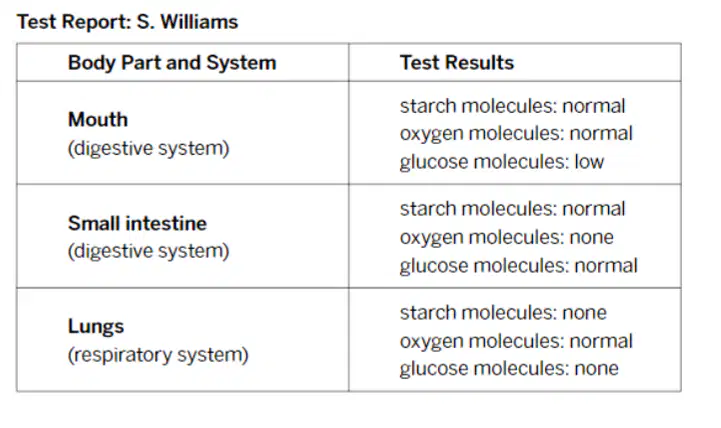
The test report above shows the level of molecules in different parts of the patient's body, S. Williams.
What does this test indicate about how her body systems are working?
Her body systems are working correctly.
Her digestive system is lacking the normal amounts of food molecules.
Her digestive system is not breaking down molecules from food.
Her respiratory system is lacking air molecules.
If a person is breathing normally, which of the following could prevent him from using his body to exercise normally?
Nothing because cells only need oxygen to function.
Not getting enough sleep because the body only make energy for exercise while asleep.
Not eating enough food because cell need molecules from both food and air.
Nothing because he/she would be able to exercise as long as their cells are getting oxgen.
Rosa eats a peanut butter sandwich for lunch. Peanut butter contains protein and bread is mostly starch. Rosa plans to go for a run later this afternoon. Rosa is breathing normally.
How do her cells use these molecules to release energy for her body to run?
Through the process of photosynthesis
By converting them into energy through cellular respiration
By storing them as fat for later use
By excreting them as waste
Paul was finding it difficult to walk up the steps to his family’s apartment. His doctor thinks that his cells might not be getting enough oxygen or glucose.
Why does having low levels of glucose or oxygen in his cells make it difficult for Paul to walk up steps?
Because glucose and oxygen are needed for energy production in cells.
Because low glucose and oxygen levels cause muscle relaxation.
Because glucose and oxygen are not related to muscle function.
Because low glucose and oxygen levels increase blood pressure.

The table shows information about the body systems and test results of a patient- R. Frost.
Are his body systems working well enough to exercise normally?
Yes- their system is working well enough to exercise normally because their cells are getting molecules from both food and molecules from the air.
No- Their system is not working well enough to exercise normally. Their cells are not getting enough molecules from FOOD.
No- Their system is not working well enough to exercise normally. Their cells are not getting enough molecules from AIR.

The table shows information about the body systems and test results of a patient-A. Kim.
Are her body systems working well enough to exercise normally?
Yes- their system is working well enough to exercise normally because their cells are getting molecules from food and molecules from the air.
No- Their system is not working well enough to exercise normally. Their cells are not getting enough molecules from FOOD.
No- Their system is not working well enough to exercise normally. Their cells are not getting enough molecules from AIR.
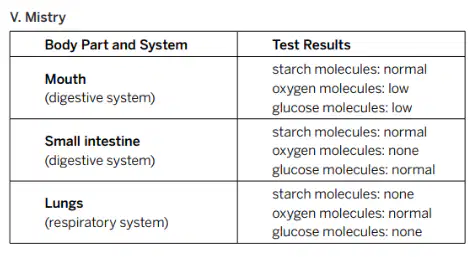
The table shows information about the body systems and test results of a patient- V.Mistry.
Are his body systems working well enough to exercise normally?
Yes- their system is working well enough to exercise normally because their cells are getting molecules from food and molecules from the air.
No- Their system is not working well enough to exercise normally. Their cells are not getting enough molecules from FOOD.
No- Their system is not working well enough to exercise normally. Their cells are not getting enough molecules from AIR.
Two teams of scientists hiked 10 kilometers to different study sites. Before their hike, the Valley team ate a lunch of mostly protein. The Mountain team ate a lunch of a mix of starch and protein but hiked at high altitudes, where there is much less oxygen.
Which team probably had an easier time hiking?
Both teams had an easy time hiking because their digestive systems broke down proteins into amino acids for cells to release energy.
Neither team had an easy time hiking; the Valley team’s cells needed more glucose from broken-down starch for a reaction, and the Mountain team’s cells needed more oxygen from the air.
The Mountain team had an easier time hiking; their cells released energy from protein reacting with glucose, which was broken down from starch in the digestive system.
The valley team had an easier time kiding; Their cells released energy from protein breaking down in the digestive system, which then combined with oxygen in the cells.
A doctor is looking to clear a patient for an upcoming marathon. What is the best choice for making sure the patient is healthy enough to participate in the race?
The doctor can make sure the patient's cells are getting enough food molecules.
The doctor could make sure the patients cells are getting the molecules from both food and air.
The doctor could make sure the patient's respiratory system is getting enough air.
The doctor can make sure the patient is getting enough sleep.
Jenny is having a hard time breathing due to asthma. How will this affect her ability to exercise?
Her cells will not work because molecules from air will be too large to enter in.
Her respiratory system will not be able to break down the oxygen molecules.
Her digestive system will have to work harder to break down food molecules.
Her cells will not work well with low levels of oxygen.
Rick ate a meal of oats before seeing his doctor. Oats are made of mostly starch molecules. Rick feels tired, so his doctor gave him a test and found that Rick’s cells contained glucose molecules, but they did not contain enough oxygen molecules. Does this explain why Rick feels tired?
No, something else must be wrong because his cells have all the molecules they need.
Yes, his digestive system is breaking down starch molecules, but his respiratory system may not be working properly.
Yes, his respiratory system is working, but his digestive system is not getting energy from combining glucose molecules.
Yes, his digestive system is working, but his respiratory system is not breaking down oxygen, so his body stopped making energy.
How do cells reproduce, grow and repair themselves?
By breaking down food molecules.
By taking in oxygen and glucose.
By transporting glucose to all cells in the body.
By combining amino acids to create larger protein molecules.
Which statement is TRUE regarding cellular respiration?
Glucose and oxygen combine to create amino acids.
Glucose and oxygen combine to create water and energy.
Glucose and water combine to create carbon dioxide and energy.
Glucose and oxygen combine to create water, carbon dioxde and energy.

