
 Worksheets
Unit 3 North America Test Corrections
Total questions: 27
Worksheet time: 14mins
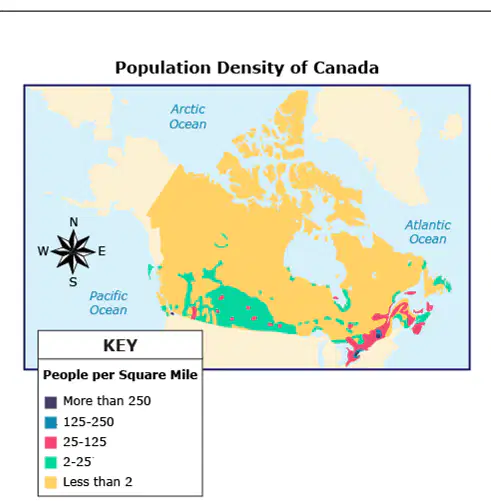
What conclusion can you draw from the map regarding patterns of settlement in Canada?
The population of the country is evenly distributed.
The greatest number of people live near Greenland.
No people have settled along the Pacific Ocean coast.
Most people live near the border with the United States.
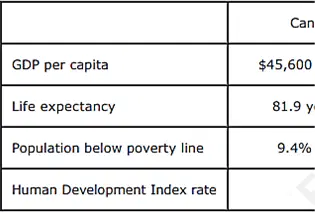
Based on the data in the table, the level of development in both Canada and the United States is considered as –
developing
more developed
newly industrialized
medium human developed
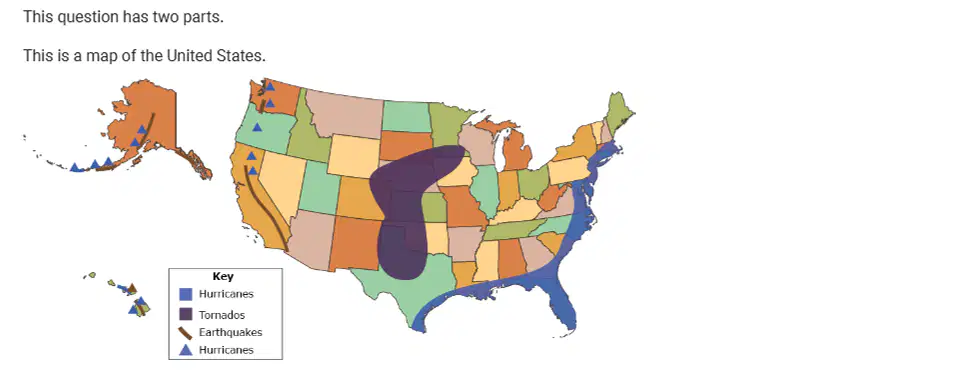
This question has two parts. This is a map of the United States. Part A: Which state listed is NOT likely to experience a significant earthquake or hurricane?
California
Alaska
Hawaii
Colorado
Part B: What evidence was used to answer part A?
Tornadoes and hurricanes occur in Colorado.
Fault lines are located in Alaska, Hawaii, and California.
Tornadoes in Colorado lead to unexpected earthquakes.
There is an unusual amount of tornadoes in Alaska, Hawaii, and California.
Which of the following is true about the tundra climate?
It averages less rainfall per year than some deserts.
It experiences frequent frontal weather disturbances.
It has average yearly temperatures that are very high.
It is influenced by offshore trade winds in the summer.
Which of the following climates is shared by Canada and the U.S.?
tropical wet
dry desert
cold tundra
dry tropical
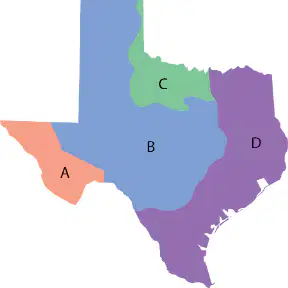
This is a map of regions in Texas. What kind of activities are most likely found in Region D? Select TWO correct answers.
snowboarding
mountain climbing
wind surfing
fishing
water surfing
Which of the following describes the influence of Creole culture on New Orleans?
French dialect and food
German dialect and architecture
French dialect and schools
Spanish dialect and festivals
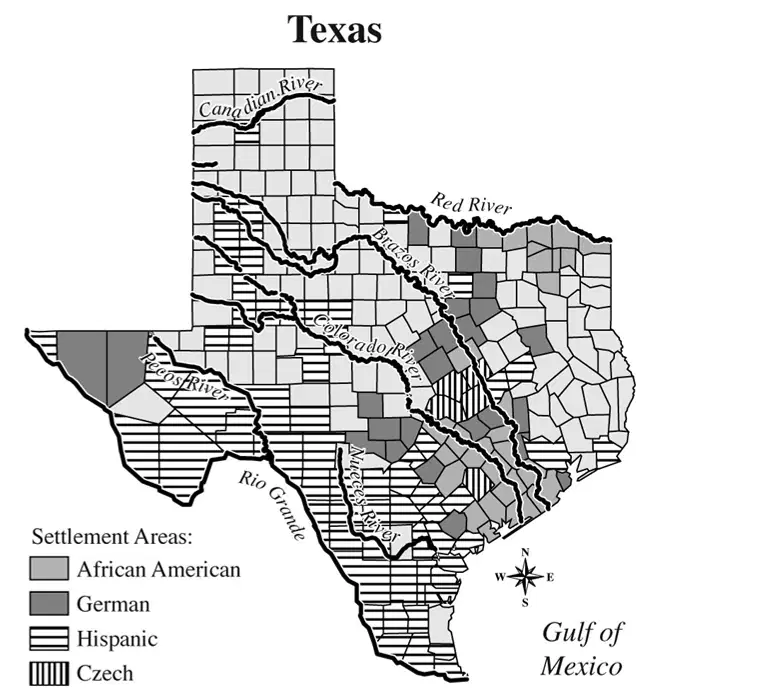
When presenting the information in the map above to your class, you can conclude that MOST Hispanic settlements were located —
in West Texas
along Texas rivers
in the Texas Panhandle
along the Texas-Mexico border
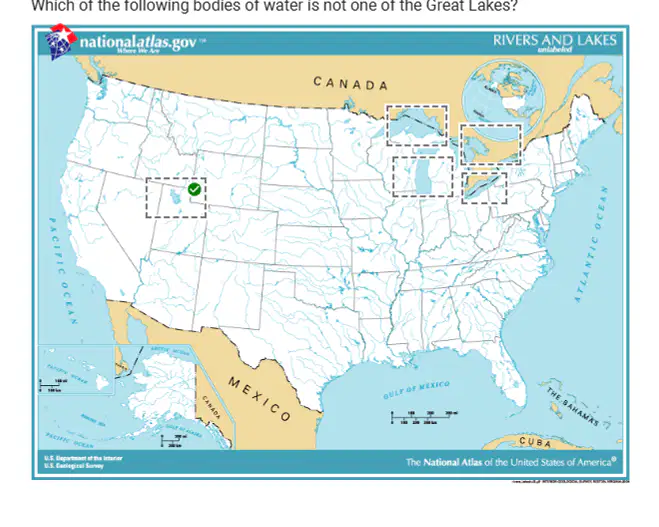
Which of the following bodies of water is not one of the Great Lakes?
Huron
Ontario
Michigan
Mississippi
Which statement best compares the climates in the United States and Canada?
The United States is usually colder than Canada.
Canada is usually colder than the United States.
The climate is basically the same in both countries.
Canada is usually hot compared to the United States.
Which natural force formed the Hawaiian Islands?
Erosion
Tsunamis
Coral deposits
Volcanic eruptions
Which of the following is a group that came to America against their will, but have assimilated and become an important part of the cultural landscape?
Hispanic
Asian
African-American
Middle Eastern
Which of the following statements is TRUE about a representative democracy?
Citizens have unlimited individual rights.
The government leaders rule by force (military).
Citizens voted directly on all laws and government actions.
The people elect government leaders to make decisions for them.
Which of the following is part of the United States Judicial Branch?
Senate
Supreme Court
Cabinet
House of Representatives
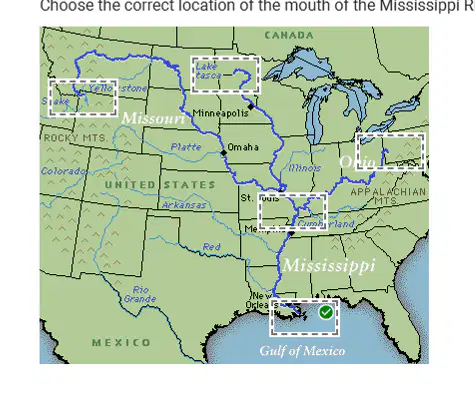
Choose the correct location of the mouth of the Mississippi River.
Missouri River
Yellowstone River
Gulf of Mexico
Atlantic Ocean
Which of these is considered a push factor in human migration?
Lower local taxes
More favorable climate
Improved education system
Lack of career opportunities
Many metropolitan areas in the United States and Canada have sprawled, or spread out, farther and farther. Cities are focusing on smart-growth
poorly planned city development
an outlying district of a city
living, located, or taking place in a city
harmful substances or products in the environment

Select the correct answer choice. The state colored red is
Maine
Washington
Montana
Alaska
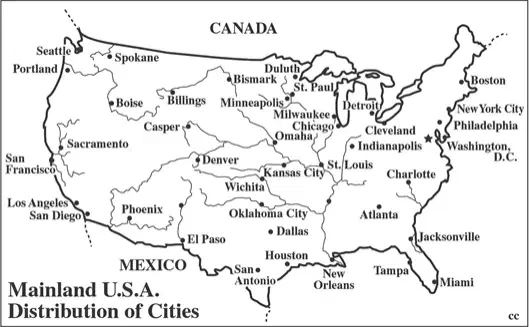
Using the map of the United States, what geographical feature is MOST associated with the distribution of major cities shown?
Mountains
Diversity
Rivers
Oceans
The United States is a nation of immigrants from all over the world. The majority of Americans, about 65%, trace their ancestry back to Europe.
True
False
What is the origin of bluegrass and country music?
African-American communities of New Orleans, Louisiana
Southerners whose ancestors came from Europe
White people from Britain in the mid 1950's
Southern whites who were influenced by the sounds of rock n' roll and jazz artists
This mountain peak is the highest point in North America. It is located in Alaska towering at 20,230 feet above sea level. The Native-American name is:
El Capitan
Mount Rainer
Mt. Mckinley
Mt. Whitney
What is most likely the reason that Canada’s population is so much smaller than Mexico’s and the United States, despite being the largest country?
Canada’s strict laws and regulations prevent people from living there, so they want to have more freedom in the United States and Mexico.
Mexico and the United States have more resources and opportunities to advance in your career.
The economic opportunities in the United States and Mexico are far greater than in Canada. Much of Canada is a rural environment, with very few urban areas.
Much of Canada’s land is located in the Northern Hemisphere where the climate is harsh and living conditions are difficult.
This French explorer explored much of the St. Lawrence river system. He led an expedition to Canada, along with few other colonists to create New France. He is:
Christopher Columbus
Francisco Vasquez de Coronado
Jacques Cartier
Leif Erickson
The first railroad to cross the United States and help overcome the long distance across the country was the _______.
Transcontinental Railroad
Union Pacific Railroad
Central Pacific Railroad
Great Northern Railway
Ellis Island is considered the busiest immigrant inspection station in the United States from 1892-1954. Immigrants were subject to medical and legal inspections.
Ellis Island
Angel Island
Liberty Island

