
 Worksheets
Africa Review
Total questions: 15
Worksheet time: 8mins
Name
Class
Date
1.
How did Ghana become such a powerful state?
a)
Ghana owned more salt than other states.
b)
Leaders in Ghana formed alliances with other groups of people.
c)
It had the strongest army in all of Africa.
d)
It gained control of the valuable trade routes.
2.
Why was salt so valuable in Africa?
a)
Salt was used as a fertilizer for crops
b)
Salt was used in many religious ceremonies.
c)
People needed salt in their diets and to preserve/season food.
d)
Salt was used in medicines.
3.
The exchange of gold and salt by silent barter helped
a)
Mali control the trade routes
b)
Traders who spoke different languages communicate
c)
Keep the location of the gold mines a secret
d)
Ghana get money to finance its army
4.
The earliest slave trade was across the Sahara. Slaves were brought up the Niger River to Timbuktu and transported across the Sahara into North Africa. Which of the following was necessary before large numbers of slaves could be moved across the desert?
a)
boats from Egypt
b)
horses from South America
c)
wagons from Europe
d)
camels from Arabia
5.
What protected Ghana from being conquered by Muslim armies in the 700s?
a)
strong walls
b)
elite warriors
c)
a peace treaty
d)
the vast desert
6.
How did the kings of Ghana and Mali ensure order and peace within their civilization? Choose the best answer.
a)
By granting fiefs in exchange for loyalty, a line of knights were recruited to keep the peace
b)
The kings imposed heavy fines on criminals
c)
The kings paid for a professional army using money collected by a tax on trade.
d)
All crime was met with harsh punishment, often death.
7.
Which of the following geographic features made trade with Arabia challenging for the Mali Empire during the Medieval period?
a)
the Mediterranean Sea
b)
the Nile River
c)
the Sahara Desert
d)
the Atlas Mountains
8.
Which of these was an advantage of becoming part of an empire?
a)
paying tribute to the king
b)
trading with the governor
c)
having to serve in the army
d)
getting protection from raiders
9.
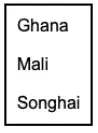
What was the importance of the empires listed above?
a)
They ended the slave trade among the central African tribes.
b)
They prevented the spread of the Islamic religion into Southern Africa.
c)
They kept European traders from exploiting African resources.
d)
They controlled the trade of salt, gold, and ivory across the Sahara.
10.
One danger associated with trade along routes like the Indian Ocean and the Trans-Saharan is that human interactions helped spread
a)
Disease
b)
Religious persecution
c)
Conquering barbarians
d)
Famine
11.
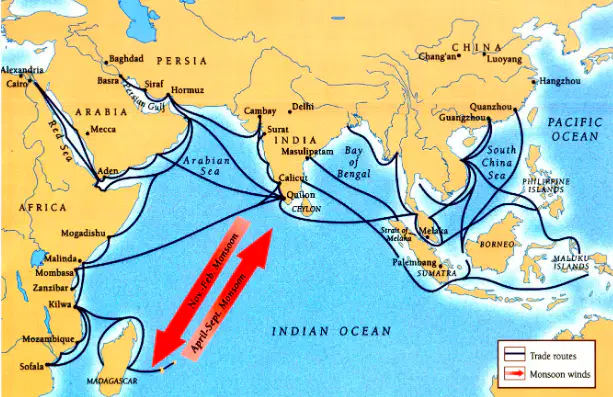
Which of the following made trade more reliable and profitable along the Indian Ocean (Choose Best Answer)
a)
Better Ship building techniques
b)
Strong and Predictable Monsoon Winds
c)
Educated Sea Captains
d)
Strong Navy to protect port-towns
12.
These were the travelers of the Sahara that made the Gold and Salt trade possible
a)
Berbers
b)
Moroccans
c)
Egyptians
d)
Swahili
e)
Moores
13.
In which language were most of the earliest books written in West Africa? This language was brought in by the Islamic Civilizations.
a)
Latin
b)
Arabic
c)
Mande
d)
Egyptian
14.
How have historians learned about the kingdom of Ghana?
a)
from writings of Arab scholars
b)
from wood carvings in the forest
c)
from royal tax collection records
d)
from paintings on salt mine walls
15.
For what was the city of Timbuktu especially well known?
a)
its productive salt mines
b)
its talented portrait artists
c)
its community of scholars
d)
its sea trade with East Asia
100 %

