
 Worksheets
Circulatory/Cardiovascular system
Total questions: 123
Worksheet time: 2hrs 40mins
Without/decreased RBC
(a)
Chest pain
(a)
Smallest veins, connects arterials and venules, where gas exchange occurs
(a)
Thickening and hardening of the walls of the arteries
(a)
Fatty plaque builds up and narrows the arteries
(a)
Heart is at rest
Ventricles are filling, atria are contract, This is the bottom of the BP
ex. 120/80
(a)
Heart is contracting
(a)
Heart is not moving/beating
(a)
Fast heart rate, greater than 100 in an adult
(a)
Slow heartrate, less than 60 in an adult
(a)
Bottom 2 chambers of the heart
(a)
Makes bigger
(a)
High BP
ex. 140/90 or higher
(a)
Low BP
ex. 90/60 in an adult or lower
(a)
Veins you can see on skin
(a)
Fainting
(a)
Blood clot
(a)
Foreign substance
(a)
Space between lungs where heart is housed/lives
(a)
Used to check blood pressure
(a)
Abnormal heart rhythm
(a)
Pericardium (visceral and parietal), Myocardium, Endocardium
(a)
RBC- carries oxygen
(a)
WBC- fights infection
(a)
Platelets- clots blood
(a)
right and left Atrium, right and left ventricle
(a)
Protein in blood, transport oxygen in blood
(a)
Tricuspid, Bicuspid (mitral), Pulmonary semi-lunar, Aortic semi-lunar
(a)
Top two chambers of the heart
(a)
Arteries carries blood away from heart
Veins carries blood to heart
(a)
Heart dz, heart cant supply enough o2 to meet body's needs
(a)
SOB, fatigue, back pain, jaw pain, etc.
(a)
Inflammation of veins
(a)
Inflammation of a vein due to a clot
(a)
Not enough/low iron
(a)
Body doesn't make enough RBC
(a)
Body stops producing all blood cells, makes you
prone to infections and hemorrhage
(a)
RBC can't pass through and clumps in one area,
blood shaped like a sickle
(a)
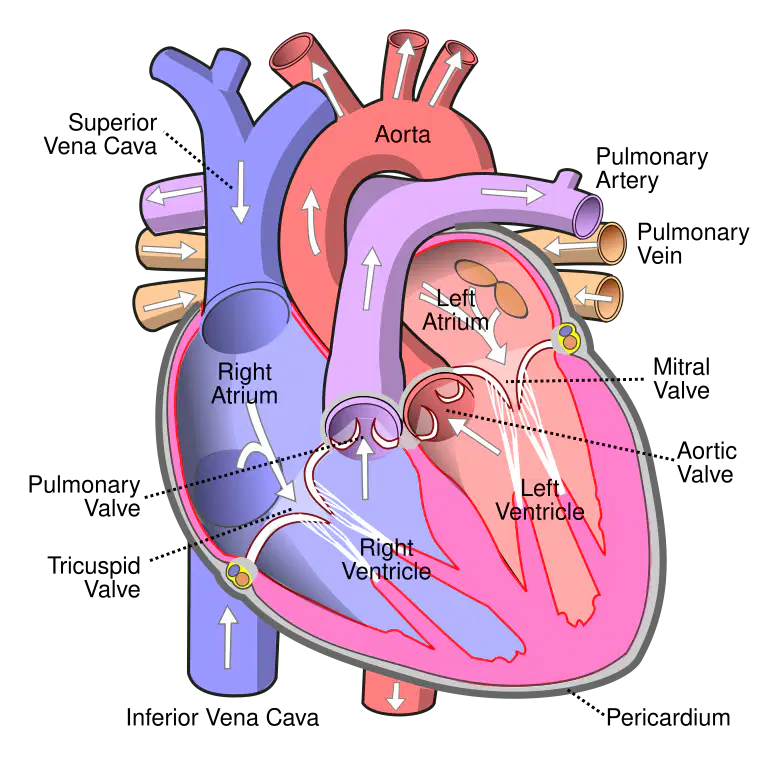
What is the largest artery?
(a)
The heart is a ____, muscular organ about the size of a ___ located between the ___. The ___ (tip) is pointed towards the left hip.
The heart is a hollow, muscular organ about the size of a fist located between the lungs.
The apex (tip) is pointed towards the left hip.
The heart is a filled, muscular organ about the size of a lung located between the mediastinum.
The apex (tip) is pointed towards the left hip.
Where is the heart located?
Between the lungs, aka mediastinum
Between the lungs aka ribcage
What is the function of the following membranes?
Fibrous-
Serous-
Visceral
Fibrous pericardium-provides protection and anchors heart in place
Serous pericardium (made of parietal & visceral)- Provides fluid to prevent friction
Visceral- directly touches the heart
Which layer of the heart is the thickest? Why?
Endocardium
The human cardiovascular system has 2 loops that circulate blood back to the heart.
Pulmonary-
Systemic-
Pulmonary circuit- Carries blood from heart to lungs and back to heart,
Picks up O2 and releases CO2
Systemic circuit- Major blood vessel attached to the heart, they are called the venae cava (superior and inferior), Aorta
The heart is located between the ____. It is protected by a multi-layered ____. The heart itself has 3 layers ____, ____, ____. It pumps blood in two paths-the ____ circuit, which delivers blood to the lungs and the ___ circuit. which delivers blood to the body.
The heart is located between the lungs. It is protected by a multi-layered pericardium. The heart itself has 3 layers Epicardium, Myocardium, Endocardium. It pumps blood in two paths-the Pulmonary circuit, which delivers blood to the lungs and the Systemic circuit, which delivers blood to the body.
The heart is located between the Ribcage. It is protected by a multi-layered endocardium. The heart itself has 3 layers visceral, parietal . It pumps blood in two paths-the ____ circuit, which delivers blood to the lungs and the ___ circuit. which delivers blood to the body.
The four chambers of the heart are:
Two ___ (right ___ and left ___)
Two ___(right ___ and left ___)
Two Atria (right atrium and left atrium )
Two Ventricle (right Ventricle and left Ventricle )
Which two chambers contains oxygenated blood?
(a)
Which side contains deoxygenated blood?
(a)
What structure separates the two sides of the heart?
(Heart is separated so blood doesn't mix)
(a)
Definition of each of the heart structure
Superior Venae Cava- Returns blood to heart
Right atrium- Gets deoxygenated blood from body
Coronary Blood Vessels- Gives oxygen to heart
Pulmonary veins- Brings oxygenated blood from lungs
Right Ventricle- Gets deoxygenated blood from right atrium
Definition of each of the heart structure
Apex is the tip of the heart (points to left hip)
Inferior Venae Cava- Returns blood to heart from lower body
Aorta- Takes oxygenated blood to blood tissue
Pulmonary artery- Carries deoxygenated blood
Left atrium- Gets oxygenated blood from lungs
Left ventricle- Gets oxygenated blood from left ventricle
What structures cover the atria
(Its the fat on the atrium)
(a)
What is the function of valves within the heart?
Keeps blood from back flowing
Helps blood mix
There are 2 sets of valves:
1. Atrioventricular valves- Between atria and ventricles
-Right side is ___
- Left side is ___
Right side is tricuspid
Left side is Bicuspid
There are 2 sets of valves:
2. Semilunar valves- between ventricles and major blood vessels
-Right___
-Left____
Right- Pulmonary Semilunar Valve
Left- Aortic Semilunar Valve
The heart is divided into 4 ____ . The right and left sides are separated by the ____. Blood flows in one direction through ___. They regulate blood flow between the ___and ___and also between the ___ and the blood ____.
The heart is divided into 4 chambers. The right and left sides are separated by the septum. Blood flows in one direction through valves. They regulate blood flow between the atria and ventricles and also between the ventricles and the blood vessels.
The heart is divided into 4 ventricles. The right and left sides are separated by the sternum. Blood flows in one direction through tunnels. They regulate blood flow between the atria and ventricles and also between the ventricles and the blood vessels.
What are the functions of the blood?
Transports oxygen, waste, and hormones
Regulated body temperature, pH, and fluid volume
Prevents infection and blood loss
Which one is the correct path for the Intrinsic conductive system?
SA node-->AV node-->AV bundle-->Bundle of HIS-->Bundle Branch--> Purkinje fibers
AV bundle--> AV node --> Bundle Branch--> Purkinje fibers--> SA node
How does the Intrinsic conduction system, regulate the heart?
SA node begins the impulse, which helps the heart contract. SA node called a cardiac pace maker.
SA node begins the contraction, which helps the heart beat. SA node called a cardiac pace maker.
What is another name for the SA node?
(a)
What is the difference between Diastole and Systole:
Diastole: Ventricle fills with blood- AV valve closes and you hear "lub" S1
Systole: Ventricles are contracting, semi-lunar valve closes, and your heart "dub" S2
What are the functions of the Blood?
1. Transports _____, _____, and _______.
2. Regulated body _______, , and fluid ____
3. Prevents _____ and _____ ____
What are the functions of the Blood?
1. Transports oxygen, waste, and hormones.
2. Regulated body temperature, pH, and fluid volume
3. Prevents infection and blood loss
What are the functions of the Blood?
1. Transports blood, pH, and temp.
2. Regulated body hormones, RBC, and fluid plasma
3. Prevents infection and blood loss
Sentence fill in
Blood is a connective tissue made of cells suspended in a fluid of matrix. The suspended cells are known as formed elements. The fluid matrix is known as plasma.
If a sample of blood is taken and shake the plasma will rise to the top and RBC and other will skin
Blood is a bloody tissue made of cells suspended in a fluid of matrix. The suspended cells are known as foced elements. The fluid matrix is known as plasma.
What is a hematocrit?
Percentage of RBC
Parentage of WBC
Blood is ___ times more _______ than water.
Blood is 5 times more viscous than water.
Blood is 4 times more thicker than water.
The color of blood ranges from ___, ____, to ___.
the color represents how much oxygen the blood has
Red, Blue, Purple
Red, Pink, Orange
Blood has a small __ of ____ to ____
Blood has a small pH to 7.35 to 7.45
Blood has a small pH to 8.25 to 8.35
You have about ____ quarts of blood in your body at all times
4-6
5-6
___% water
___% dissolved gases, salts, minerals, nutrients, enzymes, hormones, waste, and proteins
90% water
10% dissolved gases, salts, minerals, nutrients, enzymes, hormones, waste, and proteins
80% water
10% dissolved gases, salts, minerals, nutrients, enzymes, hormones, waste, and proteins
3 basic types of proteins are found in plasma:
Albumin- regulates osmosis between blood and tissue
Globulins- transports substances to fight infections
Fibrinogen- used in blood clotting
The composition of plasma is regulated by ___
The composition of plasma is regulated by homeostasis
The composition of plasma is regulated by osmosis
___ is a thick, red liquid that has several functions in the body. Most of the blood is made of fluid called ___ and the rest is comprised of ____ elements like __ and __ cells. Plasma is mostly ____, but also contains salts, nutrients, hormones, and ____
Blood is a thick, red liquid that has several functions in the body. Most of the blood is made of fluid called plasma and the rest is comprised of formed elements like platelets and blood cells. Plasma is mostly water, but also contains salts, nutrients, hormones, and proteins.
Blood is a thick, red liquid that has several functions in the body. Most of the blood is made of fluid called pulse and the rest is comprised of framed elements like platelets and blood cells. Plasma is mostly soda, but also contains salts, nutrients, hormones, and proteins.
Erythrocyte:
RBC, made in red bone marrows in adults, carries O2
WBC, fights infections protects body from forgien substances
The function of an erythrocyte is to ________________
______________-
The function of an erythrocyte is to transport oxygen around the body
The function of an erythrocyte is to help with fighting infections
The structure of an erythrocyte is well-suited for its function
_____ shape allows for greater surface area- takes in more oxygen
____ sides make for efficient flow through ___ ____
No ____ and few ___ so they don't use up ___ while transporting it
Biconcave shape allows for greater surface area- takes in more oxygen
Round sides make for efficient flow through blood vessel
No nucleus and few organelles so they don't use up oxygen while transporting it
Visceral shape allows for greater surface area- takes in more oxygen
Flat sides make for efficient flow through Blood vessel
Why must oxygen be carried by erythrocyte?
Because Oxygen is non-polar
Because Oxygen is polar
Hemoglobin is a protein composed of ___ chains called _____
Hemoglobin is a protein composed of 4 chains called globin
Hemoglobin is a protein composed of 3 chains called hemo
Each globin contains a flat molecule called a "____" which holds an Iron atom. Each Iron atom can bind to ___ O2 molecule, so one hemoglobin can hold __ O2 molecules.
Each globin contains a flat molecule called a "heme" which holds an Iron atom. Each Iron atom can bind to one O2 molecule, so one hemoglobin can hold 4 O2 molecules.
Each globin contains a flat molecule called a "heme" which holds an Iron atom. Each Iron atom can bind to 4 O2 molecule, so one hemoglobin can hold 1 O2 molecules.
Leukocyte=
WBC, fights infections protects body from forgien substances
RBC, made in red brown marrows in adults, carries O2
The function of a leukocyte is to ____
The function of a leukocyte is to fight off infections
The function of a leukocyte is to carry oxygen
____ (red blood cells) are highly efficient at transporting through blood. The ___ is carried on _____ molecule within the erythrocyte. ___ (White blooded cells) different in structure and function but are all responsible for ___ the body from foreign invaders
Erythrocyte (red blood cells) are highly efficient at transporting O2 through blood. The Oxygen is carried on Hemoglobin molecule within the erythrocyte. Leukocyte (White blooded cells) different in structure and function but are all responsible for protecting the body from foreign invaders
Leukocyte (red blood cells) are highly efficient at transporting O2 through blood. The Oxygen is carried on Hemoglobin molecule within the erythrocyte. Erythrocyte (White blooded cells) different in structure and function but are all responsible for protecting the body from foreign invaders
Hematologists
Process of blood cell formation
Process of white blood cell
Where does hematopoiesis occur?
Red bone marrow in adults
White bone marrow in adults
All formed elements are derived from a common ____ cell (called a ___)
All formed elements are derived from a common stem cell (called a hemocytoblast)
All formed elements are derived from a common plastic cell (called a hemocytoblast)
When a blood vessel is injured, ___ begin the process of forming a ___ (called ___)
When a blood vessel is injured, platelets begin the process of forming a blood clot (called homeostasis)
idk
Steps in homeostasis
1. Blood vessel contracts, causing reduce blood loss to wound
2. Platelets chemically attached to the wounded epithelium and stick together
3. Injured tissue release tissue factor which interacts with the platelets causing production of enzyme thrombin
Sometimes an abnormal clot forms within a blood vessel. This is called a ____.
If the ___ dislodges and floats through the blood, it is called an ___.
Sometimes an abnormal clot forms within a blood vessel. This is called a thrombus.
If the thrombus dislodges and floats through the blood, it is called an embolus.
akjndka
How does an abnormal clot affect the body?
Can cause cancer, jaundice, teeth loss
Can cause stroke, heart attack, or even death
All formed elements are produced through the process of ____ from ___. These process of blood clotting, involves physical and ___ reactions. If a blood clot forms abnormally, a ___ or ___ can form.
All formed elements are produced through the process of Hematopoiesis from hemocytoblast. These process of blood clotting, involves physical and chemical reactions. If a blood clot forms abnormally, a thrombus or embolus can form
All formed elements are produced through the process of osmosis from hemacrit. These process of blood clotting, involves physical and stem reactions. If a blood clot forms abnormally, a thrombus or embolus can form
AED
(a)
CABG
(a)
CAD
(a)
BP
(a)
CCU
(a)
CVRU
(a)
CHF
(a)
CPR
(a)
DVT
(a)
ECG/EKG
(a)
H&H
(a)
Hct
(a)
Hgb
(a)
MI (heart attack)
(a)
P(2)
(a)
SCD
(a)
There are three types of blood vessels
Arteries
Veins
Capillaries
Describe the flow of blood from an artery to a vein
Artery --> Arterioles --> Capillaries --> Venules ---> Vein
Artrioles --> Artery --> Capillaries --> Venules --> Vein
In which type of blood vessel are gases exchanged with surrounding tissues?
Capillaries
Arteries
Why is it helpful for capillaries to only have one layer?
For easy gas exchange
For easy cross for oxygen
What three layers are found in arteries and veins?
Tunica Intima- Slippery, thin layer
Tunica Media- Thicker layer of muscle
Tunica Externa (tunica adventitia)- Fibrous connective tissue to support and protect
How do veins maintain blood pressure?
Contraction of skeletal muscle surrounding veins increase pressure within the veins
(not sure if this is right)
denf;o:AW
What are two portions of a capillary?
Shunt- Shortcut from Artery to the vein
True Capillary- All tiny portions that exchange gases with the tissue
How can capillary sphincters restrict blood flow?
When blood is needed else where
jji
There are 3 types of ____ ____. ____ are thick, muscular tubes that delivery blood from the heart. After gases are exchanged in the ______, thinner ____ return the blood to the ___.
There are 3 types of Blood Vessels. Arteries are thick, muscular tubes that delivery blood from the heart. After gases are exchanged in the capillaries, thinner veins return the blood to the heart.
read it
The (a) is about the size of a clenched fist
The ____ ____ separates the Left Atrium from the Left Ventricle
(a)
The ____ ___ fills with blood- returning from the body.
(a)
The Left Atrium receives (a) blood from the lungs
The Pulmonary Artery transports deoxygenated blood from the Right Ventricle to the (a)
The ___ ___ fills with blood- from the Right Atrium.
(a)
The (a) valve separates the right atrium and the right Ventricle
The Left Ventricle fills with oxygenated blood from the ___ ____
(a)
The (a) is the single largest blood vessel in the body

