
Font size
 Worksheets
Tech+ 4.3
Total questions: 39
Worksheet time: 27mins
What is the impact of using security tools correctly in an organization?
Increased vulnerability to threats
Improved security posture
Decreased employee productivity
Higher operational costs
What can happen if people use security tools incorrectly?
Increased security
No impact
Decreased security
Improved performance
The concept of 'defense in depth' in network security refers to:
A single layer of security measures.
Multiple layers of security controls and measures.
Relying solely on firewalls for protection.
Using only antivirus software for network security.
Which of the following is a method to restrict access to different areas of a company's network?
Network segmentation
Automated tools
Firewall configuration
User authentication
Why are effective training, good policies, and strong security tools necessary to ensure the highest levels of cybersecurity?
They help in reducing the cost of cybersecurity measures.
They ensure compliance with international laws.
They provide a comprehensive approach to protect against cyber threats.
They eliminate the need for cybersecurity insurance.

What is the basic function of a firewall?
Fill in the blank: A firewall organizes traffic according to a set of rules that let in or keep out different types of traffic. Simple firewalls use three criteria or rules when filtering data: 1. Source: Where did the traffic come from? 2. Destination: Where is the traffic going to? 3. Protocol: What transport protocol is the traffic using?
A firewall organizes traffic according to a set of rules.
A firewall uses encryption to secure data.
A firewall monitors user activity on the network.
A firewall provides antivirus protection.
Which of the following is NOT a criterion used by firewalls to filter data?
Source
Destination
Protocol
Color
What is the primary function of a software firewall?
To enhance the speed of the internet connection
To protect against unauthorized access to or from a private network
To increase the storage capacity of a computer
To improve the graphics performance of a computer
Which type of firewall helps protect web applications by filtering and monitoring traffic?
Packet-filtering firewall
Stateful inspection firewall
Web application firewall
Next-generation firewall
True or False: It is best to run two firewall applications at the same time for increased security.
True
False
Which of the following are examples of public networks where you can set up home firewall software?
Wi-Fi networks in coffee shops
Corporate office networks
Home private networks
University campus networks
The primary function of antivirus software is to:
Detect and remove malware
Improve computer speed
Enhance graphics performance
Manage system updates
Antivirus software primarily works by using a list of known virus patterns, called ________.
signature
blueprint
template
prototype
Which of the following is a type of antivirus software?
Personal security suite
Network security suite
Both A and B
None of the above
True or False: Using two antivirus programs at the same time is better than using one.
True
False
What is real-time scanning in antivirus software?
A feature that scans files only when a full system scan is initiated
A feature that continuously monitors and scans files as they are accessed or modified
A feature that scans files only when the user manually selects them
A feature that scans files only during system startup
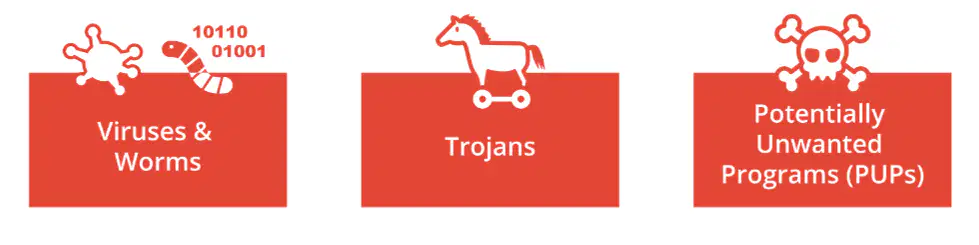
What are the three classifications of malware mentioned in the text?
A) Viruses & Worms, Trojans, PUPs
B) Adware, Spyware, Ransomware
C) Phishing, Spoofing, Hacking.
How does real-time scanning help in protecting your computer?
By detecting and removing threats as they occur
By scheduling scans at regular intervals
By only scanning files when manually initiated
By providing updates to the operating system
What should you do if a malware attack happens according to the text?
Disconnect from the internet immediately
Run a full system scan
Ignore the attack
Contact technical support
Why might antivirus software quarantine a file instead of deleting it?
To allow the user to review the file before deletion
To permanently remove the file from the system
To immediately stop the file from running
To increase the system's performance
A false positive in the context of antivirus software is:
A virus that is not detected by the software
A legitimate file incorrectly identified as a threat
A virus that is correctly identified and removed
A legitimate file that is correctly identified
Which of the following is a valid MAC address? A. 00:14:22:01:23:45 B. 192.168.0.1 C. 00-14-22-01-23-45 D. 255.255.255.0
00:14:22:01:23:45
192.168.0.1
00-14-22-01-23-45
255.255.255.0
What is the purpose of a subnet mask in networking?
To identify the network and host portions of an IP address
To encrypt data for secure transmission
To assign IP addresses to devices
To connect different networks together
Which layer of the OSI model does the IP protocol operate at?
Application
Transport
Network
Data Link
Fill in the blank: The default port number for HTTP is ____.
80
8080
443
21
Which of the following protocols is used for secure data transmission over the internet?
A. HTTP
B. FTP
C. HTTPS
D. SMTP
What is the primary function of a router in a network?
To connect devices within a local network
To route data packets between different networks
To provide internet access to devices
To store data and files for network users
Fill in the blank: The process of converting a domain name into an IP address is called ____.
DNS resolution
IP mapping
Domain translation
Network conversion
Which of the following is a private IP address?
A. 172.16.0.1
B. 8.8.8.8
C. 192.168.1.1
D. 10.0.0.1
What is the main difference between TCP and UDP?
TCP is connection-oriented, while UDP is connectionless.
TCP is faster than UDP.
TCP is used for video streaming, while UDP is used for file transfers.
TCP does not guarantee delivery, while UDP does.
Fill in the blank: The protocol used to send email messages from a client to a server is ____.
SMTP
HTTP
FTP
IMAP
What is the main purpose of software patches?
What is the process of patch management as described in the text?
A method to update software with new features.
A process to manage and apply software updates and patches.
A technique to uninstall unnecessary software.
A strategy to backup data regularly.

How many instances are up to date according to the compliance summary?
What is the purpose of Microsoft's support lifecycle policy?
To provide guidelines for product support duration
To offer discounts on software purchases
To ensure compatibility with third-party software
To enhance security features in products
How often does Microsoft release updates on 'patch Tuesday'?
Weekly
Bi-weekly
Monthly
Quarterly
What is a zero day attack?
A type of cyber attack that occurs on the same day a vulnerability is discovered.
An attack that targets outdated software.
A phishing attack that uses zero-day vulnerabilities.
A cyber attack that is planned for zero days.
Which of the following statements is true about updating non-Microsoft software?
Non-Microsoft software updates are more frequent than Microsoft updates.
Non-Microsoft software updates are less frequent than Microsoft updates.
Non-Microsoft software updates are as frequent as Microsoft updates.
Non-Microsoft software does not require updates.

