
 Worksheets
Density #3 (Irregular Solids)
Total questions: 14
Worksheet time: 10mins

Imagine you're a scientist for a day, and you've just discovered a mysterious, irregularly shaped rock! Excited to learn more about it, you carefully lower it into a graduated cylinder that already has 50 ml of water. As the rock plunges into the water, you notice the water level rises up to 75 ml. If this intriguing rock weighs 250 g, can you figure out its density?
15 g/mL
5 g/mL
10 g/mL
20 g/mL
A student has an irregularly shaped rock. She places it in a graduated cylinder containing 50 mL of water, and the water level rises to 65 mL. If the mass of the rock is 30 grams, what is the density of the rock?
0.5 g/mL
2 g/mL
3 g/mL
4 g/mL
Which of the following steps is essential when using the water displacement method to find the volume of an irregular solid?
Measure the mass of the solid before placing it in water.
Ensure the solid is completely submerged in water.
Use a balance to measure the weight of the water displaced.
Record the temperature of the water before and after displacement.
A student finds that a piece of metal displaces 10 mL of water in a graduated cylinder. If the mass of the metal is 78 grams, what is the density of the metal?
7.8 g/mL
8.0 g/mL
7.0 g/mL
6.8 g/mL
Identify which of the following objects is most likely to be an irregular solid.
A cube
A sphere
A rock
A cylinder
A student has two materials: Material X with a density of 5 g/mL and Material Y with a density of .3 g/mL. If both materials are placed in water, which material will sink and why?
Material X will sink because it is denser than water.
Material Y will sink because it is less dense than water.
Both materials will float because they are denser than water.
Neither material will sink because they are less dense than water.
A student measures the mass of an irregular solid as 45 grams. When placed in a graduated cylinder, the water level rises from 30 mL to 40 mL. What is the density of the solid?
4.5 g/mL
3.5 g/mL
5.0 g/mL
4.0 g/mL
Which of the following statements best describes why the water displacement method is used for irregular solids?
It is the most accurate method for measuring mass.
It allows for the measurement of volume without complex calculations.
It is the only method that can measure the density of a solid.
It provides a way to measure the temperature change of the water.
A student has a piece of clay that displaces 15 mL of water. If the clay has a mass of 45 grams, what is its density?
2 g/mL
3 g/mL
4 g/mL
5 g/mL
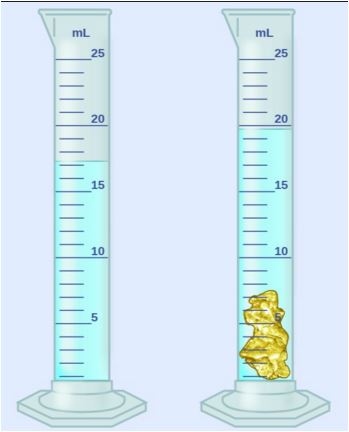
Which of the following materials is likely to have the highest density?
A piece of cork
A block of wood
A chunk of lead
A plastic bottle
A student needs to determine the density of an irregularly shaped object. Which of the following tools and methods should they use?
A ruler and the formula for volume of a cube
A graduated cylinder and the water displacement method
A thermometer and a balance
A stopwatch and a measuring tape
Peyton places a rock in a graduated cylinder containing water. The water level rises from 30 mL to 50 mL. If the mass of the rock is 40 grams, what is its density?
2.0 g/cm³
1.5 g/cm³
0.8 g/cm³
2.5 g/cm³

