
 Worksheets
GP61 FINALS REVIEWER
Total questions: 50
Worksheet time: 16mins
THIS BRANCH OF PHYSICS DEALS WITH FORCE AND MOTION.
MECHANICS
ELECTROMAGNETISM
OPTICS
THERMODYNAMICS
THIS BRANCH OF MECHANICS STUDIES THE EFFECT OF FORCES ON THE STATE OF MOTION OF OBJECTS.
DYNAMICS
KINEMATICS
KINETICS
CINEMATICS
THIS BRANCH OF MECHANICS DESCRIBES HOW OBJECTS MOVE.
KINEMATICS
KINETICS
CINEMATICS
DYNAMICS
A CAR FROM POINT A TRAVELLED 38 KM TO REACH POINT B ALTHOUGH THESE TWO POINTS ARE JUST 17 KM APART. WHAT IS THE CAR'S TOTAL DISTANCE TRAVELLED?
38 KM
17 KM
55 KM
21 KM
A CAR FROM POINT A TRAVELLED 38 KM TO REACH POINT B ALTHOUGH THESE TWO POINTS ARE JUST 17 KM APART. WHAT IS THE CAR'S TOTAL DISPLACEMENT?
38 KM
17 KM
55 KM
21 KM
IF AN OBJECT MOVES ALONG A LINEAR PATH, IT IS UNDERGOING __________.
TRANSLATIONAL MOTION
TRANSNATIONAL MOTION
ROTATIONAL MOTION
INTERNATIONAL MOTION
WHICH OF THE FOLLOWING ARE EXAMPLES OF TRANSLATIONAL MOTION?
UNIFORM MOTION
UNIFORMLY ACCELERATED MOTION
FREE-FALL
PROJECTILE MOTION
WHICH OF THE FOLLOWING BEST DESCRIBES UNIFORM MOTION?
CONSTANT SPEED
CONSTANT ACCELERATION
AT REST
CONSTANT DIRECTION
HOW DO YOU CALL A TYPE OF TRANSLATIONAL MOTION IN WHICH THE OBJECT CHANGES SPEED, DIRECTION, OR BOTH?
NON-UNIFORM MOTION
UNIFORM MOTION
PROJECTILE MOTION
FREE-FALL
WHAT QUANTITY CAN WE GET IF WE SOLVE FOR THE SLOPE OF A DISTANCE VS TIME GRAPH?
VELOCITY
ACCELERATION
SPEED
FORCE
WHAT QUANTITY CAN WE GET IF WE SOLVE FOR THE SLOPE OF A DISPLACEMENT VS TIME GRAPH?
VELOCITY
ACCELERATION
SPEED
FORCE
WHAT QUANTITY CAN WE GET IF WE SOLVE FOR THE SLOPE OF A VELOCITY VS TIME GRAPH?
DISPLACEMENT
ACCELERATION
DISTANCE
FORCE
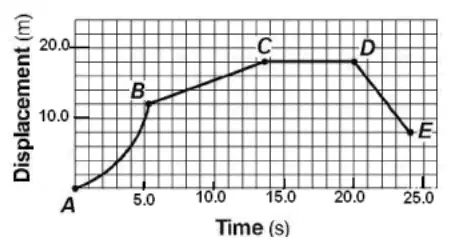
Based on this Displacement vs Time graph, how was the object moving for the first 5 seconds?
Moving forward as it speeds up
Moving forward as it slows down
Moving forward with constant velocity
Moving backwards with constant velocity
Based on this Displacement vs Time graph, how was the object moving for segment BC?
Moving forward as it speeds up
Moving forward as it slows down
Moving forward with constant velocity
Moving backwards with constant velocity
Based on this Displacement vs Time graph, how was the object moving for segment CD?
Moving forward as it speeds up
It is not moving
Moving forward with constant velocity
Moving backwards with constant velocity
Based on this Displacement vs Time graph, how was the object moving for segment DE?
Moving forward as it speeds up
Moving forward as it slows down
Moving forward with constant velocity
Moving backwards with constant velocity
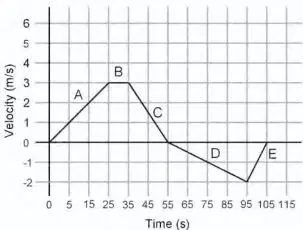
Based on this Velocity versus Time graph, which segments indicate that the object is speeding up or accelerating?
A
B
C
D
E
Based on this Velocity versus Time graph, which segments indicate that the object is slowing down or decelerating?
A
B
C
D
E
Based on this Velocity versus Time graph, which segments indicate that the object is moving with constant velocity?
A
B
C
D
E
Based on this Velocity versus Time graph, which segments indicate that the object is moving in the opposite direction?
A
B
C
D
E
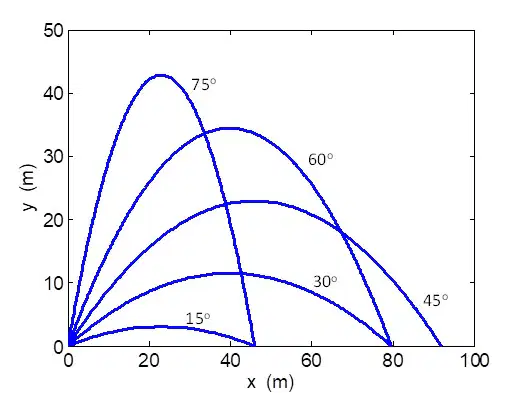
Which of the following is TRUE about projectile motion?
Projectiles launched at an angle of 45° will reach the farthest range.
The lower the angle of projection, the nearer is the range.
The higher the angle of projection, the farther is the range.
Objects launched at complementary angles will reach the same range.
TRUE
FALSE
Objects launched at acute angles higher than 45 degrees will reach higher altitudes.
TRUE
FALSE
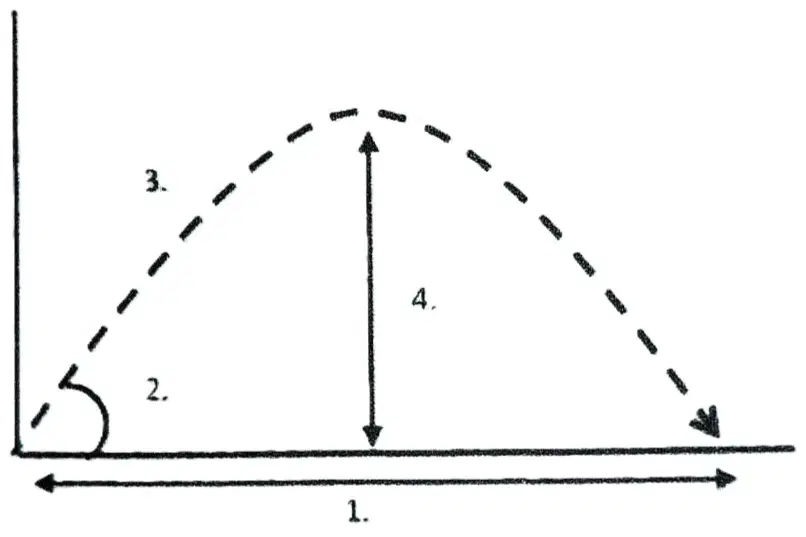
What does #1 represent in this illustration of projectile motion?
Range
Altitude
Angle of Projection
Projectile
What does #2 represent in this illustration of projectile motion?
Range
Altitude
Angle of Projection
Trajectory
What does #3 represent in this illustration of projectile motion?
Range
Altitude
Angle of Projection
Trajectory
What does #4 represent in this illustration of projectile motion?
Range
Altitude
Angle of Projection
Trajectory
He did an extensive study on bodies in motion and found out that an object in free-fall goes down at a uniformly accelerated motion.
Galileo Galileo
Isaac Newton
Nicolaus Copernicus
Albert Einstein
In free-falling bodies, which of the following is a constant?
acceleration due to gravity
initial velocity
final velocity
altitude
The vertical velocity at the highest point of objects thrown upwards is always zero.
TRUE
FALSE
THE X-COMPONENT OF PROJECTILE MOTION IS UNIFORMLY ACCELERATED MOTION
TRUE
FALSE
THE Y-COMPONENT OF PROJECTILE MOTION IS FREE-FALL
TRUE
FALSE
WHICH OF THE FOLLOWING IS BEING IGNORED IN FREE-FALL AND PROJECTILE MOTION PROBLEMS?
AIR RESISTANCE
INITIAL VELOCITY
TIME OF FLIGHT
ACCELERATION
FOR OBJECTS THROWN UPWARDS, THE TIME SPENT GOING UP IS EQUAL TO THE TIME SPENT GOING DOWN TO ITS INITIAL POSITION.
TRUE
FALSE
PROJECTILES SPEED UP AS IT GOES UP TO ITS HIGHEST ALTITUDE.
TRUE
FALSE
WHO FORMULATED THE 3 LAWS OF MOTION?
ISAAC NEWTON
ALBERT EINSTEIN
GALILEO GALILEI
NIKOLA TESLA
IT IS A PUSH OR PULL WHICH MAY CAUSE AN OBJECT TO CHANGE ITS STATE OF MOTION.
FORCE
ENERGY
PRESSURE
POWER
IF A METAL SOLID BOX WITH A MASS OF 250 KG WAS PLACED ON THE MOON, WHAT WOULD BE ITS MASS ON THE MOON PROVIDED THAT NOTHING HAS CHANGED WITH IT?
MORE THAN 250 KG
LESS THAN 250 KG
STILL 250 KG
ZERO
WHAT IS THE SI UNIT OF FORCE?
NEWTON
WATT
PASCAL
KILOGRAM
This is the branch of mechanics that deals with the study of forces and their effects on the motion of objects.
DYNAMICS
ACOUSTICS
MODERN PHYSICS
QUANTUM PHYSICS
TO MOVE AN OBJECT WITH A BIGGER MASS WITH THE SAME ACCELERATION AS AN OBJECT WITH LESSER MASS, YOU SHOULD ____________
APPLY MORE FORCE
APPLY LESS FORCE
THE FIRST LAW OF MOTION IS KNOWN AS THE LAW OF __________
INERTIA
ACCELERATION
INTERACTION
REACTION
IT STATES THAT A BODY AT REST WILL REMAIN AT REST, AND A BODY IN MOTION WILL CONTINUE TO MOVE UNIFORMLY UNLESS ACTED UPON BY AN EXTERNAL UNBALANCED FORCE.
NEWTON'S FIRST LAW OF MOTION
NEWTON'S SECOND LAW OF MOTION
NEWTON'S THIRD LAW OF MOTION
NEWTON'S ZEROTH LAW OF MOTION
IT STATES THAT FOR EVERY ACTION, THERE IS ALWAYS AN EQUAL BUT OPPOSITE REACTION.
NEWTON'S FIRST LAW OF MOTION
NEWTON'S SECOND LAW OF MOTION
NEWTON'S THIRD LAW OF MOTION
NEWTON'S ZEROTH LAW OF MOTION
THIS LAW OF MOTION IS EXPRESSED MATHEMATICALLY AS F=ma
Law of Gravitation
Law of Conservation of Mass
Law of Inertia
Law of Acceleration

CLASSIFY THIS FORCE: BUOYANT FORCE
CONTACT FORCE
NON-CONTACT FORCE

CLASSIFY THIS FORCE: DRAG
CONTACT FORCE
NON-CONTACT FORCE

CLASSIFY THIS FORCE: NORMAL FORCE
CONTACT FORCE
NON-CONTACT FORCE

CLASSIFY THIS FORCE: MAGNETIC FORCE
CONTACT FORCE
NON-CONTACT FORCE
CLASSIFY THIS FORCE: GRAVITATIONAL FORCE
CONTACT FORCE
NON-CONTACT FORCE

