
NEW
Font size
 Worksheets
Unit 6 Review
Total questions: 45
Worksheet time: 23mins
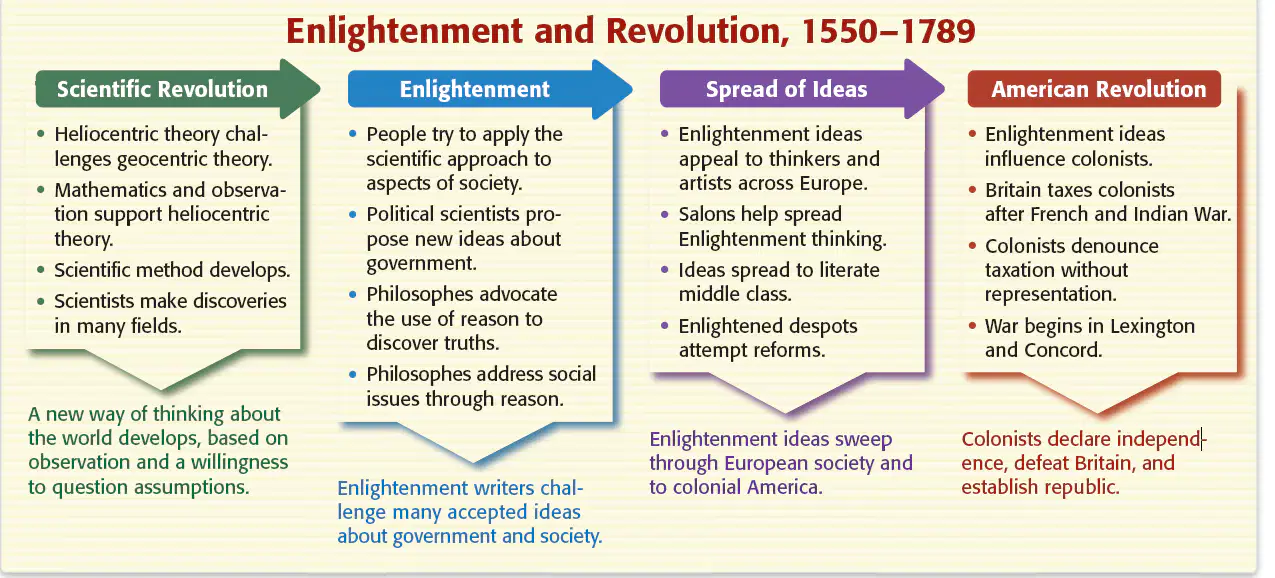
Between 1550 and 1789, Enlightenment ideas swept
Only through France and colonial America.
Only through European society.
Through European society and colonial America.
Throughout the world.
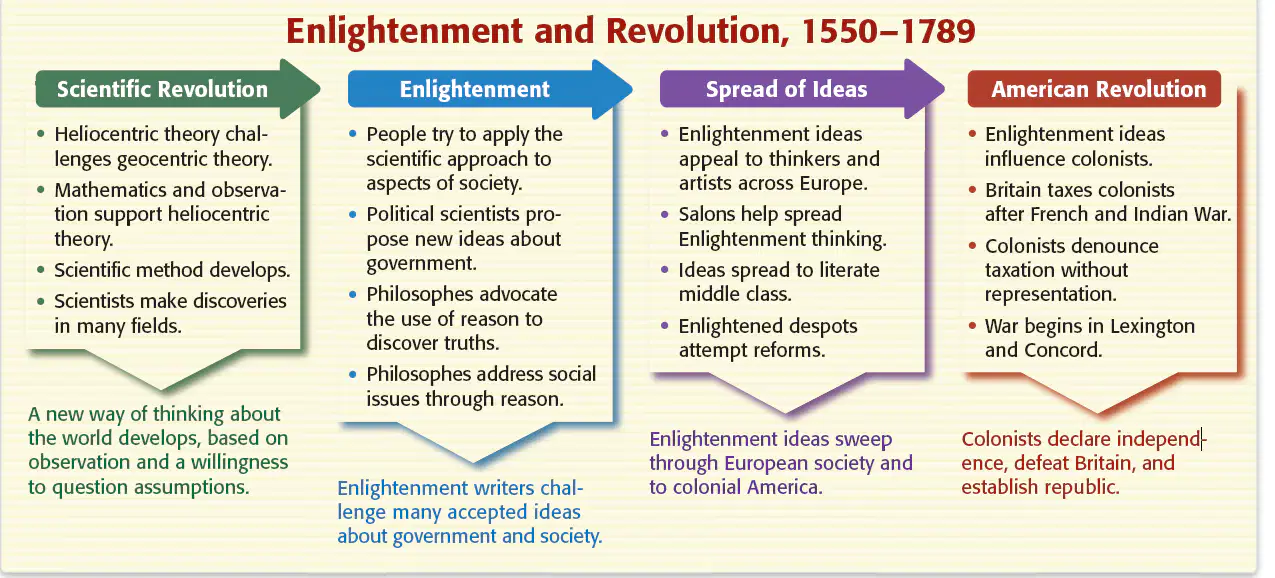
Salons helped to spread
The geocentric theory
Only the ideas of the philosophes.
Only the ideas of the political scientists
Enlightenment thinking.
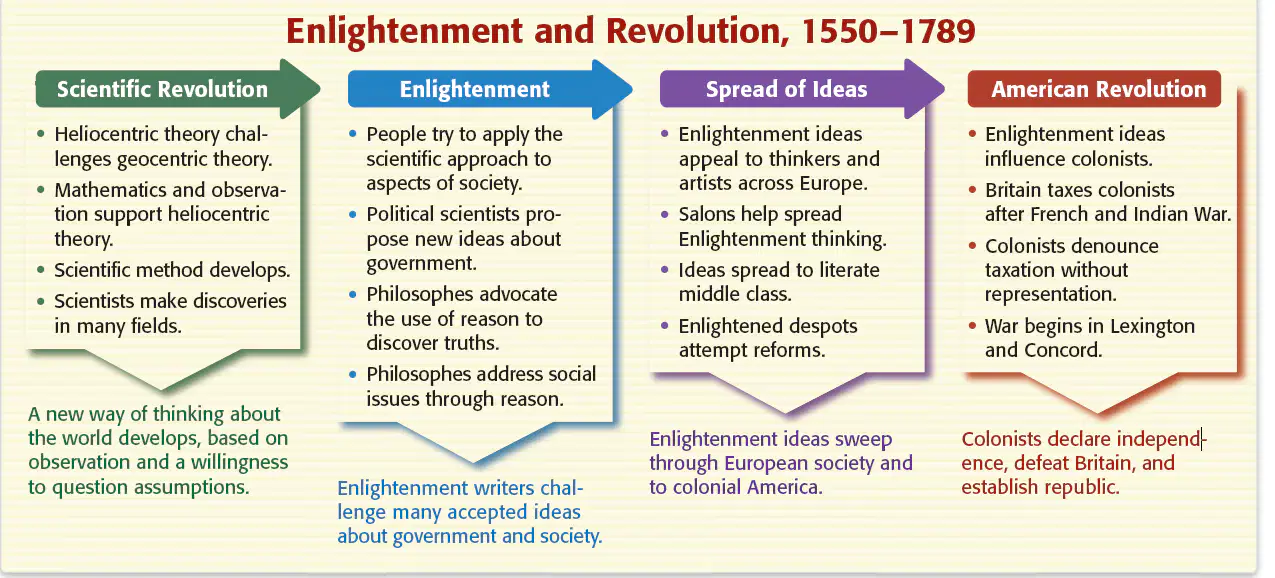
Which person would probably NOT have been influenced by the philosophes?
A scholar who believed in the geocentric theory.
A European artist living during the 1700s.
A leader of a salon.
An American patriot denouncing taxation without representation.

The philosophes used reason to address
British taxes
Social issues
Abusive rulers
All of the above
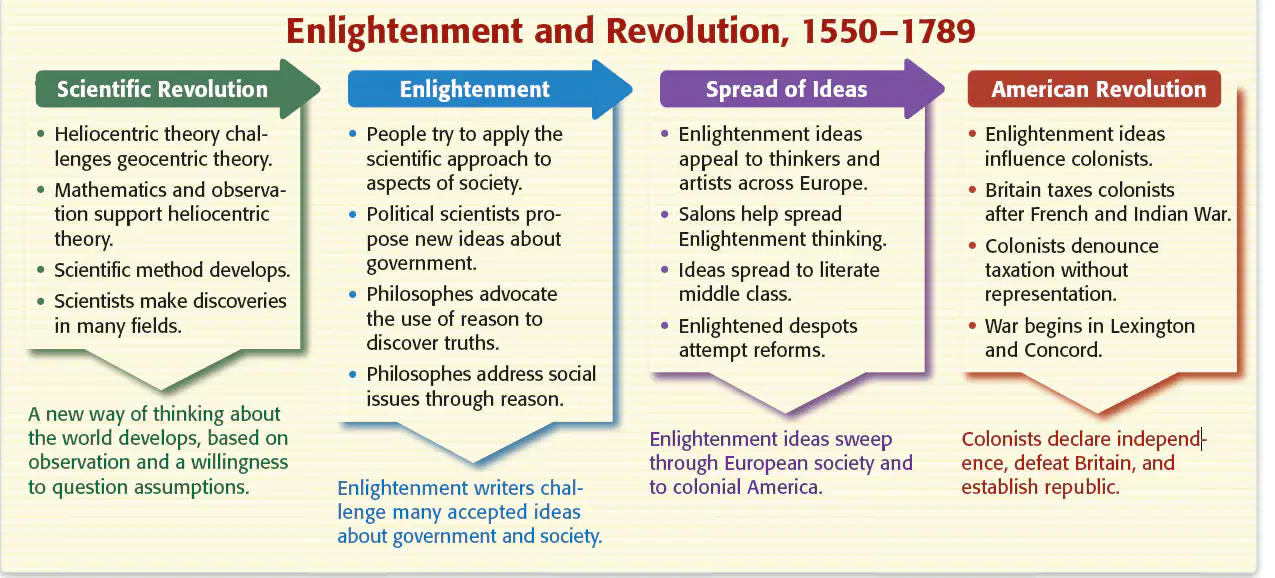
The American Revolution was influenced by
British policies
Political scientists
The philosphes
All of the above.
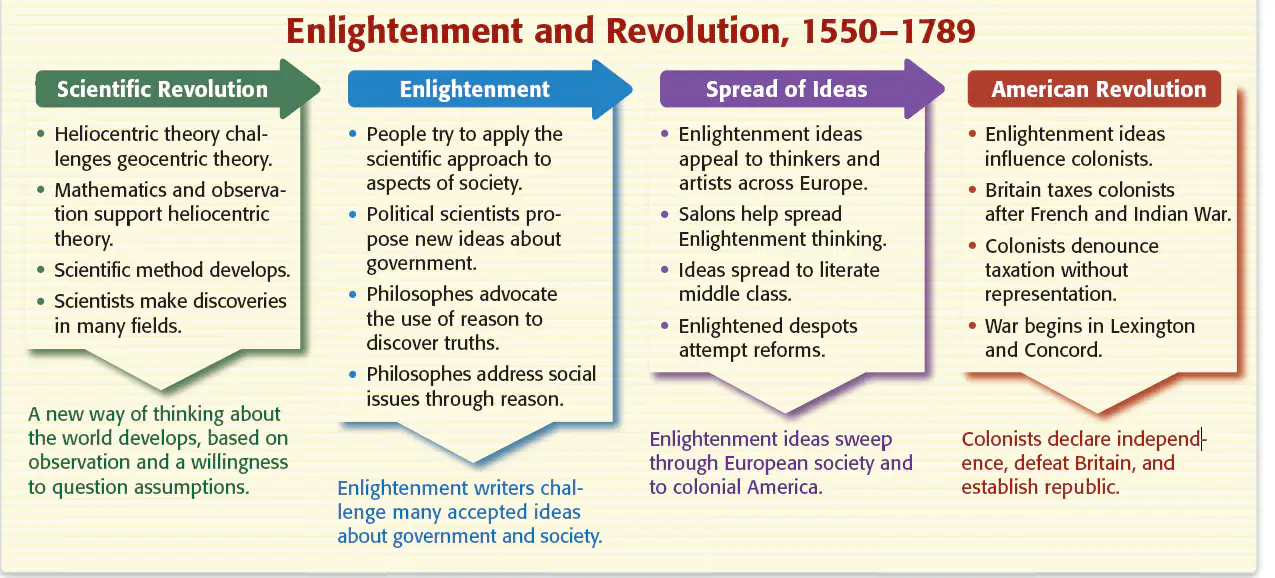
Which of the following attempted social reforms?
The philosphes
Scholars
Enlightened Despots
All of the above
Which of the following occurred after the salons spread enlightenment ideas?
The scientific method develops.
The colonists denounced taxation without representation.
Political scientists propose new ideas about government.
People apply the scientific approach to society.
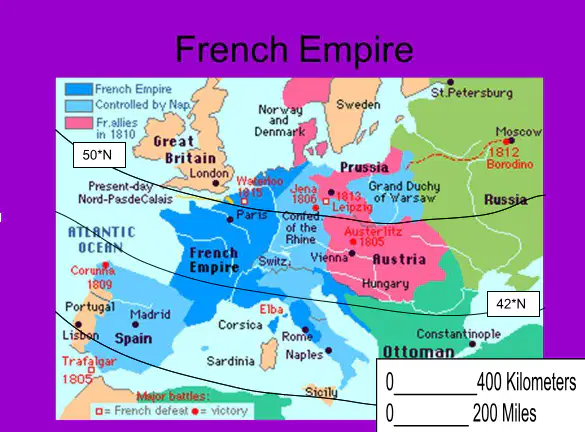
How did Napoleon's conquests affect the size of the French-controlled territory?
It shrank by half.
It approximately tripled the size.
It stayed approximately the same.
It changed only slightly.
Which routed would enable the French troops to stay within the French Empire for most of the journey to the Russian border?
crossing through Switzerland, Confederation of the Rhine, Sweden
Crossing the Confederation of the Rhine, Ottoman Empire, Austrian Empire
Crossing Switzerland, Italy, Ottoman Empire, Austria
Crossing the Confederation of the Rhine, Prussia, The Grand Duchy of Warsaw
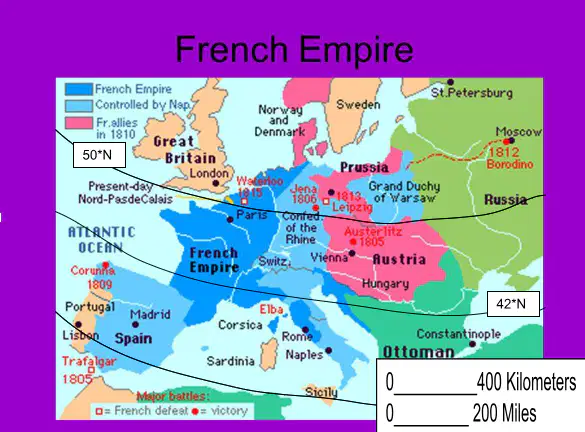
Great Britain and Moscow lie above which line of latitude?
40* S
80* W
50* N
8* E
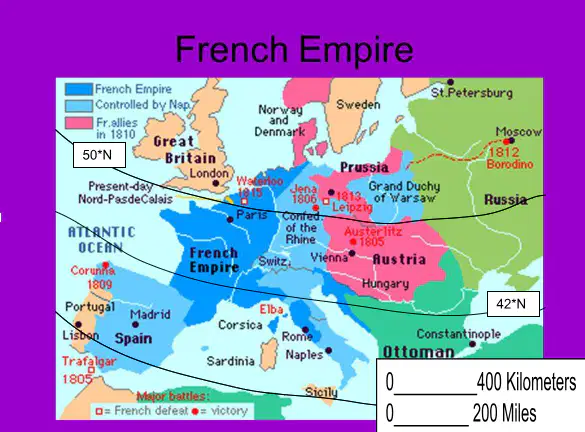
Which major advantage did Czar Alexander I have over Napoleon's Grand Army?
The Grand Army had no access to the Baltic Sea.
The Grand Army was not accustomed to Russian winters.
The Grand Army was far from its enemies.
The Grand Army had great difficulty navigating the Black Sea.
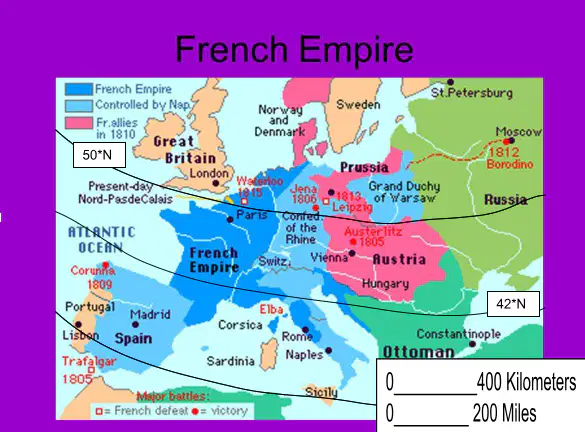
Which of Napoleon's allies shared the longest borders with the area he controlled?
Austrian Empire
Switzerland
Portugal
Denmark
Under Japan's new system of feudalism, the daimyo were
Warlords
Shoguns
Emperors
Religious leaders
The Tokugawa Shogunate was a type of
Cultural institution
Religions authority
Military government
Commercial partnership or organization
In 1600, the person who finally completed the long process of unifying Japan was
Matsuo Basho
Oda Nobunaga
Tokugawa Ieyasu
Toyotomi Hidetoshi
Tokugawa Ieyasu used the “alternate attendance policy” to control the
Foreign traders
Peasants
Merchants
Daimyo
What type of policy did Japan institute to control foreign ideas?
A closed country policy
A policy of colonization
A policy of persecution
A Zen Buddhist policy
The Declaration of Independence was written by
A
John Adams
John Adams
Benjamin Franklin
Thomas Jefferson
Patrick Henry
The Bill of Rights was influenced by
Voltaire
Locke
Rousseau
All of the above
Which of the following events occurred after the American Revolution?
Constitutional Convention
French and Indian War
Stamp Act
Navigation Acts
What was Montesquieu’s influence on the U.S. Constitution?
Public elections
Branches of government
The Bill of Rights
Representatives
What did the American colonists protest as “taxation without representation”?
French and Indian War
Navigation Acts
Stamp Act
Export tax on tea
How did the Declaration of Independence embody Enlightenment ideals?
It stated that all titles of nobility should be abolished.
It protected the rights of the accused and prohibited cruel punishment.
It set up a system of checks and balances for the U. S. government.
It said that people have rights of life, liberty, and the pursuit of happiness.
What king became France’s most powerful ruler and boasted “I am the state”?
Peter the Great
Elizabeth I
Louis XIV
Louis XVI
The first Russian ruler to adopt the title czar, meaning “Caesar,” was
Peter the Great
Ivan the Terrible
Yaroslav
Vladimir
Which of the following did the Glorious Revolution bring to England’s throne?
William and Mary
Charles II
James II
James I
A major reason for the colonists’ victory over Britain was
Superior weaponry.
A stronger motivation to fight
Military support from Italy
More experienced generals
Which of the following was created by the Articles of Confederation?
The Congress
The Supreme Court
The office of the president
The office of the vice-president
The first nation government of the 13 individual states in North America was created by the
Treaty of Paris
Navigation Acts
Articles of Confederation
Declaration of Independence
The person most responsible for the accomplishments of the Congress of Vienna was
Czar Alexander I of Russia.
Emperor Francis of Austria.
King Frederick William III of Prussia.
Prince Klemens von Metternich of Austria.
About what percentage of France’s population belonged to the Third Estate?
2
98
20
10
What happened on Bastille Day?
Robespierre was executed by guillotine.
French women marched all the way to Versailles.
A mob stormed a prison looking for weapons.
All of the above are true.
Which goal was NOT stated in the slogan of the French Revolution?
Liberty
Equality
Justice
Brotherhood
During the Reign of Terror, who was safe from the guillotine?
No one
the nobility
the clergy
Third Estate
Who was the most influential leader at the Congress of Vienna?
Czar Alexander I of Russia
Emperor Francis of Austria
King Frederick William III of Prussia
Prince Klemens von Metternich of Austria
Which of the following was an important goal of the Congress of Vienna?
to destroy France
to execute Napoleon by guillotine
to establish a balance of power in Europe
to establish Vienna as the new capital of Europe
About what percent of France’s population belonged to the First and Second Estates?
2
10
20
98
Which group most strongly embraced the ideals and principles of the Enlightenment?
the nobility
the bourgeoisie
the peasant class
the clergy
What issue led to the first meeting of the Estates-General in 175 years?
proposed taxation of the Second Estate
political representation in the government
food shortages and riots among the peasants
taking away religious freedoms from the Huguenots
Which of the following was NOT a reason for Napoleon to sell the Louisiana Territory?
to raise money
To cut his losses in America
to punish the sugar growers in Saint Domingue
to weaken Britain's power
What was one important consequence of the Battle of Trafalgar?
Napoleon gave up his plans of invading Britain.
Napoleon conquered Russia.
Portugal became part of the French Empire.
Napoleon became emperor.
How did Great Britain react to the Continental System?
It invaded France.
It organized its own blockade.
It negotiated a peace agreement with France.
It formed an alliance with Austria and Prussia.
Which of the following is an accurate description of the tax system in France in the years preceding the French Revolution?
Only peasants and the clergy paid taxes.
Only about 2 percent of the nobility paid any taxes.
The nobility paid taxes only on land, not on income.
The members of the Third Estate paid almost all of the taxes.
What does the word plebiscite mean?
an agreement
a vote of the people
a seizure of power
a public school
How did Admiral Nelson defeat the French-Spanish fleet in the Battle of Trafalgar?
He ordered the British fleet to invade France.
He bombed Napoleon's infantry.
He divided the French fleet into smaller groups and then attacked them.
He pretended to retreat and did scorched earth.

