
 Worksheets
Quiz on Circuit Theory
Total questions: 34
Worksheet time: 17mins
What happens to the current in a series circuit if one component burns out?
Current becomes inactive
Current increases
Current decreases
Current remains the same
What happens to the current in parallel branch 1 when the resistance R1 is lower than R2 and R3?
The current reduces
The current increases
The current remains the same
The current stops
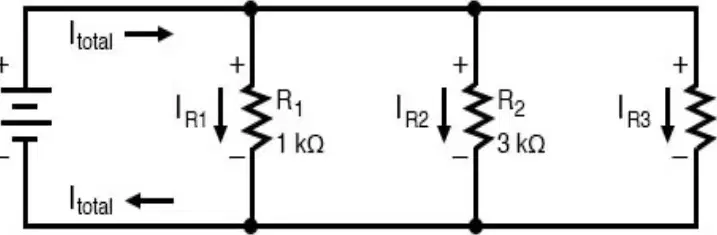
If R1 = 1 kΩ, R2 = 3 kΩ, and R3 = 2 kΩ, what is the total resistance R_{eq} in the circuit?
6 kΩ
0.55 kΩ
1.5 kΩ
0.75 kΩ
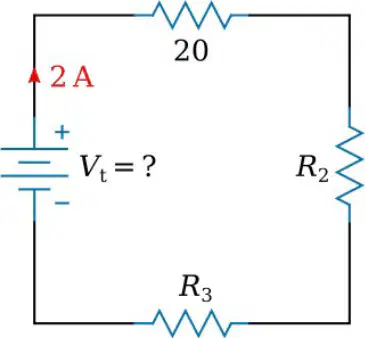
What is the total resistance in the circuit if R1 = 20 ohms, R2 = 30 ohms, and R3 = 50 ohms?
100 ohms
50 ohms
60 ohms
80 ohms
How do you calculate the total voltage (Vt) in a series circuit with a total current (I) of 2 amps and total resistance (R) of 100 ohms?
Vt = I * R
Vt = I / R
Vt = R / I
Vt = I + R
What is the total voltage (Vt) in the circuit if the total current is 2 amps and the total resistance is 100 ohms?
200 volts
150 volts
100 volts
50 volts
How is the total voltage (Vt) calculated in this circuit?
Vt = I * Rt
Vt = I / Rt
Vt = Rt / I
Vt = I + Rt
If the total current (I) is 2 amps and the total resistance (Rt) is 100 ohms, what is the total voltage (Vt)?
200 volts
50 volts
150 volts
100 volts
What is the formula for power in a resistor using current and resistance?
P = I² * R
P = V² / R
P = I * V
P = V * I_total
How is total power calculated in an electric circuit?
P_total = V * I_total
P_total = I² * R
P_total = V² / R
P_total = I * V
What is the formula for energy consumption in terms of power and time?
E = P * t
E = V * I
E = I² * R
E = V² / R
What is the unit of power consumption?
Watt-hours
watt
Kilowatts
Amperes
What is the unit of power consumption?
Joule
Newton
Watt
Volt
What is the primary function of a resistor in an electric circuit?
To increase the flow of electric current
To limit or control the flow of electric current
To generate electric current
To store electric charge
Which of the following is NOT a function of a resistor?
Reducing voltage
Protecting components in a circuit
Increasing voltage
Limiting current flow
Which of the following is a real-life example of resistance to a flow of current?
A light bulb
A flowing river
A spinning wheel
A moving car
Which of the following is a real-life example of resistance to a flow of current?
A light bulb filament
A plastic spoon
A glass window
A wooden table
What is the primary function of a transistor in an electronic circuit?
To store data
To act as a switch or amplifier
To generate electricity
To cool down the circuit
Which of the following is an example where a transistor is at work in real life?
A light bulb
A smartphone
A wooden chair
A bicycle
Which of the following is an example of a transistor at work in real life?
Filament in a light bulb
Battery in a remote control
Blade in a fan
Ink in a pen
What is the primary function of fuses and circuit breakers?
To increase the flow of electricity
To store electrical energy
To interrupt the flow of electricity
To convert electricity into heat
How does a fuse work in an electrical circuit?
It stores excess electricity
It melts down when overheated
It switches the circuit off
It amplifies the current
What happens when a circuit breaker is activated?
It melts down
It stores electricity
It switches the circuit off
It increases the voltage
Which of the following is an example where a fuse or circuit breaker is at work in real life?
A light bulb turning on
A toaster heating bread
A circuit breaker preventing an electrical overload
A fan spinning
In a real-life scenario, where might a fuse or circuit breaker be used to prevent overheating and potential fires?
In a car's engine to control speed
In a home's electrical panel to shut off power
In a refrigerator to maintain temperature
In a computer to enhance performance
What is the primary function of a capacitor in an electric circuit?
To generate electricity
To store and release energy
To convert AC to DC
To increase voltage
Which of the following is NOT a type of capacitor symbol shown in the diagram?
Non-Polarized Fixed Capacitor
Polarized Fixed Capacitor
Resistor Capacitor
Electrolytic Capacitor
How does a capacitor help in an electric circuit?
By increasing current
By smoothing fluctuations in voltage
By decreasing resistance
By generating magnetic fields
What role does a capacitor play in a camera flash?
It stores electrical energy and releases it slowly over time.
It stores electrical energy and quickly releases it to produce a burst of intense light.
It converts electrical energy into mechanical energy.
It prevents the flow of electrical current.
How does a capacitor help stabilize the power supply in a smartphone?
By converting electrical energy into light energy.
By storing and releasing energy as needed to ensure consistent current flow.
By increasing the voltage of the power supply.
By decreasing the resistance in the circuit.
What is a key characteristic of Alternating Current (AC)?
Flows in one direction
Periodically changes direction
Used only in batteries
Cannot be converted to DC
Which of the following is an advantage of Direct Current (DC)?
Easy voltage conversion
Efficient long-distance transmission
No power loss due to reactance
Simpler generator design
In which applications is Alternating Current (AC) commonly used?
Smartphones
Laptops
Household appliances
Electric vehicles
What device is used to convert AC to DC?
Transformer
Rectifier
Inverter
Generator

