
 Worksheets
Earth Science Quiz
Total questions: 43
Worksheet time: 22mins
What is the main mechanism that drives the movement of tectonic plates on the Earth's surface?
Ocean currents
Gravitational pull of the moon
Mantle convection
Wind patterns
What drives the movement of tectonic plates in the Earth's mantle?
Differences in temperature and density
Earth's rotation
Magnetic field interactions
Solar radiation
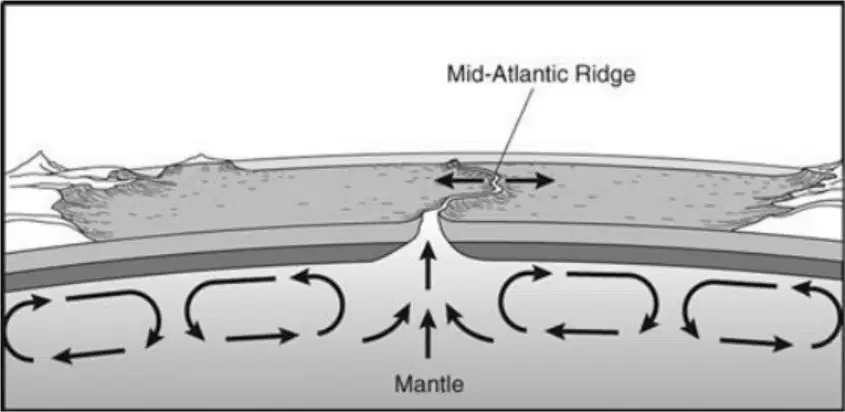
What natural phenomenon does this diagram illustrate?
Rotation
Conduction
Radiation
Convection
What is the main source of heat that contributes to the dynamic processes within the Earth's mantle, and how does it influence geological activity?
Heat from the Sun absorbed by the Earth's surface; indirectly affects mantle convection by altering surface temperatures.
Residual heat from the Earth's initial formation; maintains the temperature gradient necessary for mantle convection.
Radioactive decay of elements such as uranium-238, thorium-232, and potassium-40; provides a continuous source of heat that sustains mantle convection and drives plate movements.
Heat generated by the friction of ocean currents; contributes to mantle convection by heating the ocean floor.
Which statement accurately describes the differences in density and temperature between the Earth's layers, and how these differences affect geological processes?
The crust has the highest density and the lowest temperature, leading to mountain formation through isostatic adjustment.
The mantle has uniform density and temperature throughout its volume, resulting in consistent rates of plate movement and volcanic activity.
The outer core is less dense than the mantle but hotter, driving Earth's magnetic field through the movement of molten iron.
The inner core is the densest and hottest layer, creating convection currents in the mantle that drive plate tectonics.
When tectonic plates move, they can form different landforms. Which is LEAST likely to be associated with the movement of tectonic plates that form volcanoes?
Hotspot
Rift valley
Subduction zone
Transform boundary
What is the main difference between P waves and S waves?
P waves travel only through liquids, while S waves travel only through solids.
P waves are slower than S waves and can move through solids and liquids, while S waves are faster and only travel through solids.
P waves travel faster than S waves and can move through solids and liquids, while S waves are slower and only travel through solids.
P waves and S waves travel at the same speed but through different materials.
How does a seismograph help to triangulate the location of an earthquake?
By measuring the intensity of seismic waves at different depths within the Earth.
By detecting changes in magnetic fields caused by seismic activity.
By recording the arrival times of P and S waves at different seismographic stations.
By analyzing the chemical composition of rocks near the earthquake's epicenter.
Where are most volcanoes located?
At divergent boundaries, transform boundaries, and hotspots
At convergent boundaries, divergent boundaries, and hotspots
At convergent boundaries, hotspots, and transform boundaries
At divergent boundaries, convergent boundaries, and transform boundaries
In what type of plate boundary would you most likely find a deep ocean trench?
Convergent boundary (oceanic-oceanic)
Convergent boundary (oceanic-continental)
Divergent boundary
Transform boundary
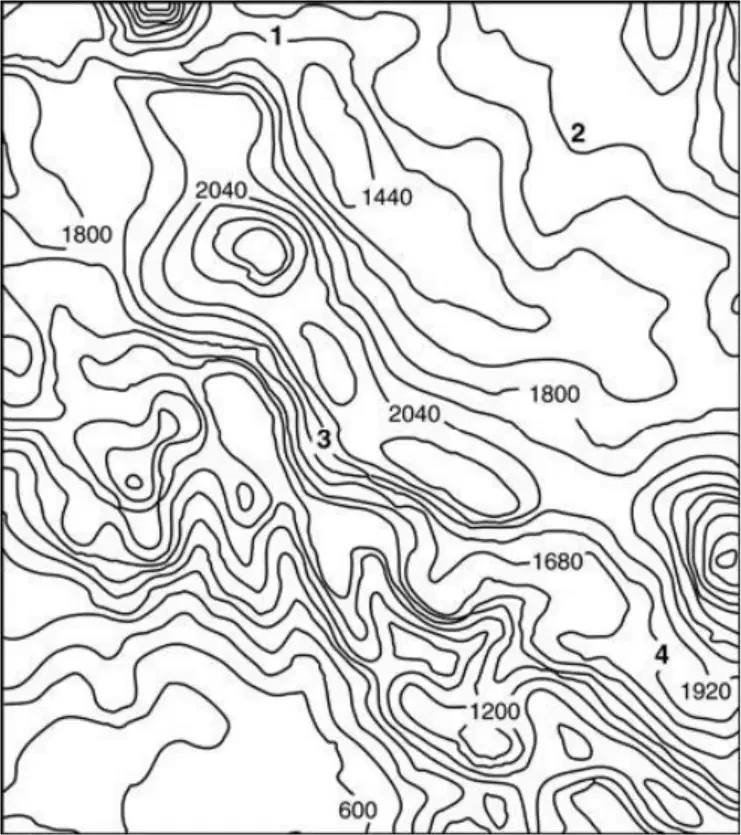
Which of the labeled points below has the steepest slope?
1
2
3
4
What is the capital of France?
Berlin
Madrid
Paris
Rome
How do hot plumes and volcanoes primarily influence changes in topography?
By causing the uplift and subsidence of the Earth's crust
By eroding mountains and valleys over time
By depositing sediments in river deltas
By creating volcanic cones and mountain chains
What type of fault is characterized by horizontal movement along the fault plane?
Normal fault
Reverse fault
Strike-slip fault
Thrust fault
Which geological process is primarily responsible for the formation of mid-ocean ridges?
Seafloor spreading
Subduction of oceanic crust
Mountain formation
Earthquakes along fault lines
Chemical weathering involves:
Breaking rocks into smaller pieces without altering their chemical composition.
Physically wearing down rock surfaces by abrasion.
Changing the chemical composition of rocks through reactions with water, acids, and gases.
The physical splitting of rocks through freeze-thaw cycles.
Which of the following describes a way in which soil formation affects the geosphere?
Reducing the rate of rock weathering
Contributing to the formation of new rock layers through sedimentation
Decreasing the amount of organic material in the Earth's crust
Preventing the formation of mineral deposits
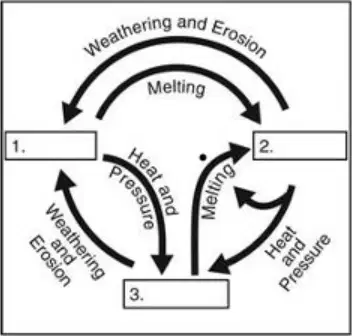
Look at the rock cycle diagram. What terms should be placed in the boxes labeled 1, 2, and 3?
1 = Metamorphic rocks, 2 = Sedimentary rocks, 3 = Igneous rocks
1 = Metamorphic rocks, 2 = Igneous rocks, 3 = Sedimentary rocks
1 = Sedimentary rocks, 2 = Metamorphic rocks, 3 = Igneous rocks
1 = Sedimentary rocks, 2 = Igneous rocks, 3 = Metamorphic rocks
What contributes most to beach erosion?
Animal activity
Wave action
Precipitation
Evaporation
Which of the following is NOT a factor that affects the amount of sediment that running water can transport?
Speed of the water
Temperature of the water
Size and shape of sediment particles
Amount of dissolved minerals in the water
The eruption of a large volcano on a tropical island releases ash and gases into the atmosphere. After the eruption, air temperatures on the island temporarily cool before returning to normal. What is the most likely reason for the temporary cooling of the island?
Water vapor condenses and causes precipitation
Large ash particles cover the ground surface
Fine atmospheric dust particles block sunlight
Carbon dioxide levels increase in the atmosphere
How do hydrothermal vents primarily release substances that contribute to ocean acidification?
Emitting large amounts of nitrogen gas
Releasing fluids rich in carbon dioxide into the ocean
Reducing the salinity of ocean water
Decreasing the temperature of the surrounding water
Which of the following is a direct effect of volcanic sulfur dioxide in the atmosphere?
Increase in acid rain formation
Decrease in atmospheric pressure
Reduced levels of atmospheric nitrogen
Increase in greenhouse gas effect
How can volcanic activity lead to the creation of new landforms such as mountains and islands?
Depositing ash that compacts into rock
Causing tectonic plates to separate
Emitting gases that condense into rock
Erupting lava that cools and solidifies into new land
Your data indicates the presence of numerous high-magnitude shallow earthquakes along a particular fault line. What type of plate boundary is most likely associated with these earthquakes?
Divergent boundary
Convergent boundary
Transform boundary
Subduction zone
You observe a group of shallow earthquakes along a tectonic plate boundary. What is the most likely cause of these earthquakes?
Movement of magma beneath a volcano
Subduction of an oceanic plate beneath a continental plate
The collision of two continental plates
Tensional forces at a divergent plate boundary
Your mapping reveals a linear arrangement of volcanic islands that become progressively older as they move away from the current volcanic activity. What tectonic feature is likely responsible for this pattern?
A divergent plate boundary
A hotspot
A subduction zone
A transform plate boundary
While studying a tectonic plate boundary, you notice frequent volcanic activity along a series of island chains. What type of plate boundary is most likely responsible for this pattern?
Transform boundary
Convergent boundary
Divergent boundary
Passive margin
On which day do the survivors begin to fortify their position at Point X?
Day 1: Initial Outbreak
Day 3: Safe Passage
Day 5: Fortifying the Position
Day 6: Final Resistance
What is the main reason for choosing Point X as a strategic location?
It is close to water sources.
It has a gradual slope.
It provides better defense and visibility.
It is near Fish Creek.
What challenge do the survivors face when moving to Point X?
Lack of food supplies
Difficulty of steep climbing
Heavy rain
Zombie ambush
Why do the survivors decide to guide others through Fish Creek on Day 3?
To avoid encounters with zombies
To find more survivors
To gather resources
To reach Point D faster
What advantage does the high elevation at Point X provide during the final resistance?
Access to more resources
Better communication signals
Strategic advantage against zombies
Easier escape routes
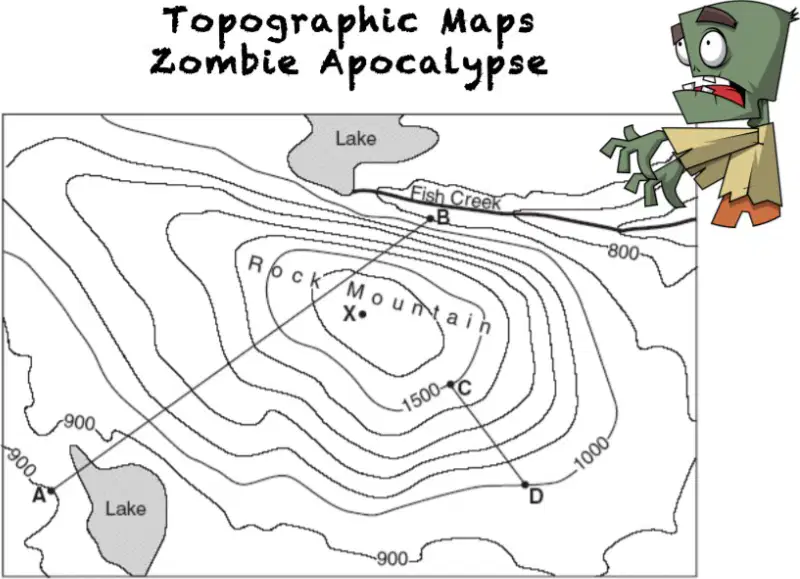
Why did the survivors choose Point X as their strategic location?
It is the highest point, offering better defense and visibility.
It is closer to water sources.
It has a direct path to escape routes.
It is surrounded by dense forests.
What was the main reason for guiding the survivors from Point B through Fish Creek?
To collect water supplies.
To avoid a steep slope and possible encounters with zombies.
To fish for food.
To set traps for zombies.
What natural resource did the survivors use near Point A?
Wood from the forest.
Wild fruits and berries.
Fish and water from the lake.
Shelter in a cave.
How did the topographic features help defend against the zombies in the final battle?
The forests provided cover.
The open fields offered clear visibility.
The rivers acted as barriers.
The steep slopes slowed down the zombies.
What process caused the granite to break into smaller fragments?
Deposition
Weathering and erosion
Metamorphism
Compaction
What process transformed loose sediments into solid rock?
Weathering
Erosion
Lithification
Fusion
As the tectonic plates shifted, the layers of sedimentary rock were pushed deeper into the Earth's crust. There, under intense heat and pressure, the rock underwent profound changes. The minerals recrystallized, altering their texture and structure. Into what type of rock did the sedimentary rock transform under these conditions?
Igneous rock
Metamorphic rock
Sedimentary rock
None of the above
Millions of years later, volcanic activity brought molten magma near the Earth's surface. As it cooled and solidified, it formed a new type of rock, born from the depths where granite once resided. What type of rock did the magma form upon cooling?
Igneous rock
Metamorphic rock
Sedimentary rock
None of the above
The Ring of Fire, known for its high volcanic and seismic activity, is primarily associated with which plate?
African Plate
Pacific Plate
Eurasian Plate
North American Plate

What moves the tectonic plates (i.e., the lithosphere/crust)?
Magic
The magnetic field
Convection currents
The gravity of the Moon

