
 Worksheets
AP Gov - Topics 4.3-4.4 - FAC (Master Copy)
Total questions: 15
Worksheet time: 11mins
Which generation tends to place a high value on religious belief and church attendance?
Silent Generation
Baby Boomers
Generation X
Millennials
Which generation grew up during the 1960s and learned to appreciate the cultural changes?
Silent Generation
Baby Boomers
Generation X
Millennials
Which generation is more ethnically diverse than the previous generations?
Silent Generation
Baby Boomers
Generation X
Millennials
Which generation is generally more conservative and supports tough-on-crime policies?
Silent Generation
Baby Boomers
Generation X
Millennials
Which generation is more favorable towards immigrants compared to the previous generation?
Silent Generation
Baby Boomers
Generation X
Millennials
Which stage of life can contribute to a person's interest in free college tuition?
18 years old and casting the first vote
Married with kids
Senior citizen
Young adult during the 1950s
Which stage of life can contribute to a person's interest in pre-k legislation or lower taxes?
18 years old and casting the first vote
Married with kids
Senior citizen
Young adult during the 1950s
The impact of historical events experienced by a generation upon their political views.
generational effect
individualism
life-cycle effect
political socialization
Generally, as we ________ we become more ________ in our political beliefs.
grow, liberal
age, liberal
evolve, conservative
age, conservative
Voter turnout, according to history, increases with age.
True
False
How do generational changes affect political ideologies?
They have no effect
Each generation adopts the ideologies of the previous one without change
New generations can bring new ideas and perspectives, potentially altering dominant ideologies
Political ideologies are solely determined by economic conditions, not generations
What impact do significant events have on public opinion and political ideologies?
They reinforce existing opinions and ideologies without change
They can lead to shifts in public opinion and changes in political ideologies
They have no impact
They only affect opinions on foreign policy
The fact that political opinions and values change over the course of an individual's life
Old Age effects
Life cycle effects
Generational effects
Party effects
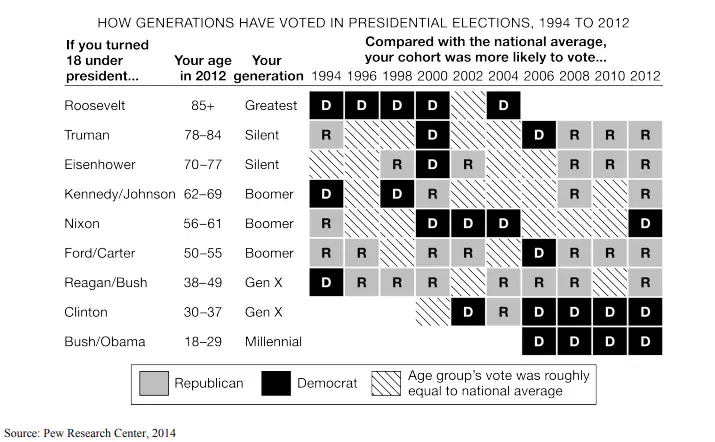
Which of the following statements draws an accurate comparison from the information graphic?
The Nixon “Boomer” generation was far more likely to vote Democrat when they were eighteen year olds than the Truman “Silent” generation.
The Ford/Carter “Boomer” generation has voted more consistently Republican than has the Bush/Obama “Millennial” generation.
The Roosevelt “Greatest” generation voted Democrat in 2000 but voted Republican in 2006.
The Reagan/Bush “Gen X” generation voted more consistently with the national average than did the Nixon “Boomer” generation.
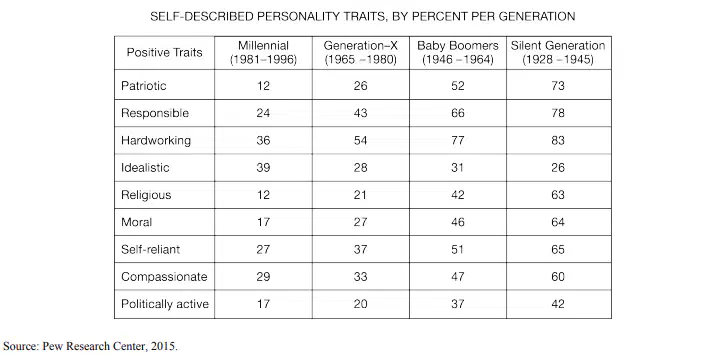
Which of the following best describes a trend in the data?
The older the respondents, the more likely they are to identify as patriotic.
Generation X respondents are more likely to be politically active than the Baby-Boomer respondents.
Baby Boomer respondents are the most likely to consider themselves self-reliant.
The younger the respondents, the more likely they are to identify as religious and moral.

