
 Worksheets
Biology - CH 6 Chemistry of Life Review
Total questions: 50
Worksheet time: 25mins
Name
Class
Date
1.
Carbon compounds that come from living organisms are called _____ compounds.
a)
A. water
b)
B. organic
c)
C. homogeneous
d)
D. biological
2.
Which of the following is a chemical reaction?
a)
A. Tearing paper into strips
b)
B. burning paper
c)
C. picking up iron filings with a magnet
d)
D. mixing salt and sugar in the same container
3.
What are the basic building blocks of proteins?
a)
A. nucleic acids
b)
B. amino acids
c)
C. peptide bonds
d)
D. glycerol and fatty acids
4.
The various enzymes in our bodies are _____.
a)
A. Lipids
b)
B. Carbohydrates
c)
C. Nucleotides
d)
D. Proteins
5.
The smaller subunits that make up nucleic acids area.
a)
A. Amino acids
b)
B. DNA and RNA
c)
C. Nucleotides
d)
D. Fatty acids
6.
Any substance that forms hydrogen ions in water is a(n)
a)
A. Isomer
b)
B. Isotope
c)
C. Acid
d)
D. Base
7.
Biological buffers function to achieve a pH range of ________.
a)
A. 4.5-5.5
b)
B. 5.5-6.5
c)
C. 6.5-7.5
d)
D. 7.5-8.5
8.
Which macromolecule stores energy for an organism, is a major component of cell membranes & makes up oils and hormones?
a)
A. Carbohydrate
b)
B. Lipid
c)
C. Carbohydrate
d)
D. Protein
9.
Which is NOT true of lipids?
a)
A. They are commonly called fats and oils.
b)
B. They are hydrophobic.
c)
C. They are good for energy storage.
d)
D. They dissolve in water.
10.
Which is true about enzymes?
a)
A. They act on nonspecific, randomly chosen substrates
b)
B. After a reaction, they cannot be reused.
c)
C. They can speed up metabolic processes in the body.
d)
D. They cannot change shape.
11.

The diagram below illustrates a biochemical process that occurs in organisms. The substance labeled catalyst also is known by what other name?
a)
A. Antibody
b)
B. Enzyme
c)
C. Ion
d)
D. Inorganic
12.
Which class of macromolecules store and communicate genetic information?
a)
A. carbohydrates
b)
B. lipids
c)
C. proteins
d)
D. nucleic acids
13.

Consider the energy diagram for a chemical reaction below. Overall, is energy released or absorbed?
a)
A. absorbed, because the energy level increases during the reaction
b)
B. absorbed, because the energy level of the products is greater than that of the reactants
c)
C. released, because the reaction is initiated by the addition of heat
d)
D. released because the energy level of the reactants is greater than that of the products
14.
Which is the best description of activation energy?
a)
A. Heat added to initiate a reaction
b)
B. Heat released as the reaction proceeds
c)
C. Heat stored within the reactant molecules
d)
D. Heat stored within the product molecules
15.
Which element is found in proteins but not carbohydrates or lipids?
a)
A. C
b)
B. H
c)
C. N
d)
D. O
16.
Glucose polymer that forms the cell walls of plants.
a)
A. Cellulose
b)
B. Polar
c)
C. Nucleus
d)
D. Peptide
17.
Molecule with unequal distribution of charge.
a)
A. Cellulose
b)
B. Polar
c)
C. Nucleus
d)
D. Peptide
18.
Center of an atom.
a)
A. Electrons
b)
B. Electron Cloud
c)
C. Nucleus
d)
D. Peptides
19.
Monosaccharides, disaccharides & polysaccharides are what macromolecule?
a)
A. carbohydrate
b)
B. lipid
c)
C. nucleic acid
d)
D. protein
20.
Triglycerides, phospholipids & steroids are what macromolecule?
a)
A. carbohydrate
b)
B. lipid
c)
C. nucleic acid
d)
D. protein
21.
DNA & RNA are what macromolecule?
a)
A. carbohydrate
b)
B. lipid
c)
C. nucleic acid
d)
D. protein
22.
How many different kinds of atoms does an element contain?
a)
Six
b)
Two
c)
FOur
d)
One
23.
Acid solutions are produced by the release of ____ ions
a)
potassium
b)
hydrogen
c)
oxygen
d)
sodium
24.
Atoms of the same element that have different numbers of neutrons are called _______.
a)
Isotopes
b)
compounds
c)
neutrino elements
d)
molecules
25.
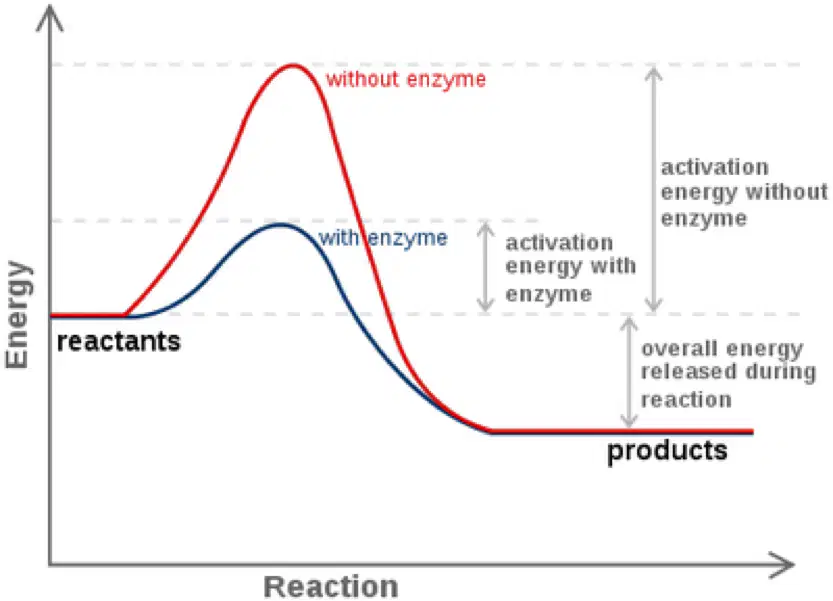
How can enzymes benefit chemical reactions as shown in this energy diagram?
a)
lowering activation energy
b)
raising activation energy
c)
slowing reactions
d)
increasing the amount of product
26.
How do buffers help maintain homeostasis?
a)
neutralize acids and bases
b)
raise PH above 9
c)
lower PH below 4
d)
remove all hydrogen ions
27.
How many electrons does a carbon (atomic number =6) atom have in its outer energy level?
a)
four
b)
two
c)
six
d)
eight
28.
the minimum amount of energy needed for a chemical reaction is called?
a)
product threshold
b)
absorbent energy
c)
principle mass
d)
activation energy
29.
What kind of chemical reaction does this energy diagram show see image below this question?
a)
exothermic
b)
endothermic
c)
ionic
d)
mass creating
30.
Which statement is true based on this scale (see image below)?
a)
Seawater has a higher concentration of hydrogen than tomatoes
b)
tomatoes have a higher concentration of hydrogen than seawater
c)
blood has no hydrogen ions
d)
household ammonia is neutral
31.
Matter is composed of tiny particles called _____
a)
oxygen
b)
atoms
c)
electrons
d)
neutrons
32.
Negatively charged particles that move around the nucleus of an atom are called _________
a)
Isotopes
b)
neutrons
c)
protons
d)
electrons
33.
Judging from this graph what are the most abundant elements in living things (see image below)?
a)
Nitrogen and calcium
b)
hydrogen carbon and oxygen
c)
carbon sodium and potassium
d)
oxygen and sodium
34.
A _____ is a special substance that lowers the activation energy needed for a chemical reaction
a)
charged particle
b)
nutrient
c)
catalyst
d)
chemical element
35.
Which statement is true regarding this energy diagram? image below
a)
It shows an exothermic reaction
b)
it shows an endothermic reaction
c)
product energy is higher than reactant energy
d)
reactant and product energy are equal
36.
Fatty molecules containing mostly carbon and hydrogen are called ____.
a)
A) enzymes
b)
B) proteins
c)
C) lipids
d)
D) catalys
37.
Small compounds that form proteins are called ____.
a)
A) amino acids
b)
B) lipids
c)
C) carbohydrates
d)
D) phospholipids
38.
Glucose molecules (like the image below) are examples of ____.
a)
A) enzymes
b)
B) carbohydrates
c)
C) proteins
d)
D) inorganic substances
39.
Which defines an atom?
a)
building block of energy
b)
building block of matter
c)
charged particle
40.
Which is true about enzymes
a)
They act on nonspecific randomly chosen substances
b)
they can speed up metabolic processes in the body
c)
they cannot change
d)
they get used up in the reaction
41.
Which substance would be extensively studied during a college organic chemistry course
a)
glucose
b)
oxygen
c)
sodium
d)
water
42.
Magnesium and oxygen combine to form a new substance, magnesium oxide, which is a ....
a)
compound
b)
element
c)
carbohydrate
d)
isotope
43.
Ammonia releases hydroxide ions, it is called a (an).....
a)
base
b)
acid
c)
buffer
d)
molecule
44.
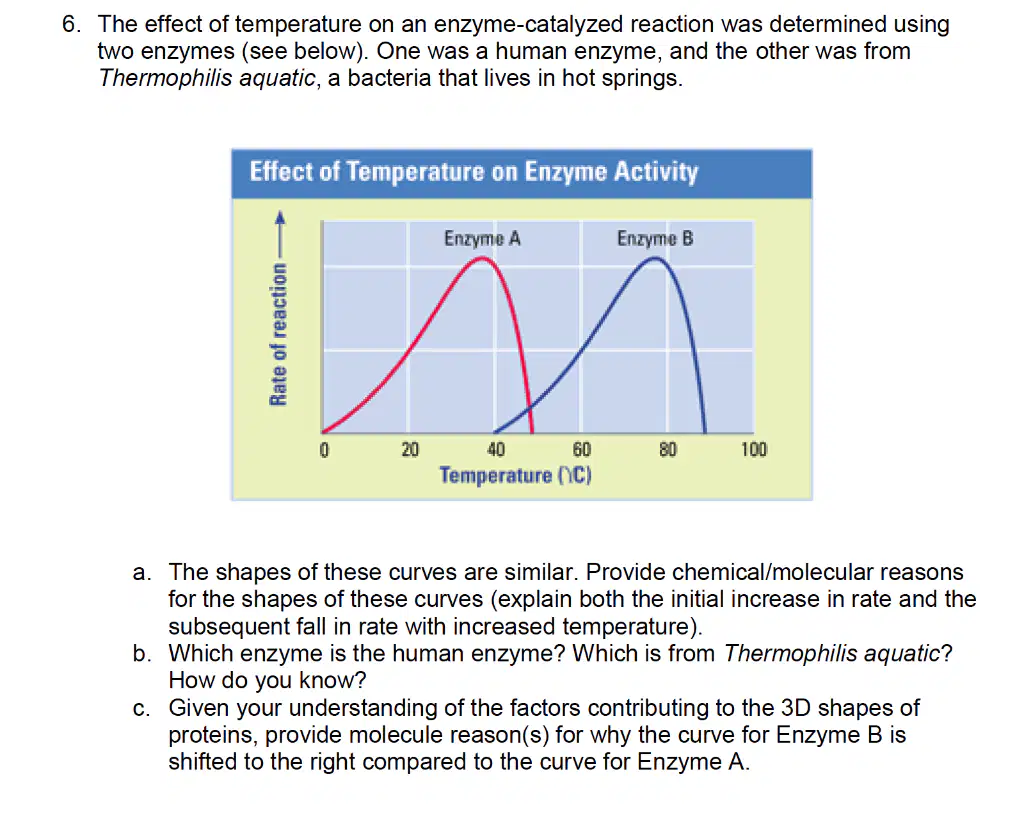
The effect of temperature on an enzyme catalyzed reaction was determined using 2 enzymes (see graph below). One was a human enzyme, and the other was from a bacteria that lives in a hot springs. Which enzyme is the human enzyme? HINT: 40 degrees C is 104 degrees F, 80 degrees C is 176 degrees F.
a)
A
b)
B
c)
Can not identify from this graph
45.
What happens when you increase the amount of substrate on the rate of an enzyme catalyzed reaction?
a)
Indirect relationship
b)
Direct relationship
c)
No relationship
46.
A bond that forms between water molecules (water molecule to a water molecule)
a)
covalent bond
b)
ionic bond
c)
metallic bond
d)
hydrogen bonds
47.
Two atoms of uranium that differ in their number of neutrons are called ____?
a)
molecules
b)
ionic bond
c)
isotopes
d)
ions
48.
Which is an example of a solute?
a)
soil suspended in water
b)
sugar that is dissolved in water
c)
water that dissolves salt
d)
water with undissolved soil
49.
Why is hagfish slime useful to us?
a)
Hagfish slime is a microscopic lipid that makes thread 10x stronger
b)
Hagfish slime is a microscopic nucleic acid that makes thread 10x stronger
c)
Hagfish slime is a microscopic protein that makes thread 10x stronger
d)
Hagfish slime is a microscopic carbohydrate that makes thread 10x stronger
50.
Some enzymes function most efficiently at the pH of our cells (amylase). What pH would have optimum levels for the enzymes in our cells like amylase?
a)
3
b)
5
c)
7
d)
9
e)
11
100 %

