
 Worksheets
24-25_Unit 5_RNA and Transcription Quiz
Total questions: 13
Worksheet time: 18mins
What type of biomolecule are DNA and RNA?
Nucleic Acids
Proteins
Carbohydrates
Lipids
Which form of nucleic acid contains the nitrogen bases guanine, cystosine, adenine, and uracil?
DNA
RNA
Both DNA and RNA
Which form of nucleic acid is composed of nucleotides?
DNA
RNA
Both DNA and RNA
Which of the following statements are correct about RNA?
I. RNA is a single strand of nucleotides
II. RNA consists of a ribose sugar
III. RNA bases are: Thymine, Adenine, Cytosine, Guanine
IV. RNA can be found both inside and outside of the nucleus
Only statement (I) is true.
Only statements (I) and (II) are true.
Only statements (I), (II) and (IV) are true.
All statements are true.
Which strand of RNA below is complementary to the DNA strand TACGAA?

What important cell process is represented in this diagram?
Transcribe the following DNA sequence into RNA:
AAT TAG GGC TCG
AAT TAG GGC TCG
TTA ATC CCG AGC
UUA AUC CCG AGC
TTU UTC CCG UGC
Which of the following is true about the molecules of DNA and RNA?
RNA contains uracil instead of thymine
RNA contains uracil instead of adenine
RNA contains uracil instead of guanine
RNA contains uracil instead of cytosine
Where does TRANSCRIPTION occur in EUKARYOTIC cells?
Nucleus
Ribosome
Cytoplasm
Mitochondria
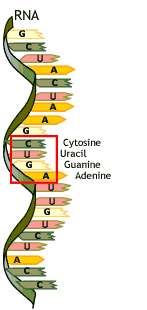
In RNA, Uracil is complementary to______.

One difference between DNA and RNA is that....
Only RNA has the base Uracil
only RNA contains the base Thymine
only RNA contains the base Cytocine
only RNA contained the base Guanine
Which of the following explains the importance of transcription in the process of protein synthesis?
Transcription is crucial because it converts DNA information into mRNA, which is necessary for protein synthesis.
Transcription is crucial because it directly synthesizes amino acids from the DNA.
Transcription is crucial because it repairs mutations to the DNA prior to cell division.
Transcription is crucial because it provides the reactants needed to make energy in the form of ATP.

